

Global trade and consumption are expanding, but logistics infrastructure is not developing uniformly across markets. Growing freight volumes, e-commerce, manufacturing, urbanization, and supply-chain diversification are increasing pressure on ports, warehouses, roads, rail networks, and distribution hubs.
Global trade in goods and services reached approximately $35 trillion in 2025, a new record, according to UN Trade and Development. Goods trade grew by around 6.5%, while services increased by almost 9%.
Yet rising trade does not automatically mean infrastructure is keeping pace. For manufacturers, retailers, freight operators, logistics providers, 3PLs, investors, warehouse operators, and governments, the central issue is understanding where infrastructure capacity is becoming constrained and where new investment can create value.
A Logistics infrastructure market assessment connects trade growth and consumption with transportation capacity, warehousing, connectivity, infrastructure quality, and future demand.
Challenges faced by Logistics Infrastructure
As logistics systems evolve, infrastructure must support not only growing freight volumes but also changing trade, manufacturing, and consumer demands. The key challenge is ensuring that infrastructure is aligned with operational requirements, connectivity needs, and future growth. These challenges can be:
- Growing expectations for faster and more reliable deliveries.
- Expansion of trade corridors and cross-border freight movement.
- Diversification of manufacturing locations and supply chains.
- Rapid growth of e-commerce and fulfillment requirements.
- Increasing demand for temperature-controlled logistics facilities.
The challenge is no longer simply building more logistics infrastructure. Success depends on developing the right infrastructure, in the right locations, with adequate capacity and seamless connectivity, enabling efficient movement of goods across the entire supply chain.
Nexdigm’s View on Infrastructure Gap
At Nexdigm, the industry experts view the infrastructure gap as a result of evolving economic and supply chain dynamics that are reshaping logistics requirements.
As trade patterns, consumer demand, and manufacturing footprints expand, infrastructure development must keep pace with changing business needs. Nexdigm assesses the following drivers to understand the gap:
- Trade growth: Higher merchandise flows increase demand for ports, freight corridors, warehouses, terminals, and transportation capacity.
- Consumption growth: Expanding consumer markets increase requirements for distribution centers, fulfillment facilities, and urban logistics infrastructure.
- Manufacturing expansion: New production clusters create demand for inbound transportation, industrial warehouses, supplier facilities, and multimodal connections.
Understanding these gaps, helps provide strategic investment decisions with the help of a framework, that align logistics infrastructure with trade growth, consumption trends, and manufacturing development to build resilient, connected, and future-ready supply chains
How Nexdigm Assesses Infrastructure Readiness
Trade and consumption growth can create very different infrastructure requirements across markets. A manufacturing hub may require freight corridors, industrial warehouses, rail connectivity, and multimodal terminals.
A growing urban market may need fulfillment centers, urban warehouses, and last-mile facilities. An export-oriented region may require stronger port capacity and inland connections.
Nexdigm connects trade flows, consumption patterns, freight demand, infrastructure availability, capacity utilization, connectivity, and development pipelines to understand where logistics infrastructure is genuinely under pressure.
Nexdigm’s Logistics Infrastructure Framework
Nexdigm’s Framework provides a structured approach to Logistics infrastructure market assessment by evaluating the relationship between trade growth, consumption demand, logistics capacity, and infrastructure readiness. By assessing these factors, this helps identify capacity constraints, growth corridors, and infrastructure opportunities across logistics markets.
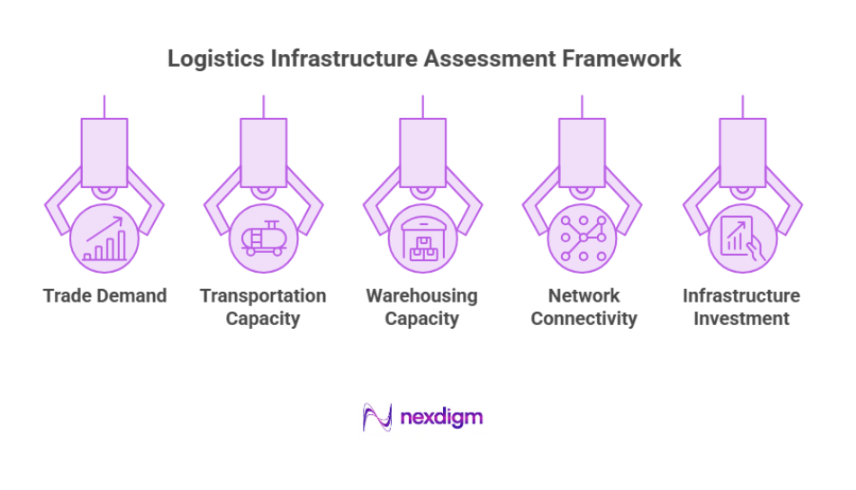
- Trade Demand: Nexdigm examines trade volumes, import and export activity, consumption growth, manufacturing output, and freight patterns to identify markets where logistics infrastructure demand is expanding.
- Transportation Capacity: The assessment evaluates roads, railways, ports, airports, freight corridors, terminals, and fleet capacity to determine whether transportation infrastructure can accommodate current and projected cargo requirements.
- Warehousing Capacity: Nexdigm assesses warehouse supply, facility specifications, utilization, location, storage categories, and development pipelines to identify markets where distribution and storage capacity may become constrained.
- Network Connectivity: The framework examines connections between production centers, ports, warehouses, consumption markets, border points, and transportation hubs to identify bottlenecks and strategically important logistics locations.
- Infrastructure Investment: Nexdigm compares demand growth, capacity gaps, development costs, utilization potential, infrastructure pipelines, and operating economics to identify opportunities for targeted logistics infrastructure investment.
The framework connects trade and consumption growth with transportation, warehousing, connectivity, and investment requirements, helping organizations identify where infrastructure needs expansion, optimization, or strategic repositioning.
How Nexdigm Identifies High Potential Infrastructure Opportunities
The strongest opportunities typically emerge where trade growth, consumption expansion, infrastructure constraints, connectivity gaps, and favorable investment economics overlap.
Nexdigm brings these signals together to identify opportunities across warehouses, freight corridors, ports, intermodal terminals, urban logistics facilities, distribution hubs, and supporting technology.
The objective is not simply to build more infrastructure. It is to determine where additional or improved capacity can solve a genuine logistics constraint and support sustainable market growth.
Nexdigm’s Case
A logistics operator used Nexdigm’s Logistics infrastructure market assessment to identify regional capacity gaps and optimize network planning. Within 12 months, infrastructure utilization increased 22%, freight handling efficiency improved 24%, transportation costs declined and delivery reliability improved 20%, supporting stronger network performance and scalable expansion.
To take the next step, simply visit our Request a Consultation page and share your requirements with us.
Harsh Mittal
+91-8422857704