

Starting a logistics business can look attractive when freight volumes, e-commerce, manufacturing, and outsourcing are expanding. However, market growth alone does not guarantee a viable business opportunity.
The global logistics market was estimated at approximately $4.1 trillion in 2025 and is projected to reach around $4.33 trillion in 2026, according to Grand View Research. Asia Pacific accounted for 35.3% of global logistics-market revenue in 2025.
The logistics services market is also expanding. Yet logistics markets differ significantly by geography, customer segment, service type, infrastructure, competition, and operating economics.
For entrepreneurs, logistics companies, 3PLs, 4PLs, investors, manufacturers, retailers, technology providers, and infrastructure developers, the key question is whether a new business can achieve sufficient demand and differentiation to compete profitably.
A logistics market feasibility study consulting approach helps evaluate market demand, competition, capacity, pricing, operating costs, infrastructure, and future growth to determine where a logistics business can enter, what proposition it should offer, and whether the underlying economics support sustainable growth.
Demand Potential Defining the Opportunity
The success of a logistics business depends on the presence of sufficient and sustainable customer demand. Factors such as industry growth, trade activity, e-commerce penetration, outsourcing trends, and customer logistics requirements influence the size and attractiveness of the market. Understanding demand patterns helps determine whether a viable customer base exists and which segments offer the greatest opportunity.
Competitive Positioning Driving Long-Term Success
Growing demand alone is rarely enough to ensure profitability. Existing service providers, pricing pressures, service capabilities, technology adoption, and customer expectations shape the competitive landscape. Businesses that can establish a clear value proposition and address unmet market needs are better positioned to achieve sustainable growth and differentiation.
Role of Nexdigm in Assessing Logistics Market Feasibility
Evaluating a logistics business opportunity requires more than understanding market demand or competitive intensity in isolation. Factors such as customer requirements, service gaps, infrastructure availability and growth potential must be assessed collectively to determine commercial viability.
Nexdigm’s Logistics Market Study provides a structured assessment of market attractiveness and business potential. By evaluating factors such as demand dynamics, customer segments, competitor capabilities and future market trends, Nexdigm helps organizations identify viable opportunities and develop strategies for successful market entry and growth.
How Nexdigm Helps Businesses Evaluate Logistics Opportunities
Nexdigm helps organizations move beyond market assumptions by providing a structured and data-driven assessment of logistics business opportunities. The study enables stakeholders to evaluate critical market factors and identify opportunities that align with their growth objectives.
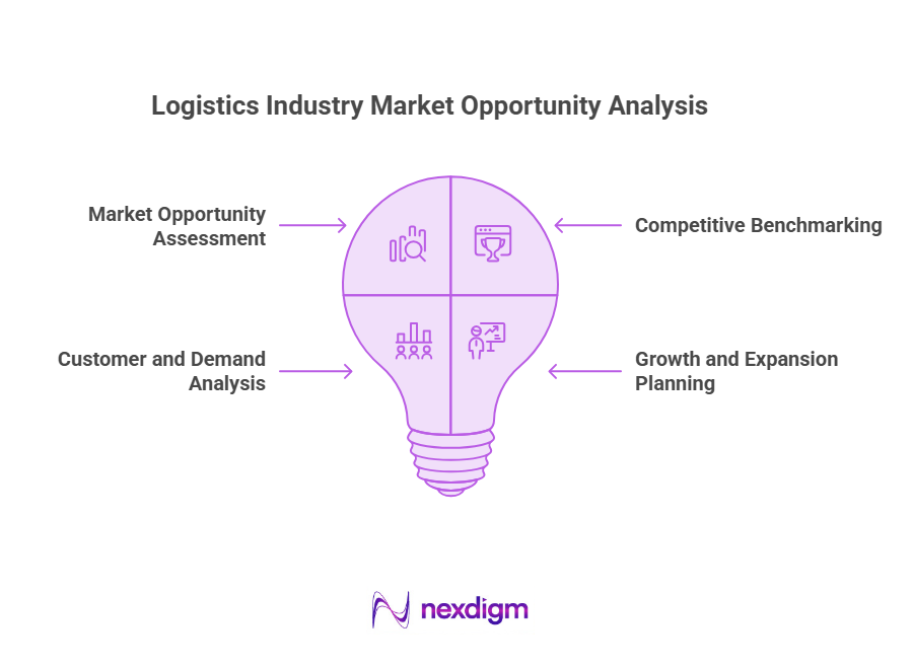
- Market Opportunity Assessment: Evaluate market size, growth prospects, customer demand, and industry trends to determine the attractiveness and potential of a logistics opportunity.
- Customer and Demand Analysis: Assess target customer segments, logistics requirements, purchasing behavior, and demand drivers to identify the most promising opportunities.
- Competitive Benchmarking: Analyze competitor presence, service capabilities, market positioning, and strengths to identify gaps and differentiation opportunities.
- Growth and Expansion Planning: Identify strategic growth opportunities, expansion pathways, investment priorities, and market-entry strategies to support business development.
To evaluate these factors holistically and develop actionable recommendations, Nexdigm applies a structured Logistics Market Assessment Framework.
Nexdigm’s Logistics Market Assessment Framework
Experts at Nexdigm leverage a structured Logistics Market Feasibility Study Consulting Framework that guides organizations through five key steps to evaluate market attractiveness and business viability. These steps are:
- Validate Market Potential: Nexdigm assesses market size, growth trends, industry activity, and logistics demand to determine whether a sufficiently attractive opportunity exists.
- Identify Target Customer Opportunities: The assessment evaluates customer segments, service requirements, pain points, and unmet needs to identify where the strongest demand and value creation opportunities exist.
- Evaluate the Competitive Environment: Nexdigm analyzes existing market participants, their capabilities, market positioning, and service offerings to uncover competitive gaps and differentiation opportunities.
- Assess Operational Readiness: The framework reviews infrastructure, warehousing, transportation assets, technology, labor availability, and logistics facilities to determine operational feasibility and scalability.
- Determine Commercial Viability: Nexdigm evaluates pricing dynamics, operating costs, investment requirements, margin potential, and scalability to assess whether the business can achieve sustainable profitability.
Following these five steps enables Nexdigm to provides a comprehensive view of market feasibility, helping organizations identify attractive opportunities, mitigate risks, and make informed market-entry decisions.
Applications of Nexdigm’s Logistics Market Feasibility Framework
Nexdigm’s framework can support a wide range of business, expansion, and investment decisions by helping organizations assess market attractiveness, operational feasibility, and long-term growth potential through:
- New Business Launch: Entrepreneurs can evaluate whether a target market offers sufficient demand, favorable competitive conditions, infrastructure readiness, and sustainable economic potential to support a new logistics venture.
- 3PL and Logistics Expansion: Existing logistics providers can assess opportunities across new geographies, customer segments, industries, and service lines to support strategic expansion plans.
- Service Portfolio Development: Organizations can identify customer pain points, unmet market needs, and emerging trends to develop specialized services that enhance differentiation and competitiveness.
- Investment and Acquisition Evaluation: Investors can assess market attractiveness, scalability, competitive intensity, profitability potential, and operational risks before making investment decisions.
By applying the framework across these strategic decisions, Nexdigm helps organizations identify attractive opportunities and develop sustainable growth strategies within the logistics sector.
Nexdigm’s Case
A logistics company engaged with Nexdigm to assess demand, competition, capacity, pricing, and operating economics before entering a new market. The assessment identified priority customer segments and service gaps, supporting 17% higher projected utilization, 12% lower operating costs, and 21% faster customer acquisition, strengthening the business for expansion.
To take the next step, simply visit our Request a Consultation page and share your requirements with us.
Harsh Mittal
+91-8422857704