

Packaging plays an important role in protecting goods as they move through manufacturing, warehousing, transportation and distribution. It must withstand handling, stacking, vibration, environmental exposure and other conditions encountered during the movement of products.
For businesses managing large supply chains, selecting packaging suppliers involves more than comparing material prices. Packaging strength, product compatibility, storage efficiency, transport requirements and sustainability considerations all influence procurement decisions.
A suitable supplier should provide packaging solutions that protect products while supporting the organisation’s distribution and commercial requirements.
Understanding Packaging Requirements Across the Supply Chain
Packaging performs different functions depending on where it is used.
Primary packaging comes into direct contact with a product and provides containment and protection. Secondary packaging groups individual products for handling or retail distribution, while tertiary packaging supports storage, palletisation and transportation.
Procurement teams should understand these distinctions before comparing suppliers because the technical requirements and commercial considerations vary across packaging categories.
Common supplier categories include:
- Corrugated packaging suppliers: Provide cartons, shipping boxes, dividers and protective inserts for storage and distribution.
- Flexible packaging suppliers: Offer films, pouches, wraps and other lightweight materials used across food, consumer goods and industrial applications.
- Rigid packaging suppliers: Manufacture containers, drums, crates and reusable boxes for different product categories.
- Protective packaging suppliers: Provide cushioning, foam inserts, air-filled materials and other solutions designed to reduce damage during handling and transit.
- Industrial packaging suppliers: Offer pallets, bulk containers, stretch wraps and load-securing materials for large shipments.
The appropriate category depends on product dimensions, weight, fragility, environmental sensitivity and transportation conditions.
Comparing Packaging Performance and Material Suitability
Packaging performance should be evaluated against the conditions a product is expected to encounter throughout distribution.
ASTM D6198 provides guidance on transport packaging design, considering hazards associated with handling, storage and shipping. It also highlights the importance of balancing product protection with the economics of packaging materials and labour.
Procurement teams should compare suppliers on material strength, compression resistance, impact protection, moisture resistance and suitability for the intended transportation mode.
For example, products transported over long distances may require stronger protective packaging than goods distributed through shorter regional routes. Fragile electronics may need customised cushioning, while industrial components may require heavy-duty containers and load-securing arrangements.
Packaging design should also account for pallet dimensions, stacking height, warehouse storage systems and container utilisation.
Storage Efficiency, Distribution and Sustainability
Packaging affects how efficiently products can be stored and transported. Poorly designed cartons may occupy unnecessary warehouse space, reduce pallet utilisation and increase the number of shipments required.
Suppliers should therefore be evaluated on packaging dimensions, weight, stacking performance and compatibility with automated handling equipment.
Sustainability has also become an important procurement consideration. Organisations increasingly assess material consumption, recyclability, reusable packaging options and waste generation.
ISO/IEC Guide 41:2018 discusses packaging functions such as containment, protection, handling, transport and storage, while also addressing resource optimisation, reuse and recovery.
Businesses should avoid assessing sustainability solely through recycled-content claims. Material performance, product damage rates, packaging weight and end-of-life arrangements should be considered together.
Packaging Supplier Selection and Commercial Assessment
Supplier comparison should include both technical capability and the ability to maintain consistent production and delivery.
Procurement teams should examine sample quality, manufacturing capacity, lead times, quality assurance procedures and the supplier’s ability to accommodate customised specifications.
Commercial evaluation should consider unit prices, tooling costs, minimum order quantities, transportation expenses, storage requirements and material price adjustments.
A supplier offering lower unit prices may not provide the best overall value if its packaging results in higher product damage or inefficient transportation utilisation.
Logistics Packaging Supplier Evaluation Framework
A structured logistics packaging supplier analysis should compare providers across six areas:
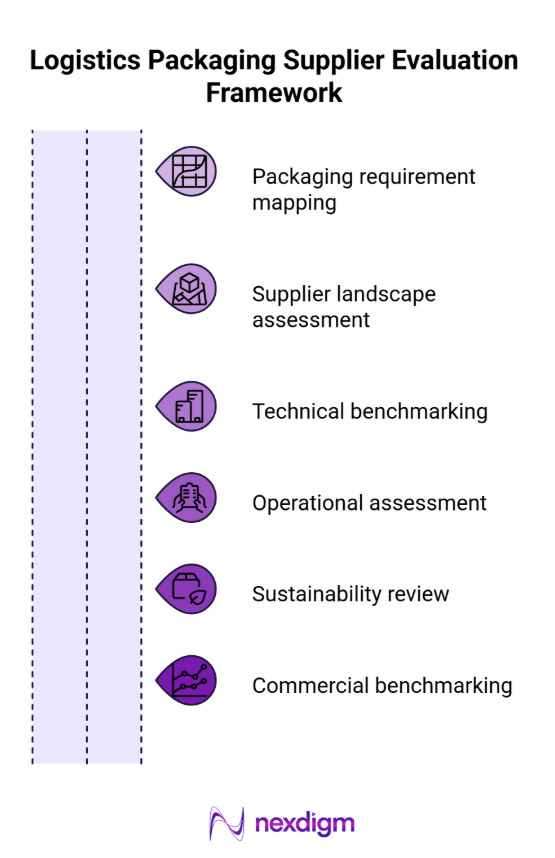
- Packaging requirement mapping: Identify product categories, dimensions, weight, fragility and distribution conditions.
- Supplier landscape assessment: Map manufacturers across corrugated, flexible, rigid, protective and industrial packaging.
- Technical benchmarking: Compare material quality, load resistance, protective performance and product compatibility.
- Operational assessment: Evaluate production capacity, lead times, customisation and delivery reliability.
- Sustainability review: Assess recyclability, material efficiency, reuse options and waste management.
- Commercial benchmarking: Compare unit costs, tooling, minimum quantities, logistics expenses and contractual terms.
Nexdigm can support organisations through packaging supplier research, market mapping, technical and commercial benchmarking, and procurement intelligence. These assessments help businesses identify packaging suppliers suited to product protection, distribution requirements and cost objectives.
Nexdigm’s Case Study: Reducing Packaging Procurement Variability
Nexdigm assessed 12 packaging suppliers across 4 material categories, comparing protective performance, production capacity, delivery timelines and pricing. The research shortlisted 4 suppliers, identified a 17% variation in comparable packaging costs and established 6 technical and commercial benchmarks for procurement decisions.
To take the next step, simply visit our Request a Consultation page and share your requirements with us.
Harsh Mittal
+91-8422857704