
Logistics pricing feasibility studies help businesses evaluate whether new freight and supply chain services can achieve sustainable demand, competitive positioning, and acceptable margins. Logistics pricing feasibility study consulting combines pricing analysis with market sizing, competitor benchmarking and service differentiation.
By testing rate structures, volume assumptions, surcharge policies, and operating scenarios, companies can identify commercially viable offerings, reduce launch risk, strengthen investment decisions, and build scalable pricing models aligned with changing market conditions across target segments globally.
A logistics benchmark found that pricing transformation can increase revenue by 2% to 4% and operating profit by 30% to 60%, representing how pricing analysis can strengthen launch decisions, pricing discipline, margin protection, and sustainable market entry outcomes significantly.
Market-Based Pricing Analysis for Emerging Logistics Offerings
Market-based pricing analysis evaluates demand, competition, costs, customer value, and service differentiation to help emerging logistics offerings establish viable rates and build sustainable commercial growth across markets. Major dimensions highlighting the importance of the analytical model are:
- Adoption Readiness Analysis: Customer awareness, switching barriers, onboarding effort, technology acceptance, and purchasing behavior are assessed to determine how quickly emerging logistics offerings can gain market traction.
- Technology Value Evaluation: Automation, predictive tracking, digital documentation, shipment visibility, and self-service capabilities are assessed to determine whether technology-enabled benefits support premium or bundled pricing.
- Payment Terms Assessment: Credit periods, advance payments, settlement cycles, financing costs, and collection risks are assessed to ensure quoted prices reflect the financial impact of different customer arrangements.
- Pricing Transparency Analysis: Base rates, surcharges, optional services, penalties, and contractual adjustments are structured clearly, improving customer understanding and reducing disputes during the launch of new logistics offerings.
- Sustainability Value: Emission reduction, route efficiency, reusable packaging, energy savings, and reporting capabilities are evaluated to determine whether environmental benefits support differentiated pricing and customer preference.
How Nexdigm Supports Market-Based Pricing for New Logistics Services
Nexdigm combines market intelligence, cost analysis, customer insights, and competitive benchmarking to help businesses gain a competitive edge in the rapidly evolving landscape and stay ahead of the competitors through:
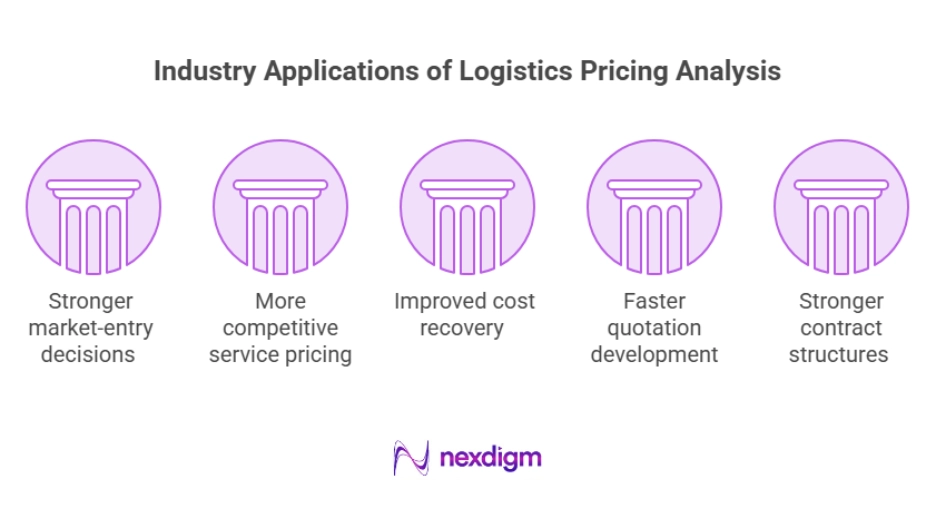
- Stronger market-entry decisions
- More competitive service pricing
- Improved cost recovery
- Faster quotation development
- Stronger contract structures
Thus, Nexdigm’s market-based pricing support helps businesses launch commercially viable logistics services with clearer rates, stronger margins, lower risk, and greater confidence in long-term market performance.
Nexdigm’s Adaptive Pricing Analysis Model for Emerging Logistics Services
Nexdigm’s adaptive pricing model combines market validation, cost intelligence, customer value, and commercial governance to help emerging freight services establish viable rates, protect margins, and scale confidently across competitive markets. Some important frameworks and strategies used in the model are:
- Entry Pricing Strategy: Introductory rates, customer incentives, volume commitments, and promotional discounts are structured carefully to accelerate market penetration without compromising long-term profitability objectives.
- Freight Network Optimization Framework: Hub locations, consolidation points, backhaul opportunities, and shipment flows are analyzed to create pricing structures aligned with efficient network utilization and lower operating costs.
- Contract Design Strategy: Minimum volumes, escalation clauses, payment terms, review periods, and service guarantees are structured to improve pricing stability and reduce future commercial disputes.
- Risk-Adjusted Pricing Strategy: Border delays, geopolitical disruptions, weather risks, compliance obligations, and operational uncertainty are incorporated into pricing to strengthen resilience and commercial sustainability.
Nexdigm’s Case
Nexdigm supported an emerging freight provider with pilot pricing, lane prioritization, and capacity-responsive rates. The model delivered approximately 10% procurement savings, improved quotation speed, strengthened margin visibility, and enabled commercially disciplined expansion across new routes, customers, and service segments.
To take the next step, simply visit our Request a Consultation page and share your requirements with us.
Harsh Mittal
+91-8422857704