
Pricing optimization models help logistics providers manage interconnected freight, warehousing, and delivery costs through data-driven pricing analysis. Logistics pricing optimization modeling combines demand signals, capacity constraints, service requirements, route economics, facility utilization, and customer value. By testing alternative rates, surcharges, service bundles, and resource allocations, businesses can improve cost recovery, protect margins, and strengthen commercial responsiveness.
This integrated approach enables consistent pricing decisions across complex logistics networks while supporting profitable growth, better asset utilization, transparent quotations, and adaptable strategies for changing market conditions and customer expectations across diverse service environments.
A logistics operation applied data-driven pickup and delivery optimization, reducing vehicle requirements by 11.27% and transportation costs by 13.12%. The results highlight how integrated pricing and operational models can strengthen cost control, resource utilization, service efficiency, and commercial performance.
Dynamic Pricing Analysis for Freight, Warehousing, and Delivery
Dynamic pricing analysis combines current costs, demand, capacity, and service data to help logistics providers coordinate pricing across interconnected operations efficiently. Strategic steps of the analytical process are:
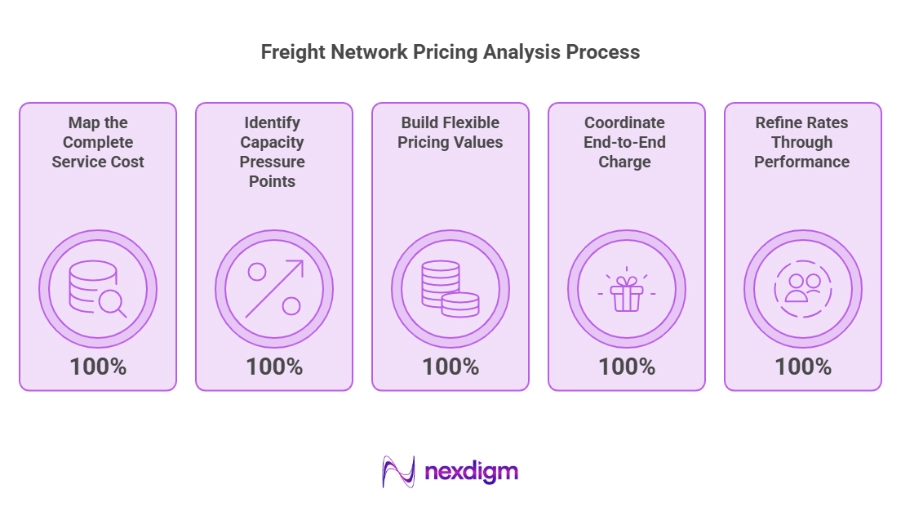
- Map the Complete Service Cost: Freight movement, storage, handling, fulfilment, labor, fuel, technology, and final-mile expenses are mapped to reveal the actual cost of delivering each logistics service.
- Identify Capacity Pressure Points: Vehicle availability, warehouse occupancy, workforce capacity, delivery slots, and seasonal demand are monitored to identify constraints requiring temporary premiums or revised commercial terms.
- Build Flexible Pricing Values: Minimum, target, and premium rates are established using service costs, customer value, market benchmarks, demand intensity, and capacity conditions to support faster pricing decisions.
- Coordinate End-to-End Charges: Freight, warehousing, handling, and delivery prices are aligned within one commercial structure, improving quotation transparency and preventing individual services from weakening overall account profitability.
- Refine Rates Through Performance: Price realization, margin contribution, capacity utilization, quotation acceptance, and customer retention are reviewed regularly to improve pricing rules and maintain sustainable network-wide commercial performance.
Nexdigm’s Pricing Expertise for End-to-End Logistics Cost Optimization
Nexdigm provides pricing expertise for end-to-end logistics cost optimization through pricing analysis, logistics pricing optimization modeling, cost-to-serve assessment, market benchmarking, and profitability analysis. By evaluating freight costs, warehouse utilization, delivery expenses, demand patterns, and service performance, Nexdigm helps businesses optimize pricing strategies, improve resource allocation, protect margins, strengthen quotation accuracy, and support profitable, scalable logistics operations across integrated networks.
Nexdigm’s Strategic Model for Freight, Warehousing, and Delivery Pricing Analysis
Nexdigm’s strategic model integrates freight, warehousing, and delivery pricing through cost intelligence, service segmentation, and governance to strengthen margins, improve utilization, and support scalable logistics growth across networks. Some important strategies used by experts in the given model are:
- Service Value Segmentation Strategy: Standard, priority, express, temperature-controlled, and specialized logistics services are grouped by customer value, operational complexity, and service commitment to support differentiated and defensible pricing structures.
- End-to-End Rate Coordination Strategy: Freight, storage, handling, fulfilment, and delivery charges are aligned within one pricing structure, improving quotation transparency and protecting overall account profitability across bundled logistics services.
- Contract Sustainability Strategy: Volume commitments, rate-review periods, escalation clauses, service limits, and minimum charges are structured carefully to preserve profitability as costs, demand, and customer requirements change.
- Route and Facility Profitability Strategy: Lane revenue, vehicle costs, storage utilization, handling effort, and delivery performance are analyzed together to identify profitable routes, facilities, and service combinations across the logistics network.
Nexdigm’s Case
Nexdigm supported an integrated logistics operator with coordinated freight, warehousing, and delivery pricing. The initiative reduced transportation costs by 13.12% and vehicle requirements by 11.27%, improving capacity utilization, margin visibility, quotation accuracy, and network-wide commercial performance across complex operations.
To take the next step, simply visit our Request a Consultation page and share your requirements with us.
Harsh Mittal
+91-8422857704