

Logistics expenditure extends across transportation, warehousing, freight forwarding, courier services, packaging, inventory handling and technology. For organisations managing complex supply chains, these costs are often distributed across multiple suppliers, contracts and operating locations. This makes it difficult to identify where procurement savings are being lost, and which categories offer the greatest opportunities for improvement.
A reduction in individual supplier rates may appear beneficial, but it does not necessarily translate into lower total logistics expenditure. Transportation costs can increase because of inefficient routing, warehouse costs may rise through poor capacity utilisation, and courier expenses can be affected by delivery failures and return shipments.
A structured logistics procurement cost analysis consulting exercise helps organisations understand their spending patterns, compare supplier economics and identify opportunities to improve overall procurement efficiency.
Understanding Logistics Spend Across Procurement Categories
The first step is to establish a clear view of logistics expenditure. Many organisations maintain separate budgets for freight, warehousing, courier services and other logistics activities. However, these categories are operationally connected.
For example, a decision to consolidate warehouse locations may reduce storage costs but increase outbound transportation expenditure. Similarly, selecting a lower-priced freight provider may introduce additional handling charges or longer transit times.
A category-level assessment should therefore consider both direct and indirect costs.
The major areas of logistics procurement expenditure generally include:
- Transportation and freight: Road, rail, air and ocean freight charges, fuel surcharges, tolls and additional handling.
- Warehousing and storage: Facility rentals, inventory handling, labour, equipment and value-added services.
- Courier and parcel delivery: Shipment rates, volumetric weight charges, remote-area fees, returns and failed delivery costs.
- Freight forwarding and customs: Documentation, brokerage, consolidation, terminal handling and clearance charges.
- Technology and support services: Transportation management systems, tracking platforms, warehouse software and related service fees.
This classification provides a starting point for identifying high-spend categories and comparing their contribution to total logistics costs.
Identifying the Largest Cost Optimization Opportunities
The most significant savings opportunities often emerge from examining how logistics services are purchased and used.
Transportation procurement can benefit from route consolidation, improved load utilisation, alternative transport modes and supplier rate benchmarking. Organisations shipping fragmented volumes may be paying more than necessary because they lack consolidated procurement arrangements.
Warehousing offers another area for optimisation. Businesses should examine storage utilisation, inventory movement, facility location and handling charges. Underutilised warehouse space or unnecessary inventory transfers can increase operating costs without improving service levels.
Courier procurement requires attention to shipment profiles, delivery zones, service categories and return rates. Organisations may be using express services for shipments that do not require time-sensitive delivery. A review of delivery requirements can help match shipment types with more appropriate service levels.
Freight forwarding costs should be assessed across the complete shipment journey. Differences in documentation charges, customs brokerage, terminal handling and consolidation arrangements can create substantial variations between providers.
Supplier Pricing, Contract Structures and Hidden Charges
Supplier contracts are an important source of potential savings. Logistics agreements may include multiple pricing components, escalation clauses, minimum volume commitments and additional service charges.
A supplier offering an attractive base rate may recover costs through fuel adjustments, waiting charges, remote-location fees or handling surcharges.
Procurement teams should compare providers using standardised shipment profiles and equivalent service requirements. This allows them to distinguish genuine price differences from variations in service scope.
Contract reviews should also examine rate validity, volume discounts, payment terms, minimum commitments and service-level penalties.
Supplier concentration is another consideration. Depending heavily on a single provider can reduce negotiating flexibility and increase exposure to service disruptions. However, spreading volumes across too many suppliers can also weaken purchasing leverage.
Prioritising Savings Without Compromising Service Quality
Cost optimisation should not be treated as a simple exercise in selecting the cheapest supplier. A lower procurement rate can create additional costs if delivery reliability, inventory handling or shipment visibility deteriorates.
Organisations should evaluate potential savings against service performance, operational risk and implementation requirements.
A practical prioritisation model can assess opportunities according to four factors: annual spend, potential savings, implementation complexity and service impact.
High-spend categories with significant rate variations and limited switching barriers may offer immediate opportunities. Changes involving warehouse relocation, technology integration or network redesign may require longer implementation periods.
Logistics Procurement Cost Optimization Framework
A structured logistics procurement cost analysis consulting exercise should include:
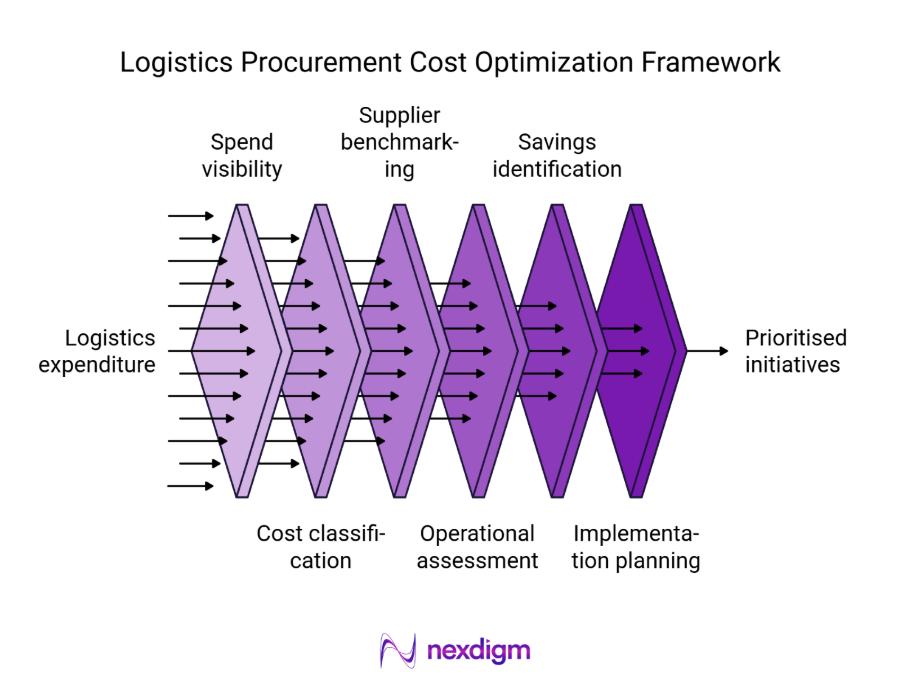
- Spend visibility: Consolidate logistics expenditure by category, supplier, location and service type.
- Cost classification: Separate base rates, surcharges, handling charges, accessorial costs and indirect expenses.
- Supplier benchmarking: Compare pricing and service performance across equivalent requirements.
- Operational assessment: Identify inefficiencies in routing, load utilisation, storage capacity and shipment handling.
- Savings identification: Quantify opportunities from renegotiation, consolidation, supplier rationalisation and process improvement.
- Implementation planning: Prioritise initiatives according to savings potential, feasibility and operational risk.
Nexdigm can support organisations through logistics spend analysis, supplier benchmarking, procurement intelligence and category-level cost assessments. These services help businesses identify where expenditure is concentrated, evaluate supplier competitiveness and develop evidence-based cost optimisation strategies.
Nexdigm’s Case Study: Identifying Cross-Category Logistics Savings
Nexdigm analysed logistics expenditure across 5 procurement categories, benchmarking 18 suppliers across 4 markets. The assessment identified 6 cost optimisation opportunities, highlighted a 14% variation in comparable supplier costs and prioritised 4 initiatives for procurement action.
To take the next step, simply visit our Request a Consultation page and share your requirements with us.
Harsh Mittal
+91-8422857704