
Logistics demand is becoming harder to understand through freight volumes alone. A customer may still contract a transport provider, but the commercial requirement around that movement can now include warehousing, inventory handling, fulfilment, returns, packaging, customs support, or technology-enabled shipment management.
This is changing where logistics companies can find growth. The opportunity may sit in a familiar transport market, but the higher-value demand is increasingly distributed across the services surrounding the shipment.
Freight Demand Is Only the Starting Point
Road, rail, air, and sea freight remain the foundation of logistics activity, but their demand profiles differ significantly.
Manufacturers moving bulk commodities require predictable capacity and competitive rates. E-commerce companies may generate large numbers of smaller shipments with much higher fulfilment intensity. Pharmaceutical companies require controlled conditions and traceability. Industrial customers may need project logistics, specialised equipment, or time-critical delivery.
Looking only at tonnage or shipment volumes can therefore conceal meaningful differences in revenue potential.
The first step is to understand who is moving what, between which locations, how frequently, and under what service requirements.
Warehousing Demand Is Becoming More Segmented
Warehousing is also moving beyond generic storage.
Some customers require conventional pallet storage. Others need cross-docking, bonded facilities, temperature-controlled environments, automated storage, or inventory services linked directly to their production or retail operations.
The location of demand matters as much as the amount of space required. Manufacturing clusters generate different requirements from urban consumption centres, while e-commerce creates pressure for facilities that can support faster order processing and last-mile distribution.
For logistics providers, this creates a more useful question than “How much warehouse space will the market need?” It becomes: which type of capacity will customers actually pay for, and where?
Fulfilment Creates a Different Revenue Pool
Fulfilment demand is closely tied to order characteristics rather than simply the physical movement of goods.
Pick-and-pack, order processing, inventory management, marketplace fulfilment, returns handling, and last-mile coordination can all become part of the logistics relationship.
This is particularly relevant for retailers and consumer brands where order volumes can grow rapidly while average shipment values remain relatively low. A provider that only captures transportation revenue may therefore handle the same underlying demand without capturing the broader service opportunity.
Returns are another consideration. Reverse logistics can require collection, inspection, grading, repackaging, restocking, refurbishment, or disposal. The resulting workflow can resemble a second logistics network rather than a simple extension of outbound delivery.
Value-Added Services Can Change the Economics
The strongest opportunities are not necessarily the largest logistics services by volume.
Kitting, labelling, packaging, quality inspection, assembly, customs support, inventory postponement, and reverse logistics can create additional revenue from customers already using a provider’s core network.
The commercial question is whether customers are willing to outsource these activities and whether the provider has the operational capabilities to deliver them profitably.
That requires looking at customer outsourcing behaviour, current service gaps, switching barriers, and willingness to pay rather than relying only on industry growth rates.
Demand Needs to Be Viewed by Customer Segment
The same logistics service can have very different demand drivers across industries.
A manufacturer may prioritise reliability and inbound inventory control. A retailer may place greater value on fulfilment speed and returns. A pharmaceutical company may pay a premium for temperature-controlled handling and compliance. A smaller e-commerce seller may prefer a bundled service because managing multiple logistics partners is costly.
Segmenting demand in this way helps identify where service expansion is commercially justified.
It also prevents providers from treating the entire logistics market as a single addressable pool.
The Opportunity Often Sits Between Services
A logistics provider may already have the customer relationship, transport network, warehouse footprint, and shipment data needed to expand into adjacent services.
The challenge is deciding which adjacency deserves investment.
A freight provider with strong manufacturing accounts may have a credible opportunity in warehousing and inventory management. A fulfilment operator may find greater value in returns or packaging. A warehouse provider located near an industrial cluster may have an opportunity in kitting or light assembly.
This is where logistics service demand analysis becomes useful: it connects customer demand with the services a provider can realistically add, rather than treating every growing logistics segment as an opportunity.
How Nexdigm Maps the Most Valuable Logistics Demand
Nexdigm’s approach evaluates demand across the logistics value chain and translates it into specific service priorities.
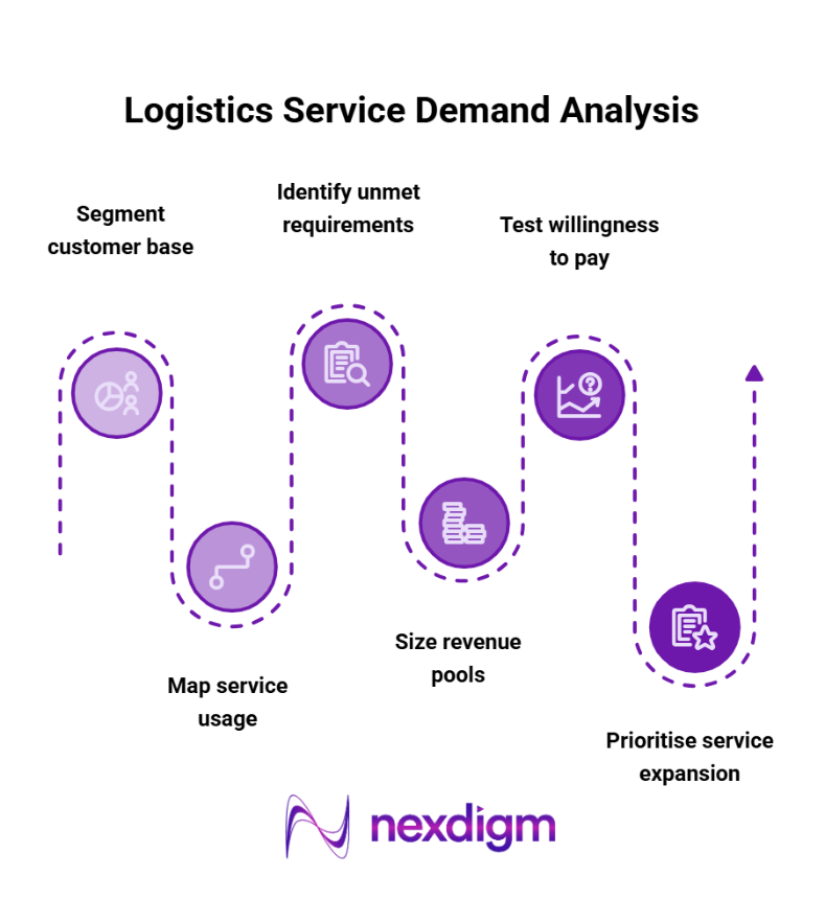
- Segment the customer base: Analyse industries, company sizes, shipment profiles, geographies, outsourcing maturity, and service requirements to identify distinct demand pools.
- Map service usage: Measure current adoption of freight, warehousing, fulfillment, returns, customs, and value-added services to identify where outsourcing is already established.
- Identify unmet requirements: Assess customer pain points, service gaps, switching behaviour, and operational challenges that could support additional logistics spending.
- Size the revenue pools: Estimate addressable demand by service, customer segment, geography, and expected outsourcing penetration rather than relying on headline market size.
- Test willingness to pay: Determine which services customers consider essential, premium, or interchangeable and establish the commercial conditions required for adoption.
- Prioritise service expansion: Compare market attractiveness, competitive intensity, operational fit, investment requirements, and potential margins to determine which services should be developed first.
How Nexdigm Helped Expand a Logistics Provider Beyond Transport
A regional logistics provider generated 82% of its revenue from freight but was seeing limited margin expansion despite 14% annual shipment growth. Nexdigm analysed customer service usage across 11 industries and identified warehousing, returns management, and kitting as the strongest adjacent opportunities. The resulting service strategy increased non-transport revenue to 27% within two years and lifted overall gross margin by 5.6 percentage points.
To take the next step, simply visit our Request a Consultation page and share your requirements with us.
Harsh Mittal
+91-8422857704