

Pricing strategies influence customer acquisition and profitability across logistics segments by shaping how services are positioned, packaged, and valued in competitive markets. Logistics providers must balance cost recovery, margin protection, customer expectations, service quality, and competitor pricing while offering transport, warehousing, fulfilment, freight, and last-mile solutions.
A strong market entry strategy must assess demand sensitivity, operating costs, service differentiation, contract models, and pricing benchmarks. A well-planned logistics service pricing entry strategy helps attract customers, improve profitability, support scalable growth, and create sustainable competitive advantage across logistics service markets.
Logistics service pricing entry strategy is important. The global logistics market was valued at about USD 4.11 trillion in 2025 and is projected to reach USD 8.50 trillion by 2033, growing at 10.1% annually. India’s logistics cost was estimated at 7.97% of GDP in 2023–24, showing how pricing efficiency directly affects profitability and customer acquisition.
Benchmarking Logistics Service Prices Against Market Alternatives
Benchmarking logistics service prices against market alternatives helps businesses compare rates, service quality, cost structures, competitor offerings, and customer value to support competitive market entry.
- Rate Comparison: Compare transport, warehousing, fulfilment, freight, and last-mile prices against market alternatives to identify competitive pricing gaps.
- Service Quality Benchmarking: Assess delivery speed, reliability, tracking visibility, handling standards, and customer support alongside quoted logistics service prices.
- Cost Structure Review: Review fuel, labor, storage, technology, handling, and compliance costs to understand pricing sustainability and margin impact.
- Competitor Offering Analysis: Evaluate competitor service bundles, contract terms, value-added services, and coverage levels to refine pricing strategy.
Nexdigm Margin Analysis for Profitable Logistics Service Expansion
Nexdigm margin analysis for profitable logistics service expansion helps businesses evaluate service costs, pricing structures, customer profitability, segment margins, and revenue potential. This supports informed market entry, sustainable pricing decisions, stronger cost control, improved customer targeting, and profitable growth across transport, warehousing, fulfilment, freight, and last-mile logistics services.
How Can Nexdigm Assess Customer Price Sensitivity for Logistics Market Entry?
Nexdigm can assess customer price sensitivity for logistics market entry by analyzing customer segments, service expectations, competitor prices, cost drivers, willingness to pay, and pricing flexibility:
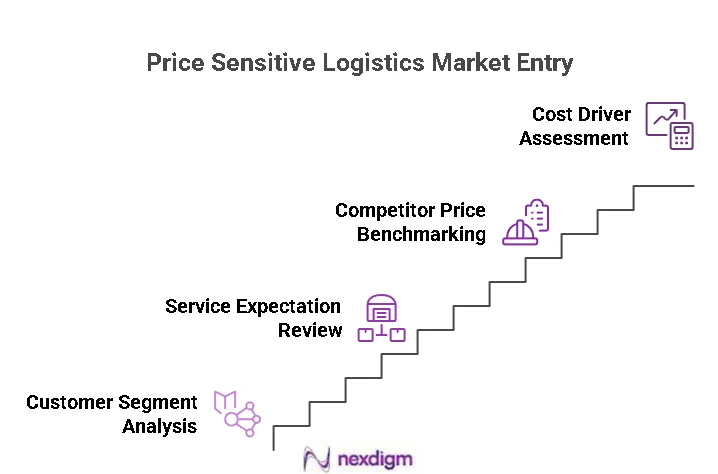
- Customer Segment Analysis: Nexdigm identifies customer groups, shipment needs, buying behavior, and budget expectations to assess pricing sensitivity.
- Service Expectation Review: Nexdigm evaluates customer expectations for speed, reliability, visibility, flexibility, and support against acceptable price levels.
- Competitor Price Benchmarking: Nexdigm compares market prices, service bundles, discounts, and contract terms to understand competitive pricing pressure.
- Cost Driver Assessment: Nexdigm reviews fuel, labor, warehousing, handling, technology, and compliance costs influencing logistics pricing decisions.
Nexdigm’s case:
Nexdigm assisted a logistics company to assess customer price sensitivity before market entry. By analyzing customer segments, competitor pricing, service expectations, cost drivers, and willingness to pay, Nexdigm helped improve pricing acceptance by 23%, increase qualified customer conversions by 18%, and protect target margins above 15%.
To take the next step, simply visit our Request a Consultation page and share your requirements with us.
Harsh Mittal
+91-8422857704