

Logistics outsourcing is moving beyond transportation and warehousing, with companies increasingly outsourcing inventory management, fulfilment, technology, returns, and customs. 87% of shippers increased their use of outsourced logistics services, while 82% of freight and transportation expenditure and 61% of warehousing expenditure was outsourced.
For logistics providers, the opportunity lies in identifying where outsourcing is deepening and which services customers are ready to add.
Outsourcing Is Moving Deeper into the Supply Chain
Transportation remains the most established Transportation remains the most common outsourced function, but 3PL relationships are expanding. Among shippers using 3PLs, 82% reported better customer service, 66% lower costs, and 68% improved logistics effectiveness.
As customers outsource more planning, inventory, fulfillment, and visibility, providers that offer integrated services can become more strategic partners. The opportunity is therefore shifting from individual logistics transactions to broader, longer-term relationships.
3PL Adoption Is Strong, But Buyers Are Consolidating Providers
In the same 2025 study, 57% of shippers said they were consolidating the number of 3PL providers they use. The figure was substantially lower than the previous year’s 78% but still indicates that rationalisation remains part of procurement strategy.
For logistics providers, this creates an important distinction. Growing outsourcing demand does not guarantee that every provider will gain share. Customers may be moving spend toward fewer partners capable of managing broader portions of the supply chain.
This favours providers that can combine operational execution with technology, analytics, and specialised services.
Warehousing Is Becoming a Service Platform
In India’s 3PL warehousing market, storage still accounted for approximately 59% of market share in 2025. But value-added services are emerging as the fastest-growing service segment, with kitting, labelling, secondary packaging, and documentation increasingly being integrated into warehouse operations.
This matters because customers can reduce handoffs when these activities are managed within the same facility. A warehouse provider can therefore capture more value from the same customer without necessarily acquiring an entirely new customer base.
The question becomes which adjacent services fit the customer’s workflow and can be delivered profitably.
Digital Booking Is Changing How Logistics Is Purchased
Technology adoption is also changing the way logistics services are bought and managed.
Shippers increasingly expect visibility, transportation-management capabilities, scheduling, and analytics alongside physical logistics services. The 2025 3PL study identified control-tower visibility, transportation-management planning and scheduling, and advanced analytics among the leading technology requirements from shippers.
Digital booking fits into this broader shift. Instant quotations, online shipment creation, carrier comparison, tracking, electronic documentation, and automated updates can reduce the administrative effort involved in managing fragmented transport networks.
But digital access alone does not create differentiation. If the underlying capacity, pricing, reliability, or service quality is weak, a better booking interface does little to change the customer’s economics.
Value-Added Services Are Becoming a Growth Lever
The strongest expansion opportunities often sit between conventional logistics services. Kitting, labelling, packaging, returns processing, customs, and documentation can help providers capture more value from existing customer relationships.
In India, 3PL providers accounted for around 44% of industrial and logistics space absorption in H2 2025, creating a substantial physical base for expanding into adjacent services.
The challenge is identifying which services customers are actually willing to outsource and pay for, rather than simply adding capabilities to the portfolio.
Usage Trends Need to Be Read Across the Entire Service Stack
A useful assessment should track several changes simultaneously:
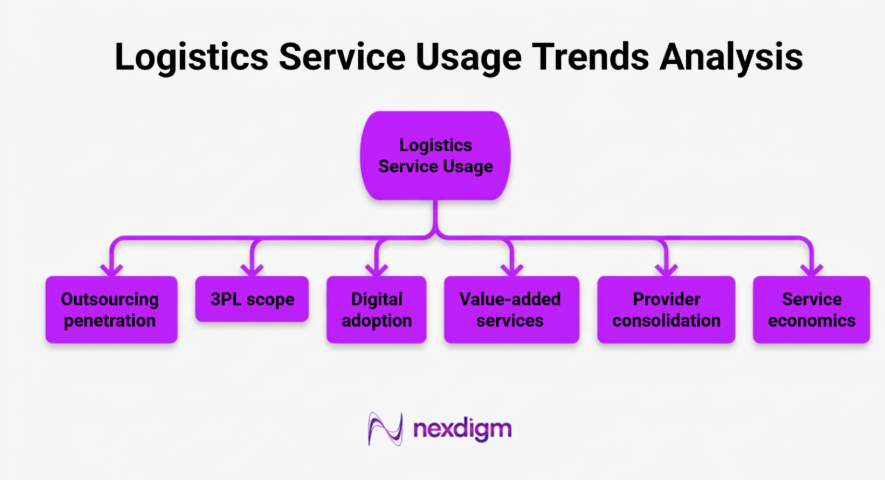
- Outsourcing penetration: Which logistics functions are moving from internal teams to external providers?
- 3PL scope: Are customers outsourcing transport alone, or adding warehousing, fulfilment, inventory, and planning?
- Digital adoption: How quickly are customers shifting booking, tracking, documentation, and planning activities onto digital platforms?
- Value-added services: Which activities are moving inside the logistics contract?
- Provider consolidation: Are customers increasing spend with existing providers or adding new partners?
- Service economics: Which outsourced services generate recurring revenue and attractive margins?
This is where logistics service usage trends become commercially useful. The objective is not simply to establish that outsourcing is growing, but to determine where the next pool of outsourced spending is likely to emerge.
How Nexdigm Identifies Where Logistics Usage Is Shifting
Nexdigm assesses logistics service usage by mapping current outsourcing behaviour against customer requirements and provider capabilities.
- Measure outsourcing penetration: Segment transportation, warehousing, fulfillment, inventory, customs, returns, and other activities by current internal versus outsourced usage.
- Track 3PL adoption: Identify industries and customer segments where outsourcing is accelerating, stabilising, or remaining limited.
- Map the technology layer: Assess adoption of digital booking, TMS, WMS, visibility platforms, control towers, electronic documentation, and analytics.
- Identify emerging services: Evaluate demand for kitting, packaging, labelling, reverse logistics, inventory management, and other value-added activities.
- Understand procurement behaviour: Assess provider consolidation, contract duration, switching barriers, service-level expectations, and decision criteria.
- Prioritise growth pools: Rank services according to addressable demand, adoption trajectory, willingness to pay, competitive intensity, and operational fit.
How Nexdigm Helped a 3PL Expand Its Service Mix
A regional 3PL derived 74% of revenue from transportation while its manufacturing customers were increasingly outsourcing warehouse and inventory functions. Nexdigm analysed service usage across 120 enterprise accounts and identified contract warehousing, inventory management, and packaging as the strongest adjacent opportunities. Within 18 months, the provider increased non-transport revenue from 26% to 41% and improved customer retention by 11 percentage points.
To take the next step, simply visit our Request a Consultation page and share your requirements with us.
Harsh Mittal
+91-8422857704