

Storage cost benchmarking helps organizations compare warehouse expenses, utilization levels, service requirements, and operating practices across locations, providers, and contract structures. Effective logistics storage cost benchmarking combines pricing analysis with activity-based costing, capacity reviews, labor metrics, inventory profiles, and regional market comparisons.
This approach exposes hidden efficiency gaps, validates storage rates, and highlights facilities performing above or below network standards. By identifying potential improvement opportunities, businesses can strengthen negotiations, optimize space and establish transparent pricing strategies that support warehousing operations and profitability.
Recent 2025 warehouse optimization cases across unnamed client implementations reported efficiency improvements of 15% to 60%, including fewer aisle visits, 30% higher processing productivity, and fewer total aisle visits, demonstrating measurable gains from data-led pricing analysis initiatives.
Storage Cost Benchmarking and Pricing Analysis for Network Optimization
Storage cost benchmarking combines operational data, market rates, and pricing analysis to identify network inefficiencies, improve warehouse utilization, strengthen contract negotiations, and support sustainable cost optimization across locations and providers. Structured steps of the analytical process are:
- Segment the Warehousing Network: Group facilities by region, product profile, storage type, service complexity, and demand pattern to ensure benchmarking compares operationally similar warehouses rather than relying on broad averages.
- Analyze Capacity Utilization: Review occupied space, peak capacity, inventory dwell time, and unused storage zones to identify underutilized assets, congestion risks, and opportunities for network rebalancing.
- Evaluate Cost-to-Service Relationships: Compare storage costs with throughput, accuracy, responsiveness, and value-added services to determine whether each warehouse delivers appropriate commercial value for its pricing level.
- Model Network Optimization Scenarios: Test facility consolidation, contract restructuring, inventory redistribution, automation, and alternative provider scenarios to estimate potential savings, operational impacts, and implementation risks before making changes.
- Prioritize High-Impact Interventions: Rank improvement initiatives by savings potential, execution complexity, service risk, and payback period, enabling management to focus resources on the most commercially attractive opportunities.
Nexdigm’s Pricing Analysis Expertise for Storage Warehousing Networks
Nexdigm leverages pricing analysis, logistics cost benchmarking, warehouse pricing optimization, storage cost analysis, and cost-to-serve modeling to help businesses optimize multi-site warehousing networks. By evaluating storage rates, capacity utilization, regional cost variations, and operational performance, Nexdigm enables data-driven pricing decisions, identifies efficiency gaps, strengthens contract negotiations, and supports sustainable profitability across complex distribution networks.
Nexdigm’s Strategic Blueprint for Storage Cost Benchmarking and Analysis
Nexdigm’s strategic blueprint combines pricing analysis, operational diagnostics, and market comparisons to help businesses benchmark warehouse and strengthen network-wide commercial performance sustainably. Some important features of the blueprint model are:
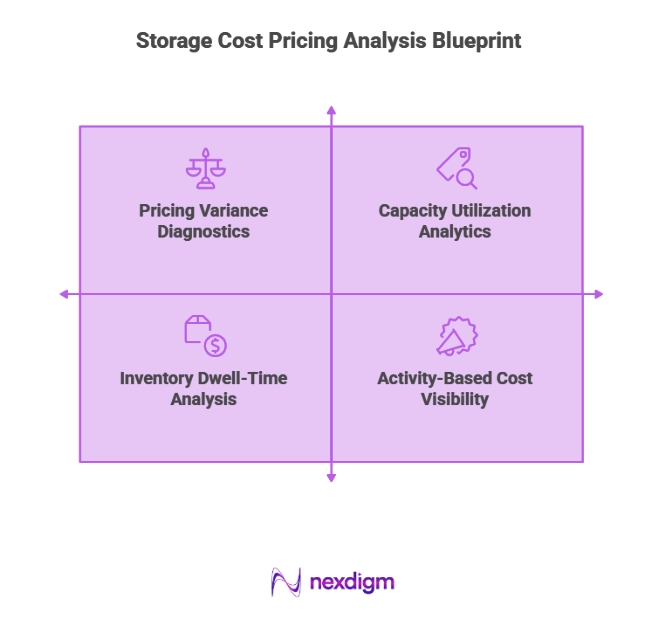
- Capacity Utilization Analytics: The blueprint measures occupied space, peak usage, inventory density, and idle capacity, helping businesses identify consolidation opportunities, rebalance stock, and reduce avoidable storage expenditure.
- Activity-Based Cost Visibility: Costs are allocated to receiving, storage, picking, packing, dispatch, and returns, revealing which warehouse activities create disproportionate expenses or require process redesign.
- Inventory Dwell-Time Analysis: The blueprint model evaluates how long inventory remains stored across facilities, helping businesses reduce slow-moving stock, release capacity, improve turnover, and lower long-term storage costs.
- Pricing Variance Diagnostics: Actual warehouse charges are compared with budgets, benchmarks, and historical trends, enabling rapid identification of unexplained cost movements, billing errors, and emerging inefficiencies.
Nexdigm’s Case
Nexdigm helped an e-commerce logistics provider benchmark warehouse automation and fulfillment efficiency, improving order fulfillment speed by 19%, reducing operational costs by 13%, and strengthening inventory accuracy across distribution centers through data-driven performance comparisons and targeted improvements.
To take the next step, simply visit our Request a Consultation page and share your requirements with us.
Harsh Mittal
+91-8422857704