

India’s expanding warehousing sector is creating greater demand for efficient storage infrastructure, modern racking systems, and material-handling solutions. According to Colliers, industrial and warehousing leasing across India’s top eight cities reached 36.9 million sq. ft. in 2025, registering 16% annual growth. Third-party logistics providers accounted for 32% of this demand.
Crisil Intelligence estimated India’s storage solutions industry, covering pallets, racking, and shelving, at approximately ₹49 billion in FY2025, with further growth expected in FY2026. These developments are encouraging businesses to modernize warehouse infrastructure and improve storage efficiency. Logistics storage infrastructure vendor analysis helps organizations evaluate supplier capabilities, compare technical specifications, understand commercial differences, and identify suitable infrastructure partners for their operational requirements.
Storage Infrastructure as a Driver of Warehouse Productivity
Warehouse storage systems influence how effectively businesses use available space, organise inventory, and manage material movement. Different configurations, including pallet racking, shelving, mezzanine structures, and automated storage systems, serve different operational requirements. Selecting appropriate infrastructure requires consideration of product dimensions, load capacities, inventory turnover, facility layout, and equipment compatibility. The right configuration can improve storage density, accessibility, and warehouse productivity.
What Determines the Suitability of a Storage Infrastructure Vendor?
Businesses should look beyond product availability and examine how effectively vendors can support infrastructure requirements throughout the equipment lifecycle. Three considerations are particularly important:
- Technical and Safety Standards: Evaluate load-bearing capacity, material quality, structural stability, safety provisions, and compliance with applicable standards.
- Installation and Project Execution: Assess vendor experience in site assessment, system design, installation timelines, commissioning, and post-installation support.
- Scalability and Commercial Fit: Compare expansion flexibility, maintenance costs, warranty coverage, pricing structures, and long-term ownership expenditure.
These factors help businesses assess whether a vendor can deliver infrastructure that meets present requirements while accommodating future operational changes.
Nexdigm’s Procurement Intelligence for Storage Infrastructure Sourcing
Nexdigm can help organizations understand the competitive supplier environment through structured logistics storage infrastructure vendor analysis. Our research can examine several dimensions of the storage equipment market:
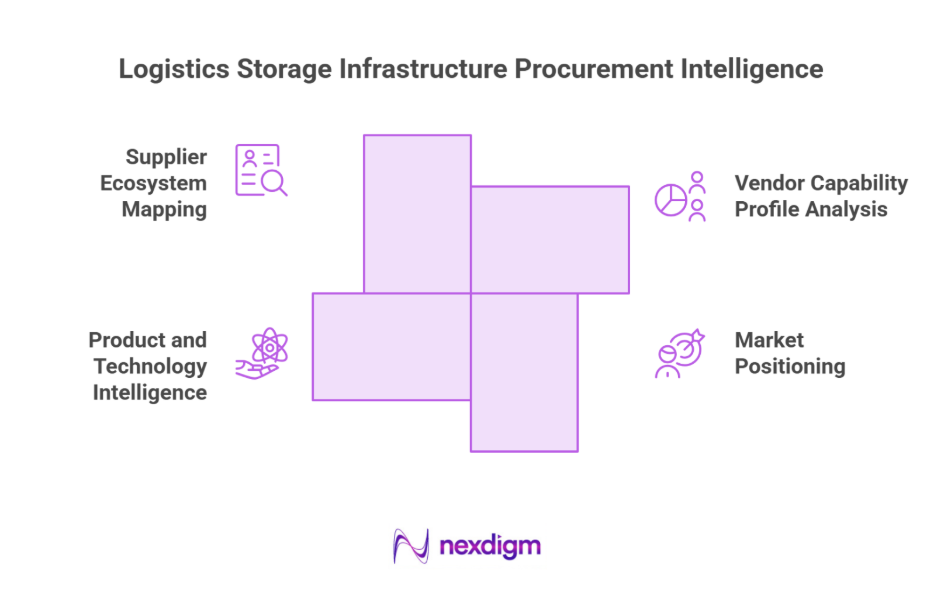
- Supplier Ecosystem Mapping: Identify manufacturers, distributors, and system integrators across pallet racking, shelving, mezzanine structures, and automated storage categories.
- Product and Technology Intelligence: Compare equipment specifications, design configurations, material grades, automation features, and customization capabilities.
- Vendor Capability Profiling: Assess manufacturing capacity, project experience, installation expertise, service networks, and after-sales support.
- Market Positioning: Understand supplier specializations, industry presence, product strengths, and competitive differentiation.
This provides businesses with a broader view of available suppliers and their suitability for different infrastructure requirements.
How Nexdigm Supports Vendor Comparison and Benchmarking
Nexdigm can help procurement teams establish a structured framework for comparing storage infrastructure vendors rather than relying solely on individual quotations. Our research can assess suppliers across key parameters:
- Technical Benchmarking: Compare load-bearing capacities, structural specifications, material quality, system configurations, and customisation options to understand product suitability.
- Commercial Benchmarking: Evaluate equipment pricing, installation charges, transportation expenses, warranty terms, and maintenance costs to identify differences in total ownership expenditure.
- Quality and Safety Assessment: Examine product quality standards, safety provisions, inspection practices, and warranty coverage to understand supplier reliability.
- Service Capability Evaluation: Compare installation expertise, spare-part availability, maintenance arrangements, service networks, and response capabilities.
By bringing these findings together, Nexdigm can help businesses understand vendor strengths and limitations, assess competitive positioning, and develop a shortlist aligned with their operational and procurement requirements.
Procurement Outcomes from Nexdigm’s Structured Vendor Benchmarking
Nexdigm’s vendor comparison and market intelligence can support better-informed storage infrastructure decisions through:
- More Effective Supplier Selection: Shortlist vendors based on technical suitability, delivery capabilities, and service support.
- Improved Cost Visibility: Understand pricing differences and additional ownership costs before making investment decisions.
- Stronger Negotiation Preparedness: Use market benchmarks to evaluate quotations and support commercial discussions.
- Reduced Supplier Risk: Identify potential gaps in manufacturing capacity, product availability, installation expertise, and after-sales support.
- Better Long-Term Planning: Consider scalability, maintenance requirements, and future capacity needs when selecting infrastructure partners.
These outcomes can help businesses make more transparent procurement decisions, manage infrastructure investments, and select storage solutions that support warehouse performance and future growth.
Nexdigm’s Case
A manufacturing company planning to expand its warehouse capacity sought to identify a reliable storage infrastructure partner while controlling capital expenditure. Nexdigm’s vendor assessment compared racking specifications, load capacities, installation capabilities, safety standards, and commercial terms. The analysis identified 14% potential savings in infrastructure costs and 18% scope for improving storage space utilization, helping the company refine its supplier shortlist and investment decisions.
To take the next step, simply visit our Request a Consultation page and share your requirements with us.
Harsh Mittal
+91-8422857704