

India’s logistics sector is expanding, making supplier selection increasingly important for businesses managing complex distribution networks. According to the Department for Promotion of Industry and Internal Trade (DPIIT), India’s logistics costs were estimated at 7.97% of GDP, equivalent to approximately ₹24.01 lakh crore, in FY 2023–24.
Meanwhile, Indian Railways’ freight loading reached 1,670 million tonnes in FY 2025–26, reflecting the scale of freight movement across the country. These developments highlight the importance of selecting logistics partners with suitable network coverage, service capabilities, and commercial models. Logistics supplier identification consulting can help businesses assess the supplier landscape, compare providers, and identify partners aligned with their distribution requirements.
Why Supplier Fit Matters Across Logistics Networks
A logistics supplier may offer competitive rates but lack the geographic reach, infrastructure, or operational capacity required by a business. Similarly, a provider with extensive coverage may not deliver the service consistency or cost structure expected. Companies therefore need to assess suppliers against specific distribution routes, shipment volumes, delivery expectations, and service requirements rather than relying on price or reputation alone.
Dimensions That Shape Logistics Supplier Selection
A structured supplier assessment should consider three interconnected dimensions before businesses move towards shortlisting potential logistics partners:
- Network Compatibility: Examine geographic coverage, warehouse locations, transport routes, regional presence, and connectivity to key sourcing or distribution points.
- Service Delivery Capability: Evaluate delivery timelines, shipment visibility, handling infrastructure, technology integration, scalability, and the provider’s ability to meet service-level expectations.
- Commercial Competitiveness: Compare freight rates, warehousing charges, additional fees, contract terms, and pricing structures against expected shipment volumes and service requirements.
Considering these dimensions together helps procurement teams identify suppliers that offer a practical balance of network suitability, service reliability, and cost efficiency.
How Nexdigm Approaches Logistics Supplier Identification
Nexdigm’s logistics supplier identification consulting can help businesses navigate fragmented logistics markets through structured supplier research and comparative assessments. Rather than limiting the exercise to a list of providers, our research can examine the factors that influence supplier suitability across transportation, warehousing, freight forwarding, and distribution services.
Our research can support businesses in understanding the available supplier base, identifying relevant providers across target regions, and evaluating their capabilities against defined procurement requirements.
Nexdigm’s Expert-led Initiative in Building a Logistics Supplier Shortlist
Nexdigm can help procurement teams develop a focused supplier shortlist by examining different aspects of the logistics ecosystem:
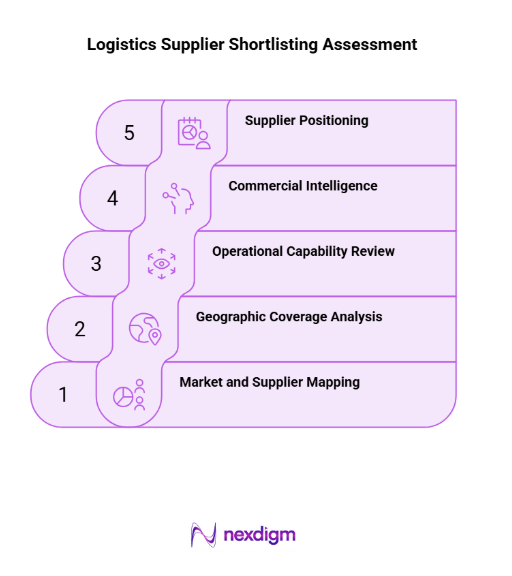
- Market and Supplier Mapping: Identify logistics providers across relevant service categories, operating regions, and transportation modes.
- Geographic Coverage Analysis: Compare supplier networks, warehouse locations, distribution centres, route connectivity, and regional service availability.
- Operational Capability Review: Assess fleet availability, storage infrastructure, shipment handling, technology adoption, and service portfolios.
- Commercial Intelligence: Research available pricing structures, service charges, contract models, and other commercial considerations.
- Supplier Positioning: Compare providers based on network reach, service offerings, operational strengths, and suitability for specific business requirements.
This approach can help businesses move from broad market visibility to a more targeted evaluation of potential logistics partners.
How Nexdigm Matches Supplier Capabilities with Evolving Distribution Needs
Supplier suitability can change as businesses expand into new markets, modify distribution models, or experience fluctuations in shipment volumes. Nexdigm can help monitor supplier developments, assess emerging service capabilities, and identify alternative providers across relevant regions. This research can support periodic supplier reviews and help procurement teams maintain sourcing options as network requirements evolve.
Nexdigm’s Case
A consumer goods company wanted to identify logistics partners capable of supporting its expanding distribution network while managing transportation and warehousing costs. Nexdigm’s research assessed 30 logistics providers across 6 regions, comparing network coverage, service capabilities, infrastructure, and commercial offerings. The assessment identified 9 suppliers for further evaluation and highlighted opportunities to improve regional supplier coverage.
To take the next step, simply visit our Request a Consultation page and share your requirements with us.
Harsh Mittal
+91-8422857704