

Trade routes rarely remain static. Changes in sourcing, demand, shipping services, infrastructure and geopolitical conditions can redirect cargo between ports and corridors. These shifts create opportunities for logistics providers, but they can also produce congestion, capacity shortages and rising costs. Monitoring trade flows helps businesses identify where network conditions are changing before committing resources to a route.
Identify Routes with Sustained Growth
Begin by tracking cargo volumes, shipment frequency and changes in origin-destination pairs over time. A route with sustained growth may justify additional capacity or new service offerings, but a short-term increase does not necessarily signal a durable trend.
Compare several periods and distinguish physical cargo growth from changes in freight prices or shipment composition. Where possible, analyse products and cargo types separately because containerised goods, bulk commodities and time-sensitive cargo can follow different patterns.
UN Trade and Development reported that global maritime trade grew by 2.2% in 2024, while growth was expected to slow to 0.5% in 2025. It also found that rerouting pushed global maritime ton-mile demand up by nearly 6% in 2024. These measures show why cargo volume and distance travelled need to be considered separately when estimating transport requirements.
Detect Congestion and Capacity Risks
A growing route can become less attractive when port waiting times, transshipment delays or inland constraints increase. Conversely, a route with moderate volume may offer better reliability and room for service expansion.
Track the following indicators:
- Cargo Growth: Monitor volumes and shipment frequency by corridor and product group.
- Port Congestion: Review vessel waiting, turnaround time, dwell time and missed schedules.
- Service Availability: Track sailing frequency, direct connections, available capacity and alternative routes.
- Transit Variability: Compare actual delivery times with planned schedules.
- Cost Pressure: Monitor freight rates, handling fees, storage and delay-related charges.
The World Bank’s Logistics Performance Indicators 2.0 use operational shipment data to examine connectivity and time performance. Its findings identify unpredictability at ports, transshipment hubs and inland checkpoints, demonstrating why route growth should be assessed alongside reliability.
Translate Flow Intelligence into Capacity Decisions
Effective logistics trade flow intelligence combines cargo trends, route connectivity, port performance and transport costs to identify where additional capacity may be needed and where existing services face growing risks.
A logistics provider might use rising shipment volumes to evaluate additional departures, warehouse space or equipment allocation. An exporter may use the same information to reconsider shipment timing or split volume across routes. A freight buyer may prioritise alternative corridors where congestion threatens delivery commitments.
However, expanding capacity solely on the basis of recent growth can create underutilisation if demand later weakens. Decisions should consider seasonality, customer contracts, competing services, equipment availability and the cost of reversing an investment. Scenario planning helps test whether a route remains viable under different volume and delay assumptions.
Nexdigm’s Trade Route Capacity Planning Framework
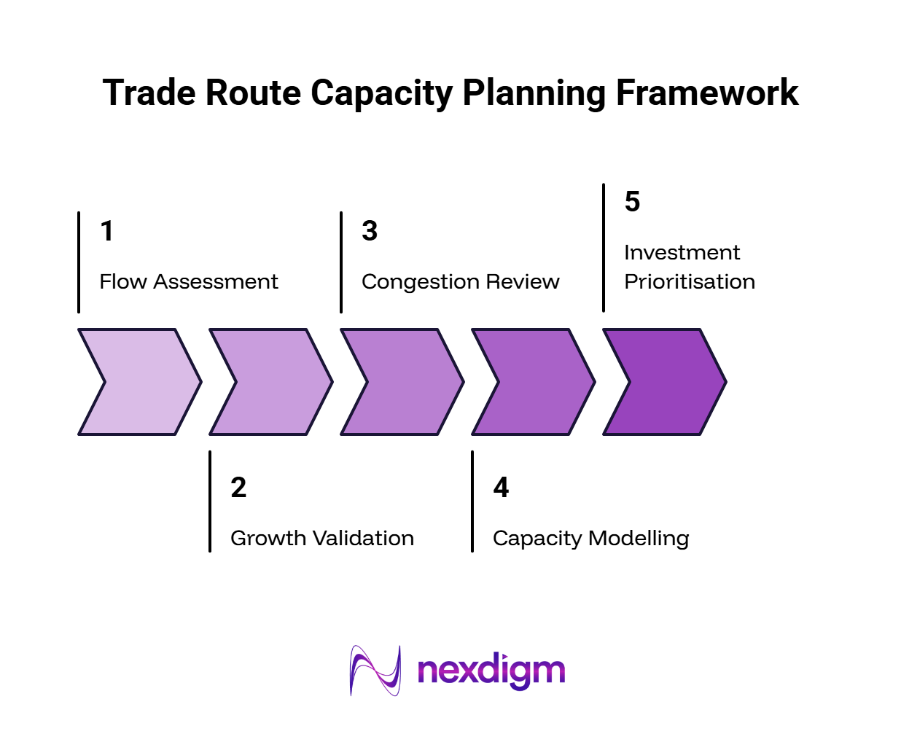
- Flow Assessment: Measure cargo volumes, shipment frequency and origin-destination changes.
- Growth Validation: Separate sustained demand from seasonal peaks, price effects and temporary rerouting.
- Congestion Review: Assess port delays, transit variability and inland capacity constraints.
- Capacity Modelling: Estimate service, equipment, warehouse and transport requirements under alternative scenarios.
- Investment Prioritisation: Select route or capacity changes based on demand evidence, cost, reliability and downside risk.
Nexdigm’s Case Study: Planning Capacity on A Growing Corridor
A freight forwarder reviewed monthly cargo movements across eight trade corridors. Two showed sustained volume growth, while another experienced longer port dwell times despite stable demand. The company prioritised capacity discussions on the growing corridors and introduced closer monitoring of the congested route before changing its service commitments.
To take the next step, simply visit our Request a Consultation page and share your requirements with us.
Harsh Mittal
+91-8422857704