

The rapid expansion of e-commerce has fundamentally changed how goods move from warehouses to consumers. What was once a supply chain focused on bulk transportation and retail replenishment has evolved into a highly dynamic ecosystem driven by speed, visibility, and last-mile fulfillment.
As online shopping continues to influence consumer behavior, logistics providers are facing mounting pressure to deliver faster, more efficiently, and at lower costs. This transformation is directly impacting demand for logistics vehicles, from urban delivery vans and heavy-duty trucks to temperature-controlled vehicles and specialized fleets.
A comprehensive Logistics vehicle demand analysis reveals that vehicle procurement decisions are no longer based solely on transportation capacity. Today, fleet composition is increasingly shaped by delivery models, geographic coverage, sustainability goals, and technology integration.
Understanding the Demand Across the Logistics Ecosystem
As e-commerce continues to transform supply chains, demand is no longer concentrated in a single vehicle category. Instead, logistics operators are investing across multiple fleet segments to support faster deliveries, operational efficiency, and evolving customer expectations. This shift is creating distinct demand patterns across vehicle types, each playing an important role in supporting the modern logistics network.
A Three-Layer Transformation of Vehicle Demand
The rapid growth of e-commerce is fundamentally changing how logistics networks operate and, consequently, the types of vehicles businesses require. To meet evolving delivery expectations, logistics providers are increasingly investing in specialized vehicle segments that support faster, more flexible, and efficient transportation across the supply chain.
1. Vans Are Becoming the Backbone of Last-Mile Delivery
The most visible impact of e-commerce growth is the rising demand for delivery vans. Consumer expectations for same-day and next-day delivery have increased the need for vehicles capable of operating efficiently in urban and suburban environments. Key drivers include:
- Higher order frequency
- Smaller shipment sizes
- Residential delivery growth
- Urban fulfillment centers
- Subscription-based delivery services
Modern logistics providers are expanding van fleets to improve route density and reduce delivery times.
Business Impact
For fleet operators, the challenge is no longer moving large volumes in fewer trips. The focus has shifted toward maximizing delivery stops and improving route productivity.
2. Trucks Remain Essential but Their Role Is Evolving
While e-commerce growth has accelerated demand for vans, trucks remain critical to logistics networks. However, their purpose is changing. Previously, trucks primarily supported retail distribution channels. Today, they increasingly connect:
- Ports to fulfillment centers
- Distribution centers to micro-fulfillment hubs
- Regional warehouses to urban delivery networks
This creates demand for:
- Medium-duty trucks
- Regional haul vehicles
- High-frequency transportation fleets
- Flexible load-capacity solutions
Rather than replacing trucks, e-commerce has redefined their position within the logistics ecosystem.
The Emerging Priority
Fleet operators are increasingly evaluating:
- Fuel efficiency
- Fleet utilization
- Route optimization
- Maintenance costs
- Digital fleet monitoring
As margins tighten, operational efficiency becomes just as important as transportation capacity.
3. Specialized Fleets Are Experiencing Accelerated Growth
One of the most significant developments often overlooked in traditional market assessments is the growth of specialized logistics fleets. The rise of online grocery, pharmaceutical distribution, and direct-to-consumer products has generated demand for purpose-built transportation assets.
Examples include:
Temperature-Controlled Vehicles
Used for:
- Fresh food delivery
- Grocery fulfillment
- Pharmaceutical transportation
- Healthcare logistics
High-Security Delivery Vehicles
Increasingly deployed for:
- Electronics
- Luxury products
- High-value shipments
Electric Commercial Fleets
Driven by:
- Sustainability mandates
- Urban emission regulations
- Corporate ESG commitments
How Is E-Commerce Reshaping Logistics Vehicle Demand?
The e-commerce is shifting demand from traditional transport-heavy fleets toward diversified, specialized, and technology-enabled vehicle ecosystems. Instead of relying primarily on long-haul transportation assets, logistics operators now refer to Logistics Vehicle Demand Analysis which requires a balanced mix of:
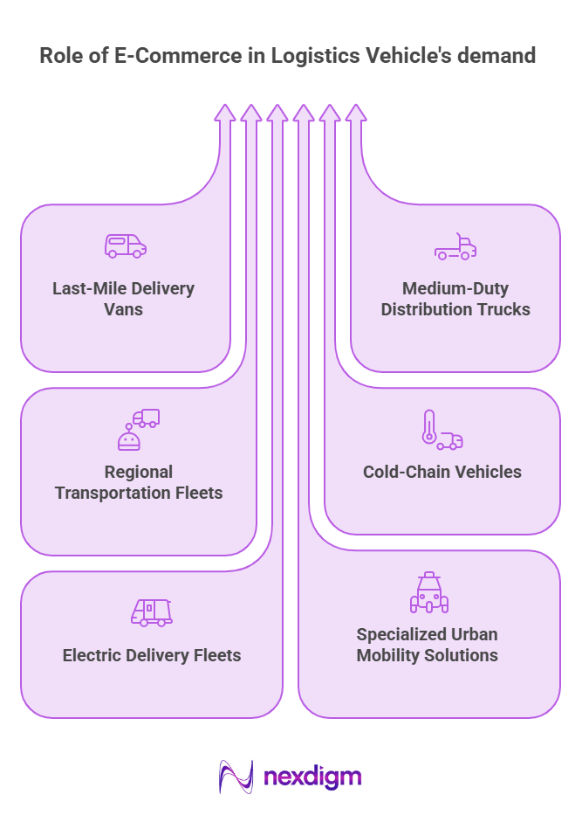
- Last-Mile Delivery Vans: Last-mile delivery vans enable fast, frequent deliveries in urban and suburban areas, helping e-commerce companies meet growing consumer expectations for same-day and next-day fulfillment services.
- Medium-Duty Distribution Trucks: Medium-duty trucks transport goods between fulfillment centers and local hubs, ensuring efficient inventory movement and supporting faster replenishment across regional distribution networks.
- Regional Transportation Fleets: Regional fleets connect warehouses, sorting centers, and distribution hubs, enabling decentralized supply chains, reducing delivery timelines, and improving operational flexibility during demand fluctuations.
- Cold-Chain Vehicles: Cold-chain vehicles maintain controlled temperatures for groceries, pharmaceuticals, and other perishables, ensuring product quality, regulatory compliance, and safe delivery throughout transit.
- Electric Delivery Fleets: Electric delivery fleets help reduce emissions and operating costs while supporting sustainability goals, making them increasingly attractive for urban last-mile logistics operations.
- Specialized Urban Mobility Solutions: Specialized urban mobility solutions improve delivery efficiency in congested cities through compact, purpose-built vehicles that enhance accessibility and support rapid order fulfillment.
Understanding these demand shifts is critical for making informed fleet and market expansion decisions. Nexdigm supports businesses through data-driven market and investment assessments to help them identify and capitalize on emerging market opportunities.
Reshaping Logistics Vehicle Demand with Nexdigm
While vehicle demand is growing, businesses face increasingly complex decisions around fleet expansion, investment planning, compliance, and operational efficiency. This is where Nexdigm can play a critical role. As e-commerce continues to reshape logistics networks, organizations require a clear understanding of where demand is emerging and how market dynamics are evolving. Nexdigm can support businesses through:
- Market Opportunity Assessment: Nexdigm can help businesses identify high-growth logistics segments, emerging geographic markets, and evolving customer demands, enabling companies to prioritize investments and capture new revenue opportunities.
- Demand Forecasting: Nexdigm supports organizations in analyzing market trends, e-commerce growth patterns, and industry dynamics to forecast future vehicle demand and optimize long-term planning decisions.
- Fleet Investment Strategy: Nexdigm can assist in evaluating fleet mix requirements, vehicle technologies, and capital expenditure priorities, helping businesses maximize returns while maintaining operational efficiency.
- Expansion Planning: As logistics networks grow, Nexdigm can support strategic expansion initiatives by assessing market potential, infrastructure requirements, and operational feasibility across new regions.
- Competitive Benchmarking: Nexdigm helps organizations compare their fleet capabilities, operational performance, and market positioning against industry peers to identify improvement opportunities and sustain competitive advantage.
Nexdigm’s Case
Nexdigm supported an automotive player in assessing logistics vehicle demand as India’s e-commerce logistics market reached $19.54 billion in 2025, projected to grow at 20.4% CAGR. The study mapped vans, trucks, and specialized fleets, identifying growth opportunities.
To take the next step, simply visit our Request a Consultation page and share your requirements with us.
Harsh Mittal
+91-8422857704