

Logistics vehicle procurement involves financial commitments that extend well beyond the initial purchase price. Businesses must evaluate acquisition costs, financing, leasing arrangements, maintenance expenses, fuel consumption, and vehicle resale value before making investment decisions.
According to the Society of Indian Automobile Manufacturers (SIAM), India recorded approximately 10.80 lakh commercial vehicle sales in FY2025–26, representing 12.6% growth over the previous financial year.
The Council on Energy, Environment and Water (CEEW) also highlights how total cost of ownership varies across vehicle categories and fuel technologies, making lifecycle comparisons important for procurement decisions. In this environment, logistics vehicle procurement benchmarking can help companies compare commercial offerings, identify cost differences, and improve fleet investment planning.
Why Vehicle Procurement Costs Need a Lifecycle Perspective
Comparing vehicles solely on acquisition prices can lead to incomplete procurement decisions. Financing costs, fuel efficiency, maintenance frequency, insurance, downtime, and resale value influence the overall economics of fleet ownership. Logistics companies must therefore evaluate vehicle costs across their expected operating life to understand the financial implications of different manufacturers, models, and sourcing arrangements.
Areas to Examine Before Procuring Logistics Vehicles
Logistics companies should evaluate vehicle procurement across three important cost dimensions. These include initial purchase and financing commitments, recurring maintenance and operating expenses, and long-term ownership economics. Comparing vehicle durability, fuel efficiency, servicing requirements, and resale value helps businesses understand the full financial impact of procurement decisions and select vehicles that meet operational and budgetary requirements.
Nexdigm’s Expert-led Approach to Logistics Vehicle Procurement Benchmarking
Nexdigm can support logistics companies through structured procurement research, commercial benchmarking, and supplier assessments. Our approach focuses on the following areas:
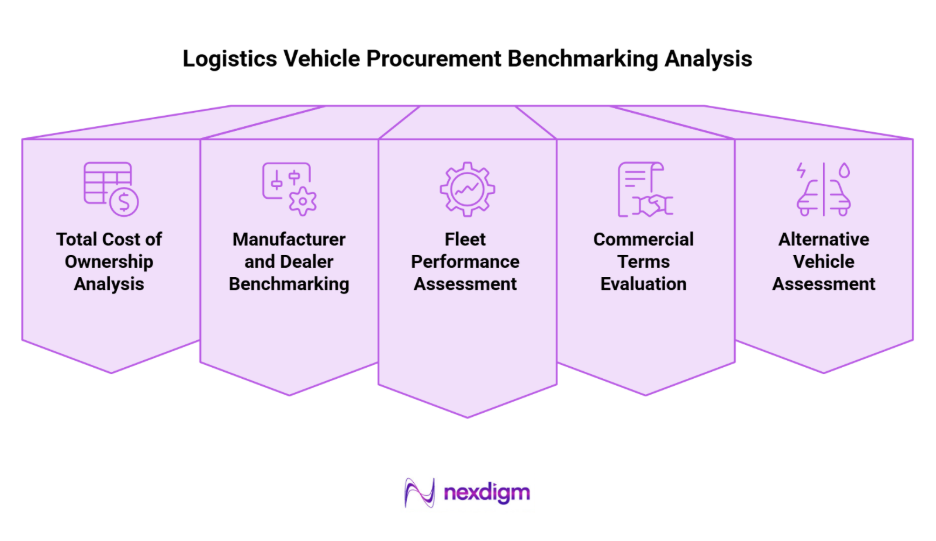
- Total Cost of Ownership Analysis: Compare acquisition, financing, fuel, maintenance, insurance, and resale costs to understand vehicle economics across the ownership lifecycle.
- Manufacturer and Dealer Benchmarking: Assess suppliers across product portfolios, pricing structures, distribution networks, warranty provisions, and after-sales capabilities.
- Fleet Performance Assessment: Examine payload capacity, fuel efficiency, vehicle utilization, reliability, and maintenance frequency against operational requirements.
- Commercial Terms Evaluation: Review payment conditions, financing options, leasing agreements, service contracts, and warranty coverage to identify differences in supplier offerings.
- Alternative Vehicle Assessment: Compare conventional, electric, and alternative-fuel vehicles across acquisition costs, operating expenses, infrastructure requirements, and application suitability.
These research capabilities can help procurement teams identify cost differences, assess supplier competitiveness, and make informed vehicle investment decisions.
Measurable Business Impact Created From Nexdigm’s Procurement Insights
Effective procurement benchmarking can help logistics companies move beyond price comparisons and identify opportunities to improve fleet economics. Nexdigm combines logistics vehicle procurement benchmarking with market intelligence and commercial assessments to support business outcomes across several areas:
- Improved Procurement Cost Efficiency: Identify competitive pricing, favourable financing arrangements, and opportunities to optimize vehicle acquisition and maintenance expenditure.
- Better Capital Allocation: Compare purchasing and leasing alternatives to help businesses allocate investments according to fleet utilization and financial priorities.
- Enhanced Fleet Productivity: Evaluate vehicle reliability, fuel efficiency, and maintenance requirements to support better utilization and reduce operational disruptions.
- Stronger Commercial Negotiations: Equip procurement teams with supplier comparisons and market pricing insights to strengthen negotiations and commercial decisions.
- Long-Term Investment Visibility: Assess lifecycle costs, technology developments, and replacement requirements to support sustainable fleet investment planning.
By connecting procurement intelligence with business priorities, Nexdigm can help logistics companies improve cost visibility, strengthen fleet economics, and make more informed investment decisions.
Why Logistics Businesses Rely on Nexdigm for Procurement Intelligence
Nexdigm combines market research, industry understanding, and procurement intelligence to help logistics companies make informed vehicle sourcing decisions. Its capabilities support businesses across four key areas:
- Industry and Market Understanding: Analyze commercial vehicle markets, manufacturer landscapes, pricing trends, and emerging technologies to provide relevant market insights.
- Research-led Procurement Expertise: Conduct comparative assessments of vehicle acquisition, leasing, financing, maintenance, and lifecycle costs to support procurement planning.
- Supplier and Commercial Intelligence: Evaluate manufacturers, dealers, leasing providers, and service networks to help businesses understand supplier capabilities and commercial offerings.
- Business-focused Recommendations: Translate research findings into actionable insights that support cost optimization, supplier selection, fleet investment, and long-term procurement priorities.
Through these capabilities, Nexdigm can help logistics businesses strengthen procurement decisions and align vehicle sourcing with wider operational and financial objectives.
Nexdigm’s Case
A logistics operator sought to reduce vehicle ownership costs while improving fleet availability. Nexdigm’s assessment compared supplier pricing, leasing models, and maintenance arrangements, identifying 16% potential savings in lifecycle expenditure, 13% improvement in fleet availability, and 19% scope for better supplier cost competitiveness. The findings helped the company prioritize cost-effective sourcing options, negotiate better supplier terms, and improve fleet investment planning.
To take the next step, simply visit our Request a Consultation page and share your requirements with us.
Harsh Mittal
+91-8422857704