

Selecting logistics vehicle vendors involves more than comparing purchase prices or vehicle specifications. Fleet operators must consider how manufacturers perform across vehicle categories, operating economics, reliability, and service capabilities. According to the International Energy Agency (IEA), global electric truck sales exceeded 400,000 in 2025, representing 9% of total truck sales worldwide.
The IEA also reports that electric trucks remain two to three times more expensive to purchase than diesel alternatives, although operating cost advantages are improving their competitiveness in certain markets. These developments are expanding supplier choices while creating new cost and technology considerations. A structured logistics vehicle vendor comparison can help businesses evaluate manufacturers against fleet requirements and identify suitable sourcing partners.
Why Logistics Vehicle Vendors Need to Be Evaluated Beyond Price
A competitively priced vehicle may not deliver the best long-term value if it has limited service coverage, higher maintenance requirements, or inadequate payload capacity. Logistics companies must examine vendor capabilities in relation to fleet utilisation, route conditions, vehicle lifespan, and operating intensity. This broader evaluation helps businesses understand the relationship between acquisition costs, vehicle performance, service availability, and overall fleet productivity.
What Should a Logistics Vehicle Vendor Comparison Include?
A meaningful vendor assessment should examine three fundamental dimensions:
- Fleet Range and Specifications: Compare vehicle categories, payload capacities, configurations, fuel options, and technical features against different transportation and cargo requirements.
- Operating Cost and Reliability: Evaluate acquisition costs, fuel efficiency, maintenance expenses, warranty coverage, vehicle durability, and expected uptime across operating conditions.
- Service and Support Infrastructure: Assess dealership coverage, spare-parts availability, maintenance response, technical assistance, and after-sales service across operating locations.
Considering these dimensions together helps procurement teams identify vendors offering a suitable balance of cost, performance, and support.
Nexdigm’s Comparative View of Logistics Vehicle Vendors
Nexdigm can help logistics companies move beyond individual vendor assessments by developing a structured view of the supplier market. Its research can examine manufacturers across relevant vehicle segments, compare their capabilities, and identify differences that influence procurement decisions. The assessment can include:
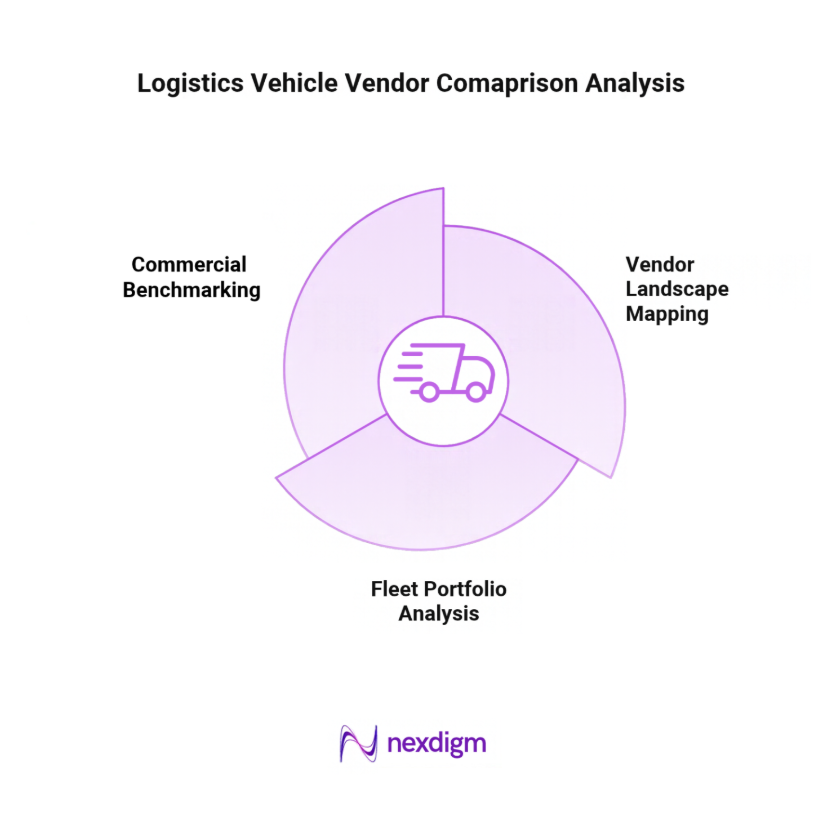
- Vendor Landscape Mapping: Identify relevant vehicle manufacturers and suppliers based on market presence, product portfolios, geographic reach, and target customer segments.
- Fleet Portfolio Analysis: Compare light, medium, and heavy commercial vehicles based on specifications, payload, configurations, and suitability for logistics applications.
- Commercial Benchmarking: Examine available vehicle pricing, financing arrangements, warranty conditions, and other commercial terms to understand differences between vendors.
This research can give procurement teams a consolidated understanding of vendor capabilities and competitive positioning.
Evaluating Vendor Performance Across the Vehicle Lifecycle with Nexdigm
Vendor suitability should also be assessed beyond the initial purchase. A manufacturer’s ability to provide consistent service, technical assistance, and replacement parts can influence vehicle availability and operating continuity over time. Nexdigm can support logistics companies in examining:
- Maintenance Support: Compare vendor service networks, maintenance arrangements, and access to authorised service facilities.
- Parts Availability: Research spare-parts distribution, supplier coverage, and potential availability constraints.
- Warranty and Service Terms: Review warranty coverage, service agreements, and available support provisions.
- Vehicle Replacement Considerations: Examine available information on vehicle lifecycle, resale markets, and replacement options.
These insights can help businesses understand the longer-term implications of choosing different vehicle vendors.
How Experts of Nexdigm Assess Alternative-Fuel and Electric Vehicle Vendors
Changes in commercial vehicle technology are creating additional considerations for fleet procurement. Nexdigm can help businesses compare vendors offering diesel, CNG, hybrid, and electric vehicles by examining product availability, technical capabilities, market presence, and supporting infrastructure.
Research can also assess manufacturer investments, emerging vehicle models, charging or refuelling requirements, and technology developments. This enables logistics companies to understand the alternatives available across suppliers and evaluate their relevance to specific routes, operating costs, and fleet transition plans.
Nexdigm’s Case
A logistics company wanted to evaluate vehicle vendors before expanding its fleet across regional distribution and last-mile delivery operations. With Nexdigm’s assessment, the insights identified 19% potential cost optimization through vendor comparison, 16% scope for improving service coverage, and 13% potential improvement in vehicle-category selection. These insights helped the company refine its vendor shortlist, identify suitable alternatives, and align vehicle sourcing decisions with fleet requirements.
To take the next step, simply visit our Request a Consultation page and share your requirements with us.
Harsh Mittal
+91-8422857704