

India’s logistics network is expanding across transport modes and regions, creating new opportunities for businesses to review their supplier mix. Indian Railways recorded freight loading of 1,670 million tonnes in FY 2025–26, compared with 1,617 million tonnes in the previous year. Major ports handled 915.17 million tonnes during the same period, registering 7.06% year-on-year growth.
The country’s national waterways network has also expanded to 111 waterways, with 32 operational as of 2026. These developments indicate a growing and increasingly connected logistics ecosystem. For businesses, however, access to a wider network does not automatically ensure sourcing flexibility. A structured logistics vendor diversification strategy can help identify alternate providers, assess regional capabilities, and reduce dependence on limited supplier arrangements.
Why a Wider Supplier Base Matters
Relying on a small group of logistics providers can limit a business’s ability to respond to capacity shortages, regional disruptions, service failures, or changing commercial conditions. Diversification helps procurement teams identify additional providers and assess where alternative arrangements may improve flexibility. The objective is not simply to increase vendor numbers, but to build a supplier network that supports operational requirements across locations and transport needs.
Areas to Examine Before Expanding the Vendor Base
Supplier diversification requires more than identifying providers with available capacity. Businesses should assess whether alternatives can meet their operational and commercial requirements:
- Regional Provider Availability: Identify logistics companies operating across key markets and assess their geographic coverage, infrastructure, and ability to support location-specific requirements.
- Commercial and Continuity Suitability: Review pricing structures, contractual flexibility, service reliability, and backup capacity to determine whether alternate providers offer viable sourcing options.
These considerations help businesses distinguish potential suppliers from providers that can genuinely strengthen network flexibility.
Nexdigm’s Strategic Research Support for Expanding Vendor Base
Building on these evaluation areas, Nexdigm’s procurement research and market intelligence capabilities can help businesses examine the wider logistics supplier market. Our research can support the identification of potential providers, comparison of regional capabilities, and assessment of commercial suitability. This enables organisations to move from understanding diversification requirements to exploring relevant sourcing alternatives.
Nexdigm’s Role in Mapping Alternate Supplier Landscape
Nexdigm’s xpert-led capabilities can help businesses understand the logistics supplier market beyond their existing vendor relationships. Our logistics vendor diversification strategy support can cover several areas:
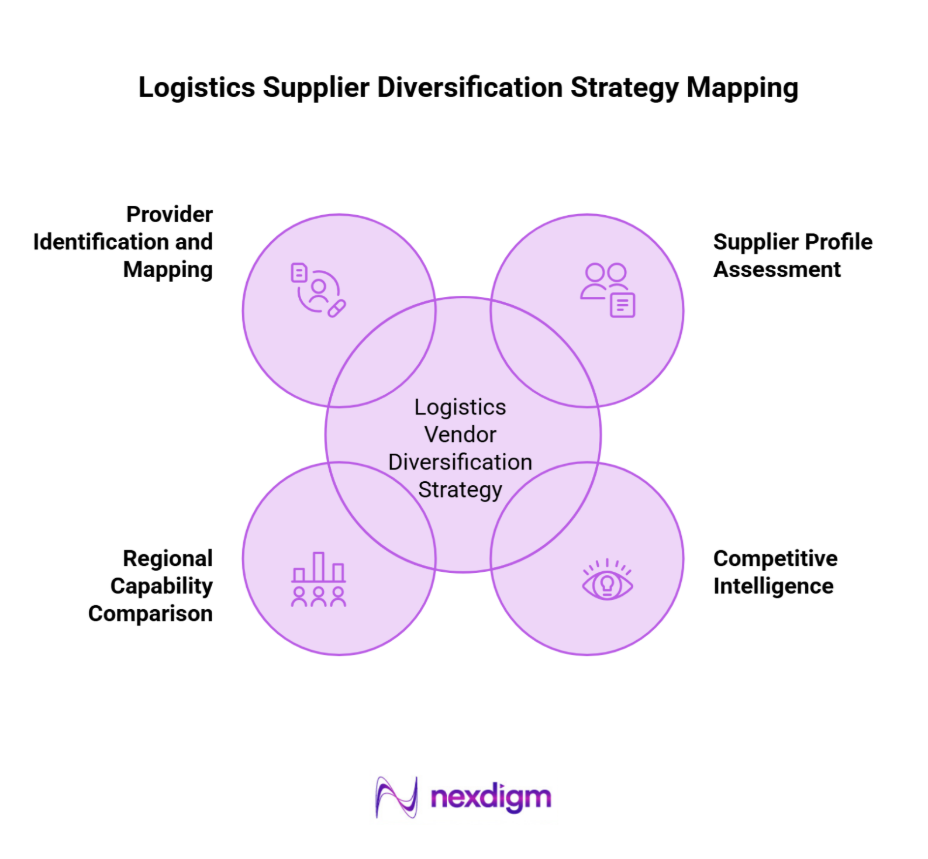
- Provider Identification and Market Mapping: Identify logistics companies across relevant regions, transport categories, and service segments to expand visibility into the available supplier landscape.
- Regional Capability Comparison: Examine provider locations, infrastructure, operating presence, and service coverage to understand where additional sourcing options may be available.
- Supplier Profile Assessment: Research business background, service portfolios, operational capabilities, and market positioning to support an informed review of potential providers.
- Competitive and Commercial Intelligence: Compare available supplier offerings, pricing indicators, service models, and commercial conditions to identify potential sourcing alternatives.
This research gives procurement teams a structured view of the market and helps them shortlist providers for further evaluation.
Procurement Advantages Delivered by Nexdigm’s Analysis
A well-evaluated supplier base can support more than contingency planning. It can also improve the quality of procurement decisions by giving businesses greater visibility into market options. Nexdigm’s research-led analysis and support can help organizations:
- Reduce Supplier Concentration: Identify excessive dependence on individual providers and explore opportunities to broaden the supplier portfolio.
- Improve Regional Coverage: Understand the availability of providers in underserved markets and assess options for strengthening geographic reach.
- Strengthen Negotiating Leverage: Use market comparisons and alternative supplier intelligence to support more informed commercial discussions.
- Increase Operational Flexibility: Evaluate additional capacity and service options that may help businesses respond to changing logistics requirements.
- Support Continuity Planning: Identify potential backup providers and assess their suitability for critical logistics activities.
Together, these outcomes can help organizations build a supplier network that is better aligned with operational priorities and changing market conditions.
Nexdigm’s Case
A regional manufacturing company wanted to expand its distribution network but relied heavily on a small group of logistics providers. Nexdigm’s research mapped potential transport and warehousing suppliers across key markets, comparing regional presence, service capabilities, and commercial offerings. The assessment shortlisted 12 potential providers across 4 regions and identified 3 locations where additional supplier coverage could improve sourcing flexibility.
To take the next step, simply visit our Request a Consultation page and share your requirements with us.
Harsh Mittal
+91-8422857704