

Logistics operations depend on a network of suppliers that perform different but interconnected functions. Transportation providers move goods between facilities, warehouses manage inventory, freight forwarders coordinate international shipments, and courier companies support final delivery.
A disruption involving any of these providers can affect the wider supply chain. However, not every supplier presents the same level of risk. A regional courier operator handling low-priority shipments may have limited business impact, while a specialised freight provider responsible for critical production inputs could represent a significant operational dependency.
For procurement teams, logistics vendor risk assessment consulting helps establish which suppliers require closer attention, where vulnerabilities are concentrated and how risk management resources should be allocated.
Why Logistics Supplier Risk Needs Prioritisation
Many organisations assess suppliers using general risk questionnaires or periodic compliance reviews. While these provide useful information, they may not adequately reflect the operational importance of individual providers.
A supplier’s risk should be evaluated according to both its exposure to disruption and the consequences of that disruption.
For example, a financially stable warehouse operator may still represent a high operational risk if it serves as the only distribution facility for a particular region. Similarly, a transportation provider with extensive capacity may create significant exposure if it depends on a limited number of routes or subcontractors.
Risk prioritisation helps organisations distinguish between suppliers that require routine monitoring and those that need additional controls, contingency arrangements or alternative sourcing options.
Assessing Risk Across Logistics Service Categories
Different logistics categories involve different risk drivers.
Transportation providers may be exposed to fuel price volatility, vehicle availability, route restrictions, workforce shortages and infrastructure disruptions. Their ability to maintain service depends on fleet capacity, maintenance arrangements and access to alternative routes.
Warehousing suppliers face risks associated with facility availability, inventory security, labour dependence, equipment reliability, fire protection and technology systems. A disruption at a critical warehouse can affect inventory access and downstream distribution.
Freight forwarders introduce exposure through carrier relationships, customs processes, documentation accuracy, trade restrictions and international route dependencies.
Courier providers may face risks involving network congestion, delivery workforce availability, failed deliveries, technology outages and subcontractor performance.
Specialised providers, including cold chain operators and hazardous goods handlers, require additional assessment of equipment, handling procedures, technical competence and regulatory compliance.
A category-specific approach makes risk assessment more relevant to the services being purchased.
Evaluating Supplier Financial and Operational Stability
Financial risk is an important part of supplier assessment. Procurement teams should examine available financial statements, liquidity, debt levels, revenue stability and profitability.
A supplier experiencing financial pressure may struggle to maintain equipment, retain employees or invest in operational improvements.
Operational capacity should be assessed against actual business requirements. Relevant factors include facility capacity, fleet availability, workforce strength, technology infrastructure, geographical coverage and peak-period performance.
Businesses should also examine subcontractor dependence. A logistics provider may appear capable of managing a service directly but rely on external operators for important routes or activities.
This creates additional dependencies that should be identified before contracts are awarded or renewed.
Understanding Geographical, Regulatory and Technology Exposure
Logistics suppliers operate within geographical environments that can introduce different levels of risk.
Infrastructure constraints, port congestion, border delays, extreme weather and regional instability can affect service continuity. Procurement teams should identify whether critical suppliers depend on vulnerable locations or transportation corridors.
Regulatory exposure also varies by service and market. Relevant considerations may include transport permits, customs requirements, safety standards, labour regulations, insurance and product-specific handling obligations.
Technology risk has become increasingly important as logistics operations depend on digital platforms for shipment tracking, warehouse management, documentation and delivery coordination.
Supplier assessments should consider system availability, data security, backup arrangements and incident response procedures.
Building a Risk-Based Supplier Prioritisation Model
A practical prioritisation model should evaluate suppliers according to likelihood of disruption, potential business impact and the organisation’s ability to recover.
High-impact suppliers may require more frequent reviews, stronger contractual safeguards and documented continuity arrangements.
Medium-risk suppliers may be monitored through periodic performance and financial assessments, while lower-risk providers can follow standard review schedules.
Risk scoring should also account for existing controls. A supplier operating in a challenging market may still present manageable exposure if it has alternative facilities, sufficient insurance and effective recovery procedures.
The resulting assessment should lead to clear actions rather than simply assigning a risk label.
Logistics Vendor Risk Assessment Framework
A structured logistics vendor risk assessment consulting exercise should include:
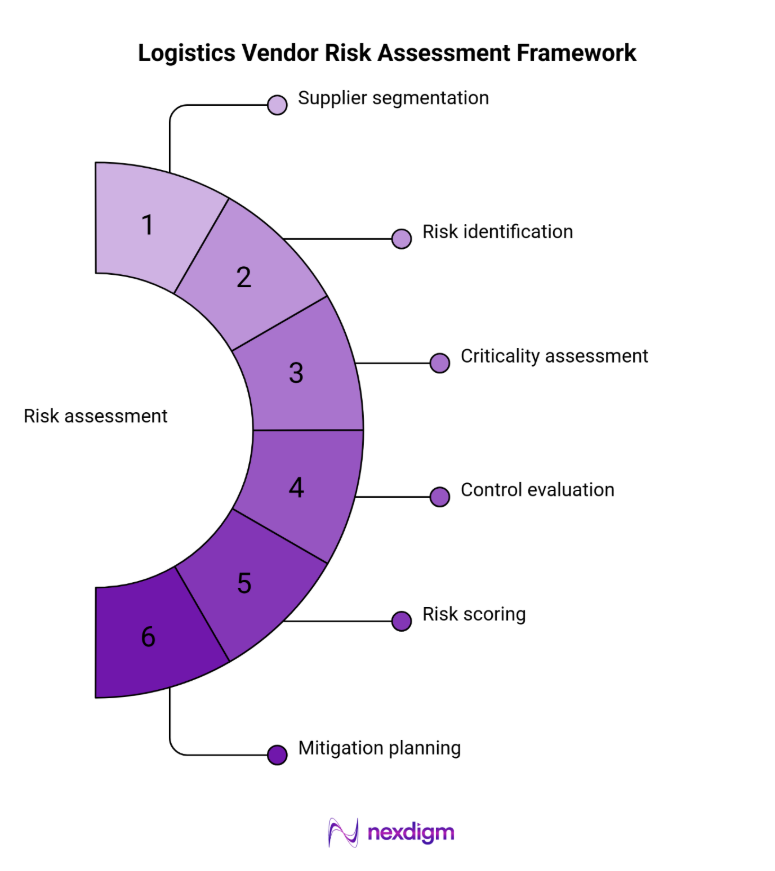
- Supplier segmentation: Classify providers by service category, business criticality, geography and operational dependency.
- Risk identification: Map financial, operational, geographical, regulatory, technology and subcontractor exposure.
- Criticality assessment: Evaluate the business impact of supplier failure, service interruption or capacity loss.
- Control evaluation: Review continuity plans, insurance, compliance records, alternative capacity and recovery procedures.
- Risk scoring: Prioritise suppliers according to disruption likelihood, impact and control effectiveness.
- Mitigation planning: Define monitoring frequency, corrective actions, alternative suppliers and contingency arrangements.
Nexdigm can support organisations through logistics supplier risk research, vendor intelligence, operational and financial assessments, and market-level risk analysis. These services help procurement teams identify critical dependencies, prioritise supplier reviews and strengthen supply chain resilience.
Nexdigm’s Case Study: Prioritising Critical Logistics Supplier Risks
Nexdigm assessed 20 logistics providers across 6 service categories and 5 operating markets. The exercise identified 6 high-priority supplier risks, mapped 8 critical dependencies and developed 7 risk indicators to support procurement monitoring and mitigation planning.
To take the next step, simply visit our Request a Consultation page and share your requirements with us.
Harsh Mittal
+91-8422857704