

India’s transport ecosystem is seeing measurable changes in low-carbon mobility. According to the Ministry of Railways, 99.6% of the broad-gauge railway network had been electrified by July 2026. The ministry also reported that rail transport emits approximately 89% less CO₂ than road transport.
Meanwhile, Vahan-based registration data recorded 20,352 electric trucks and buses in FY 2025–26, representing 113% growth over the previous financial year. These developments are creating new considerations for businesses evaluating freight and logistics partners.
Transport procurement teams need to understand which vendors are investing in cleaner technologies, expanding their capabilities, and offering practical alternatives. Low carbon transport vendor analysis can help organizations compare these capabilities and identify suitable sourcing options.
Low-Carbon Capability Is Becoming a Vendor Selection Factor
Transport providers are increasingly differentiated by their investments in fleet technology, fuel alternatives, network efficiency, and emissions management. However, adopting cleaner vehicles does not automatically make a vendor suitable for every logistics requirement. Businesses must also consider route coverage, freight capacity, service reliability, and infrastructure availability. Assessing these factors together helps procurement teams understand whether a provider can support both sustainability priorities and operational expectations.
What Should Businesses Examine Before Selecting a Low-Carbon Transport Partner?
A useful vendor assessment should focus on capabilities that can influence actual transportation performance. Three considerations provide a practical starting point:
- Availability of Cleaner Transport Modes: Examine electric, CNG, LNG, biofuel-powered, and rail-based freight options to understand the alternatives available for different transportation requirements.
- Infrastructure and Network Readiness: Assess charging facilities, fuel availability, route connectivity, maintenance networks, and regional operating coverage to determine deployment feasibility.
- Operational Performance and Accountability: Compare delivery reliability, vehicle utilisation, load efficiency, fuel consumption, and emissions reporting to evaluate overall supplier suitability.
Together, these considerations help businesses distinguish vendors with practical low-carbon capabilities from those whose sustainability positioning is primarily based on stated commitments.
How Nexdigm Helps Identify High-Capability Low-Carbon Transport Vendors
Nexdigm’s expert-led procurement research and market intelligence capabilities can help businesses understand the competitive landscape of low-carbon transport providers. Through structured supplier research, capability comparisons, and market assessments, Nexdigm’s experts can support procurement teams in identifying vendors that offer relevant transportation solutions while meeting operational and commercial requirements.
Mapping Capabilities Behind Low-Carbon Transport Solutions with Nexdigm
Nexdigm can help businesses examine the supplier landscape through distinct low carbon transport vendor analysis to gain a thorough understanding of factors affecting supplier selection. These areas/factors are:
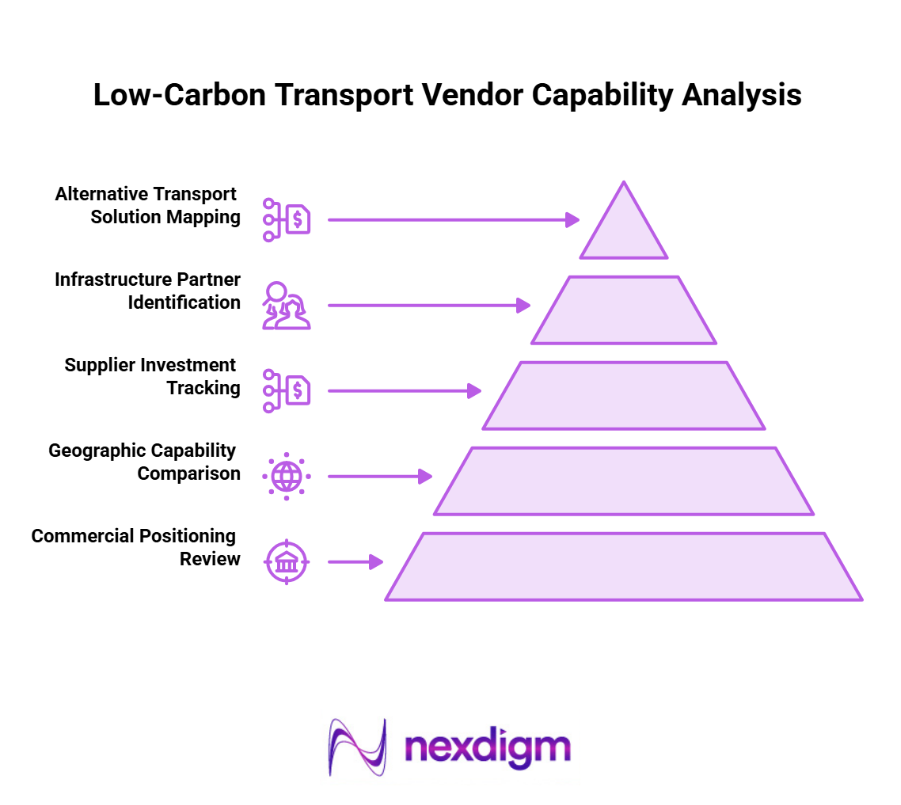
- Alternative Transport Solution Mapping: Identify providers offering electric fleets, alternative-fuel vehicles, rail freight, and other lower-emission transportation services across relevant markets.
- Infrastructure Partner Identification: Research charging network operators, alternative-fuel infrastructure providers, maintenance partners, and other supporting service providers.
- Supplier Investment Tracking: Examine vendor investments in fleet modernisation, cleaner technologies, digital fleet management, and operational efficiency initiatives.
- Geographic Capability Comparison: Compare supplier presence, service coverage, infrastructure access, and transport capacity across target regions.
- Commercial Positioning Review: Evaluate available pricing information, service models, operating capabilities, and commercial terms to understand supplier competitiveness.
This research can help procurement teams build a more comprehensive view of available vendors and identify providers for further evaluation.
Nexdigm’s Vendor Analysis Supporting Procurement Decisions
Nexdigm can help businesses translate market information into practical supplier comparisons by examining environmental capabilities alongside service coverage, operational capacity, and commercial considerations. This integrated perspective can support vendor shortlisting, alternative supplier identification, and periodic market reassessments as low-carbon transport solutions and provider capabilities evolve.
Nexdigm’s Case
A distribution company wanted to identify transport partners capable of supporting its low-carbon logistics plans. Nexdigm’s research assessed 28 providers across regions, comparing alternative-fuel capabilities, fleet investments, infrastructure access, and service coverage. The assessment identified 8 vendors for further evaluation and highlighted 3 regional opportunities for expanding access to lower-emission transport solutions.
To take the next step, simply visit our Request a Consultation page and share your requirements with us.
Harsh Mittal
+91-8422857704