

Low-code adoption expands as enterprises seek faster application development, enabling rapid, visual-driven app creation and quicker deployment cycles. Conducting low-code platform analysis allows organizations to evaluate platform features, scalability, integration, and user adoption, while comparing performance against industry peers. Integrating these insights into competitive intelligence helps businesses identify best practices, understand competitor strategies, and optimize platform selection.
By leveraging benchmarking and market intelligence, enterprises can accelerate development, reduce costs, improve operational efficiency, and maintain a strategic advantage in delivering innovative, digitally enabled applications.
Low‑code platforms are gaining traction, with over 70 % of enterprises reporting active low‑code usage in application development. Analysts estimate the global low‑code market will surpass $52 billion by 2027, growing at a 25 % CAGR, as organizations prioritize speed and agility. Reports also show low‑code can accelerate development cycles by up to 10×, enabling faster delivery and reduced costs compared with traditional coding approaches. Low‑code demand spans industries from finance to healthcare and manufacturing.
Leveraging Competitive Intelligence to Optimize Low-Code Investments
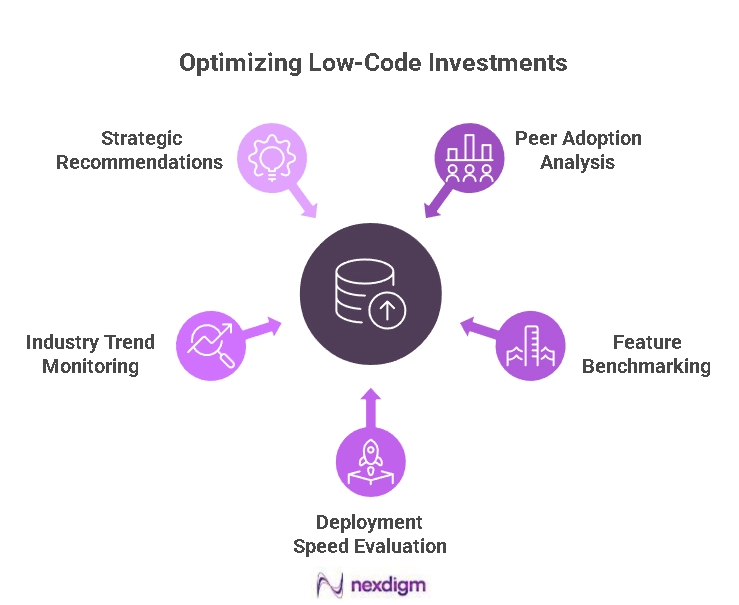
Leveraging Competitive Intelligence to Optimize Low-Code Investments involves analyzing peer platform adoption, features, and deployment strategies to guide selection, improve application delivery speed, reduce costs, and maximize development ROI:
-
Analyzing Peer Low-Code Adoption
Reviews competitor platform usage, deployment strategies, and success metrics to identify best practices and improvement opportunities.
-
Benchmarking Platform Features and Capabilities
Compares scalability, integration, and usability to ensure selected low-code platforms meet enterprise development and operational requirements.
-
Assessing Deployment Speed and Efficiency
Evaluates time-to-market improvements and workflow automation to optimize application delivery and accelerate digital transformation initiatives.
-
Monitoring Industry Trends and Innovations
Tracks emerging low-code tools, automation enhancements, and development trends to guide strategic investment decisions.
-
Competitive Insights into Strategic Recommendations
Converts analysis into actionable guidance for platform selection, deployment planning, and maximizing ROI from low-code adoption.
Nexdigm Competitive Intelligence for Low-Code Platform Selection
Nexdigm Competitive Intelligence for Low-Code Platform Selection helps organizations make informed decisions by analyzing platform capabilities, adoption trends, integration flexibility, and deployment success across industry peers. By benchmarking against competitors, Nexdigm identifies the most suitable low-code platforms, highlights best practices, and uncovers gaps in current processes. This approach optimizes platform selection, accelerates application development, improves operational efficiency, and maximizes ROI.
Nexdigm Rapid Application Development Optimization Services
Nexdigm Rapid Application Development Optimization Services streamline low-code development by enhancing workflow automation, reducing deployment time, improving collaboration, and accelerating application delivery, ensuring faster time-to-market and measurable operational efficiency.
-
Workflow Automation Enhancement
Optimizes development pipelines and repetitive processes to reduce manual effort, accelerate builds, and improve application delivery speed.
-
Collaboration and Team Productivity Improvement
Enhances cross-functional communication, project tracking, and coordination to streamline development and reduce bottlenecks.
-
Deployment Acceleration and Efficiency
Implements strategies to shorten release cycles, minimize errors, and ensure faster, more reliable application deployment.
-
Platform Performance and Scalability Assessment
Evaluates low-code tools’ capacity to support complex applications and future growth for optimized enterprise performance.
-
Continuous Process Monitoring and Improvement
Tracks development metrics and adoption trends to identify gaps, refine processes, and maximize ROI from rapid application development.
Nexdigm’s case:
Nexdigm helped a large logistics enterprise, for rapid application development optimization services accelerated low‑code project delivery by 60 %, reducing average release cycles from eight weeks to three weeks. Workflow automation improvements cut manual errors by 45 %, and enhanced collaboration tools raised team productivity by 30 %. These outcomes improved time‑to‑market for customer‑facing applications and delivered measurable operational gains.
To take the next step, simply visit our Request a Consultation page and share your requirements with us.
Harsh Mittal
+91-8422857704