

Enterprise IT teams rarely run out of applications to build. They run out of development capacity. Internal workflow requests, approval systems, operational dashboards, customer portals, and data-entry applications compete with the engineering resources needed for core products and revenue-generating platforms.
Low-code development addresses part of this constraint by abstracting recurring development tasks such as interface construction, workflow configuration, database connectivity, and API integration. Microsoft reports that a Forrester study of Power Apps modelled a 206% three-year ROI for a composite enterprise, while a newer commissioned Forrester study for OutSystems reports 363% ROI and payback in under six months. These are vendor-commissioned studies and should therefore be treated as indicative business cases rather than universal returns.
The commercial question is therefore less about whether low-code is useful and more about where it creates sufficient productivity without compromising application architecture.
Start With the Workload, Not the Platform
Low-code is particularly effective when an application is built around defined processes rather than highly specialised computation.
Internal approval workflows, employee-facing applications, case management tools, departmental request systems, operational dashboards, and straightforward customer portals often share characteristics that make them suitable. Their logic is relatively structured, user roles are clearly defined, data is commonly stored in relational systems, and integrations can usually be handled through standard APIs or connectors.
These characteristics allow a platform to remove repetitive development effort without requiring the organisation to surrender control over the underlying business process.
Complexity Is Where the Advantage Starts to Narrow
An application can begin as a simple low-code workflow and gradually become something much harder to maintain.
As requirements accumulate, developers may introduce custom scripts, specialised integrations, complex data transformations, bespoke interfaces, or increasingly elaborate business rules. At that point, the organisation is still paying for the platform while recreating many of the complexities that conventional development was designed to handle.
The suitability assessment therefore needs to examine how much of the application’s logic can remain within standard platform capabilities.
High-volume transaction processing, specialised algorithms, extreme concurrency, latency-sensitive workloads, and applications requiring extensive control over runtime behaviour are more likely to require conventional software engineering.
Customer-Facing Does Not Automatically Mean Unsuitable
External applications often receive more scrutiny because they affect customers directly. Yet a customer portal with predictable workflows, standard authentication, structured data and moderate transaction volumes can be an effective low-code candidate.
The more useful distinction is between conventional complexity and architectural complexity.
A self-service portal for submitting service requests may fit naturally within a low-code environment. A global consumer platform requiring highly customised rendering, massive concurrency, real-time computation and specialised security controls is a different proposition.
This distinction matters because application classification determines the appropriate technology architecture before development expenditure begins.
Governance Determines Whether Speed Lasts
Low-code also changes who can build applications. That can accelerate delivery, but it introduces another management problem.
Business teams may create applications without permanent ownership, documentation or lifecycle controls. Applications can accumulate redundant data connections, unmanaged credentials, inconsistent access permissions and dependencies that become difficult to identify when their original creators move roles.
Governance therefore needs to cover application ownership, environment controls, data access, integration standards, security, version management and retirement.
A low-code portfolio without these controls can simply replace an IT backlog with a maintenance backlog.
A Workload Suitability Test Can Prevent Expensive Misclassification
Nexdigm’s low code platform market opportunity analysis can evaluate application opportunities through a structured suitability framework:
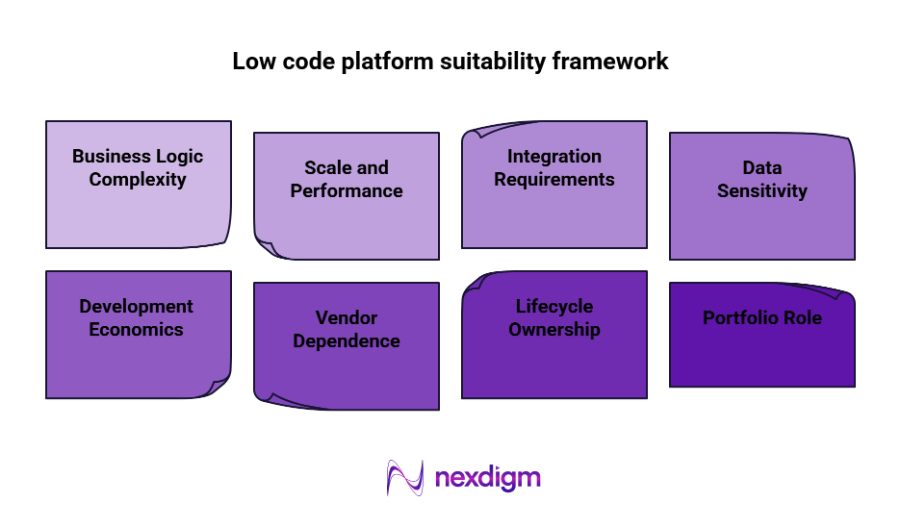
- Business Logic Complexity: Determines whether workflows can be implemented using standard rules or require substantial custom code and extensions.
- Scale and Performance: Assesses transaction volumes, concurrency, response-time requirements and expected growth to identify applications that may outgrow platform constraints.
- Integration Requirements: Maps ERP, CRM, database, API and legacy-system dependencies to understand implementation complexity.
- Data Sensitivity: Evaluates confidential, regulated and commercially sensitive information and the controls required around access, storage and auditability.
- Development Economics: Compares platform licensing, development effort, maintenance requirements and expected productivity gains against conventional development.
- Vendor Dependence: Examines portability, platform-specific dependencies, pricing exposure and the practical difficulty of migrating applications later.
- Lifecycle Ownership: Establishes who will maintain, secure, enhance and eventually retire the application.
- Portfolio Role: Distinguishes tactical departmental applications from systems that should remain part of the enterprise’s core technology architecture.
The resulting portfolio can classify workloads into three broad decisions: build with low code, use a hybrid architecture, or retain conventional development.
Case Study: Automation With Controls Built In
Nexdigm helped a healthcare client implement a distributor-claims portal across India. The intervention reduced claims-processing turnaround time from 30 days to 5 days, a 45% reduction in time spent by approvers and processors and brought the defect rate down from 100,000 DPMO to zero. Process controls also eliminated the identified fraud risk, with potential savings of USD 1.2 billion.
Harsh Mittal
+91-8422857704