

Enterprise application development is under pressure to deliver more functionality without allowing technology backlogs to grow indefinitely. Business teams need internal applications, approval systems, reporting interfaces and customer-facing tools, while IT departments must maintain security, integration and architectural consistency. Traditional development remains essential for complex systems, but not every business requirement needs to begin with a lengthy custom coding project.
Low-code platforms offer an alternative by providing visual development environments, reusable components and prebuilt integrations. However, rapid application development is only one part of the procurement decision. A low code platform vendor research exercise helps organisations understand which suppliers can support application delivery while maintaining security, scalability, governance and long-term maintainability.
Why Low-Code Procurement Needs a Clear Scope
Low-code products vary considerably in their intended use. Some are designed for departmental applications and workflow automation, while others support enterprise application development, customer portals and complex integrations. No-code tools may offer even simpler interfaces, but they can impose greater limitations when applications require custom logic or specialised functionality.
The first step is therefore to identify the applications the organisation intends to build. Internal request forms, employee onboarding tools and approval workflows may require different capabilities from customer-facing applications or systems handling sensitive financial information.
The distinction matters because a platform that performs well for a small departmental workflow may not be suitable for applications requiring high availability, complex data models or extensive integration with enterprise systems.
The Capabilities That Separate Low-Code Vendors
Development environment and usability
Visual development tools should make application creation more accessible without restricting professional developers. Procurement teams should assess interface design, component reuse, debugging, testing and the ability to extend applications with custom code.
A useful evaluation involves asking both business users and developers to build or modify a representative application. This reveals whether the platform genuinely accelerates development or simply moves complexity into configuration and troubleshooting.
Integration and data management
Enterprise applications rarely operate independently. They need to exchange information with ERP, CRM, HR, finance and other business systems. Vendors should be assessed on API connectivity, prebuilt connectors, database support, authentication methods and integration monitoring.
Data architecture deserves particular attention. Organisations should understand where application data is stored, how it is synchronised, what controls are available and whether the platform can support existing data governance policies.
Security and governance
Low-code development can increase the number of people creating applications. Without appropriate controls, this can lead to duplicated data, inconsistent access permissions and applications operating outside approved IT processes.
Supplier evaluation should cover role-based access, identity integration, encryption, audit logs, environment separation, application lifecycle management and security testing. Organisations should also examine whether administrators can monitor applications developed by different teams and prevent unauthorised deployment.
Scalability and performance
Applications that begin with a small user group may eventually become business-critical. Procurement teams should assess how the platform handles increasing users, transaction volumes, data growth and integration workloads.
Performance testing should reflect realistic conditions. Vendors should explain infrastructure dependencies, capacity limits, availability commitments and the cost implications of scaling applications.
Licensing and long-term flexibility
Commercial models can differ significantly. Some platforms charge by user, application, developer, environment or resource consumption. Organisations should model expected costs across multiple deployment scenarios rather than rely on the initial subscription quote.
They should also examine application portability, source-code access where applicable, data export, customisation limits and exit provisions. A platform that accelerates initial development but makes applications difficult to maintain or migrate can create long-term dependency.
Evaluating the Market Through Practical Use Cases
A supplier comparison becomes more meaningful when vendors are evaluated against the same application requirements. For example, an organisation might select one internal approval process, one data-driven reporting application and one customer-facing workflow as test scenarios.
Each vendor can then be assessed on development time, integration effort, security configuration, user experience and ongoing administration. The exercise should include changes to business rules after the initial application is built. This helps reveal how easily applications can adapt when requirements evolve.
The assessment should also distinguish between platform functionality and implementation partner capability. A low-code product may offer extensive features, but successful deployment can depend on architecture design, application governance and integration expertise.
Organisations should establish who will build applications, who will approve them and who will maintain them after deployment. A centre of excellence or equivalent governance function can help define development standards, reusable components and escalation processes without preventing business teams from addressing routine needs.
Balancing Speed with Enterprise Control
The strongest low-code strategy does not treat development speed as the only objective. Applications need to remain secure, reliable and maintainable after the initial project is completed.
IT departments should establish clear rules for application classification. Low-risk departmental tools may follow a lighter approval process, while applications handling sensitive data or supporting critical business operations should undergo more extensive architecture, security and testing reviews.
This approach allows organisations to gain the productivity benefits of low-code development without turning every business function into an independent software environment.
How Nexdigm Supports Low-Code Platform Research
Nexdigm supports technology procurement through market research, supplier intelligence, competitive benchmarking and commercial analysis. Its research can help organisations map low-code providers, compare platform capabilities, assess licensing structures and understand supplier positioning against enterprise application requirements.
Low-Code Platform Vendor Evaluation Framework
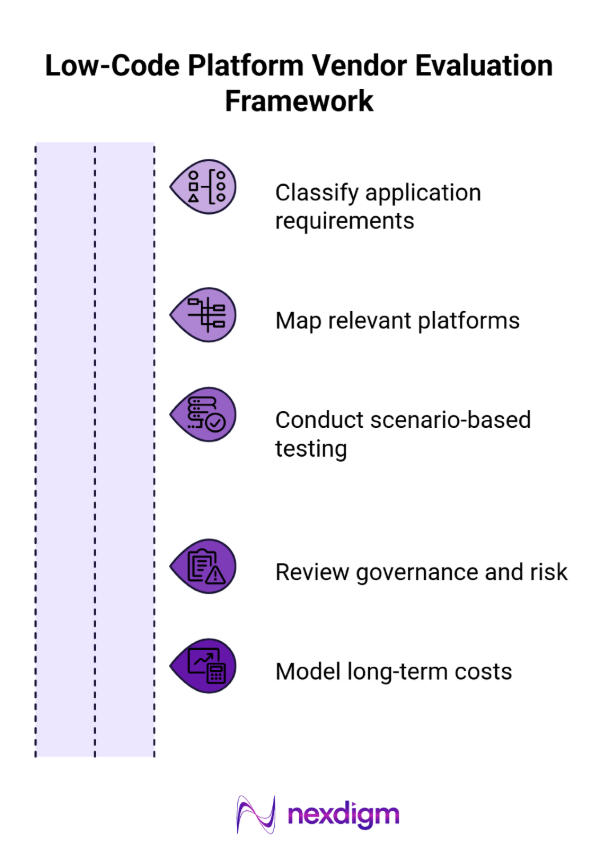
- Classify application requirements: Identify intended users, application complexity, data sensitivity and business criticality.
- Map relevant platforms: Compare suppliers by development model, enterprise focus, industry coverage and deployment options.
- Conduct scenario-based testing: Evaluate development speed, integration effort, usability and performance using consistent use cases.
- Review governance and risk: Assess security, application lifecycle management, data controls and vendor dependency.
- Model long-term costs: Compare licensing, implementation, administration, training and scaling requirements.
Nexdigm’s Case Study: Evaluating Low-Code Application Platforms
Nexdigm compared nine low-code providers across 16 technical and commercial criteria, tested their suitability against six enterprise application scenarios and shortlisted three platforms based on development flexibility, integration capabilities and governance requirements.
To take the next step, simply visit our Request a Consultation page and share your requirements with us.
Harsh Mittal
+91-8422857704