

Luxury retail pricing feasibility analysis helps premium brands determine whether proposed prices reflect customer expectations, brand equity, product exclusivity, and commercial goals across different markets. Through practical Pricing Strategy Analysis, businesses can evaluate willingness to pay, competitor positioning, regional purchasing power, channel costs, and demand sensitivity before making launch or expansion decisions.
This approach helps brands protect prestige while avoiding overpricing, unnecessary discounting, or missed margin opportunities. It also supports clearer price architecture, stronger customer value, and more consistent profitability across products, channels, customer segments, and international luxury markets worldwide.
Luxury remains a high-value but demanding market. The personal luxury goods generated about €358 billion in 2025, while LVMH reported a 23.1% operating margin for 2024. These figures show why disciplined pricing analysis matters for protecting exclusivity, customer demand, and profitability.
Strategic Luxury Retail Pricing Analysis for Brand Value and Margin Growth
Strategic luxury retail pricing analysis helps premium brands align exclusivity, customer value, market positioning, and profitability while strengthening price confidence, protecting margins, and supporting sustainable growth across global markets. Its advantages are as follows:
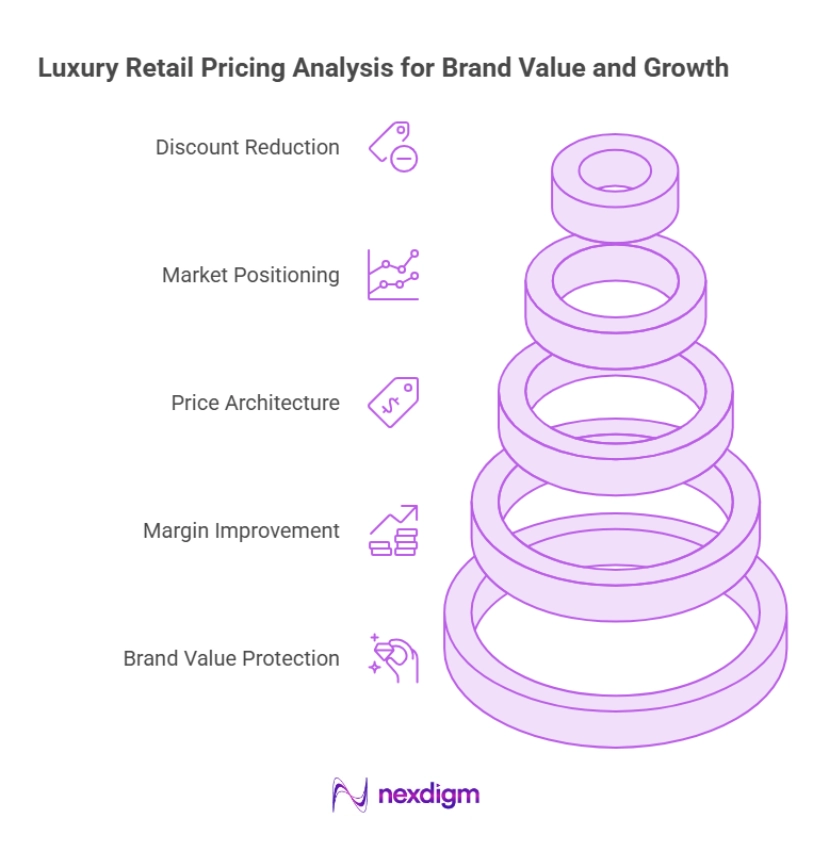
- Stronger Brand Value Protection: Pricing analysis ensures prices reflect exclusivity, craftsmanship, heritage, and customer perception, helping luxury brands preserve prestige while avoiding discounting that may weaken long-term brand equity.
- Improved Margin Performance: By assessing costs, customer willingness to pay, channel economics, and competitive positioning, brands can identify pricing opportunities that improve margins without reducing perceived product value.
- Clearer Price Architecture: Structured pricing creates logical distinctions across entry, core, premium, and limited-edition products, making customer choices easier while strengthening value perception and portfolio profitability across categories.
- Better Market Positioning: Competitor benchmarking and regional demand analysis help luxury brands maintain relevant price points, differentiate effectively, and avoid pricing gaps that could weaken market credibility or demand.
- Reduced Discount Dependency: Understanding demand sensitivity and perceived value allows brands to set stronger initial prices, improve full-price sales, and reduce reliance on promotions that may dilute exclusivity significantly.
Nexdigm’s Expertise in Luxury Price Benchmarking and Demand Analysis
Nexdigm helps premium brands make informed pricing decisions through Luxury Retail Pricing Analysis, Luxury Price Benchmarking, Demand Analysis, and Pricing Strategy Analysis. By evaluating customer willingness to pay, competitor positioning, regional price differences, product exclusivity, channel economics, and demand sensitivity, Nexdigm develops data-driven luxury pricing strategies that protect brand equity, improve margins, strengthen market positioning, and support sustainable growth across global markets.
Nexdigm’s Integrated Model for Luxury Pricing and Market Demand
Nexdigm’s integrated model connects brand value, customer demand, market intelligence, and commercial economics to guide luxury pricing decisions that protect exclusivity, strengthen margins, and support sustainable global business growth. Its major steps include:
- Decode Luxury Purchase Motivations: Examination of status, craftsmanship, rarity, heritage, experience, and emotional appeal to understand why customers buy and which value drivers can support premium pricing across global markets.
- Establish Prestige Price Boundaries: Defining acceptable pricing floors, target levels, and prestige ceilings using brand equity, customer expectations, competitive references, and margin requirements for each product category and market.
- Evaluate Demand by Client Segment: Assessing demand across loyal clients, aspirational buyers, collectors, tourists, and digital shoppers to identify segment-specific sensitivity, purchase frequency, and potential for premium upgrades across markets.
- Align Prices Across Global Markets: Comparing taxes, currencies, purchasing power, travel retail, channel costs, and cross-border price gaps to maintain consistency while reflecting local market realities and customer expectations appropriately.
- Protect Scarcity and Product Exclusivity: Using availability, limited editions, launch timing, distribution control, and product storytelling to support premium prices without increasing supply or weakening perceived rarity among target customers.
Nexdigm’s Case
A luxury retailer engaged Nexdigm to align pricing across products, customer segments, and international markets. The analysis increased full-price revenue by 13%, improved average transaction value by 11%, reduced cross-market price gaps by 17%, and raised premium-product conversion by 8%, strengthening brand consistency, margins, and demand across priority markets.
To take the next step, simply visit our Request a Consultation page and share your requirements with us.
Harsh Mittal
+91-8422857704