

Machine learning platforms involve complex cost structures spanning compute capacity, model training, inference, storage, deployment, and ongoing workload management. Machine learning platform pricing benchmarking helps businesses compare provider rates, normalize infrastructure configurations, evaluate training economics, and assess deployment costs across competing platforms.
Through pricing analysis services, organizations can identify cost gaps, benchmark usage-based charges, optimize workload placement, and strengthen commercial negotiations. Supported by machine learning pricing analysis, businesses can improve spending efficiency, protect margins, and make more informed platform selection and monetization decisions.
Where comparable machine learning workloads show 15%–30% cost variation across compute, training, and deployment environments, structured Pricing Analysis Services can reveal meaningful optimization opportunities and enhance long-term ML workload economics.
Pricing Analysis for Machine Learning Workload and Deployment Efficiency
Machine learning pricing analysis evaluates compute intensity, training requirements, inference demand, deployment architecture, and platform costs to help businesses improve workload economics, provider selection, scalability, and overall operational efficiency. Its major dimensions in focus are:
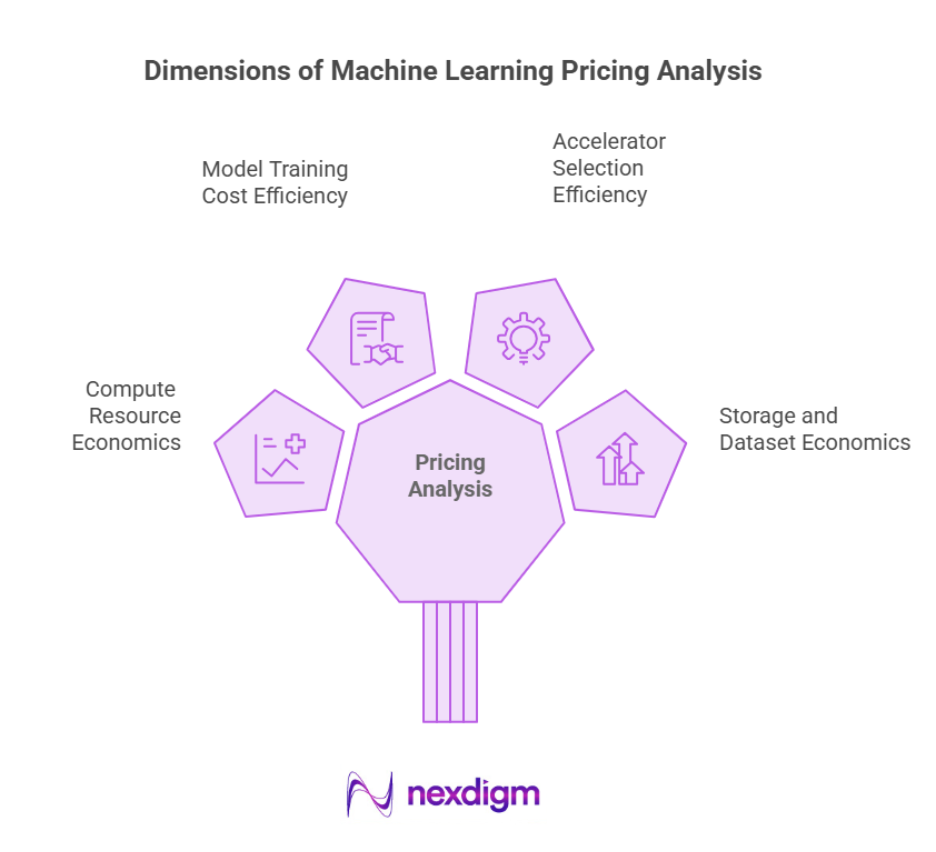
- Compute Resource Economics: Comparison of CPU, GPU, accelerator, memory, and processing requirements across workloads to understand infrastructure cost differences and select economically appropriate resources for machine learning operations.
- Model Training Cost Efficiency: Assessment of training duration, dataset size, compute consumption, experimentation frequency, and hardware requirements to identify opportunities for reducing model development and retraining expenses.
- Storage and Dataset Economics: Comparison of dataset storage, checkpoint retention, feature stores, model artifacts, and backup requirements to identify cost-efficient storage approaches across the ML lifecycle.
- Accelerator Selection Efficiency: Analysis of GPU, TPU, and specialized accelerator pricing against workload performance to determine which hardware configurations deliver stronger cost-to-performance outcomes.
Nexdigm’s Assistance in Machine Learning Pricing and Infrastructure Optimization
Nexdigm helps businesses strengthen machine learning economics through data-driven pricing analysis services across compute, training, inference, and deployment environments. Combining machine learning platform pricing benchmarking, ML pricing analysis, compute cost benchmarking, training cost analysis, inference pricing, deployment cost optimization, workload economics, vendor pricing intelligence, and infrastructure cost analysis, Nexdigm supports efficient spending, smarter platform selection, and scalable ML operations.
Nexdigm’s Machine Learning Economics Blueprint for Training and Optimization
Nexdigm’s strategic ML economics blueprint integrates workload intelligence, infrastructure benchmarking, lifecycle costs, and deployment analysis to help businesses optimize machine learning spending, scalability, and long-term operational efficiency. The blueprint model follows strategies to help business grow; these strategies are:
- Deployment Model Strategy: Compare managed, serverless, dedicated, containerized, and hybrid environments to identify deployment structures that provide stronger cost, scalability, and operational flexibility.
- Lifecycle Cost Strategy: Assess experimentation, training, validation, deployment, monitoring, retraining, and retirement costs to improve visibility and control across the complete machine learning lifecycle.
- Compute Right-Sizing Strategy: Match CPU, GPU, accelerator, and memory configurations with workload requirements to reduce overprovisioning and improve cost efficiency across training and production environments.
- Training Efficiency Strategy: Analyze training duration, dataset size, experimentation cycles, and resource utilization to identify opportunities for lowering development costs without compromising model performance.
Nexdigm’s Case
Nexdigm supported an enterprise in benchmarking machine learning compute, training, and deployment economics. The engagement identified opportunities for lower training costs, 16% improved infrastructure utilization, and 12% lower deployment expenses, strengthening scalability, workload efficiency, and long-term ML economics.
To take the next step, simply visit our Request a Consultation page and share your requirements with us.
Harsh Mittal
+91-8422857704