

Machine learning initiatives require more than access to algorithms or computing resources. Organisations need a technology environment that supports data preparation, model development, experimentation, deployment, monitoring and ongoing improvement. As machine learning moves into operational applications, the choice of technology suppliers can influence development speed, model reliability, infrastructure expenditure and the ability to scale across business functions.
The market includes cloud-based machine learning services, open-source frameworks, data science platforms, model management tools and specialised MLOps providers. These suppliers may address different stages of the machine learning lifecycle, making direct comparisons difficult without a clear understanding of the organisation’s requirements.
A structured machine learning technology supplier benchmarking exercise helps enterprises assess the capabilities available across the market and identify solutions that can support both development teams and production environments.
The Machine Learning Lifecycle Determines What Enterprises Need to Buy
Machine learning projects involve several connected stages. Supplier evaluation should consider the entire lifecycle rather than focusing only on model development.
The process begins with data preparation, where information is collected, cleaned, transformed and made suitable for training. Development teams then select algorithms, train models, evaluate performance and refine parameters.
Once a model is approved, it needs to be deployed into an application or operating environment. Its performance must then be monitored to detect issues such as data drift, changing accuracy, latency or unexpected behaviour.
This creates demand for platforms that can support:
- Data preparation and feature engineering.
- Model development, experimentation and training.
- Model evaluation, versioning and reproducibility.
- Deployment through APIs, batch processing or edge environments.
- Monitoring, retraining and lifecycle governance.
A supplier may offer strong development tools but limited production monitoring. Another may provide a comprehensive MLOps environment while relying on external services for data preparation. These differences should be visible in the procurement assessment.
Model Development: Evaluating the Tools Available to Data Teams
Development environments influence how quickly teams can build and test machine learning models.
Buyers should examine support for programming languages, machine learning frameworks, notebooks, automated experimentation, distributed training and access to specialised computing resources.
The platform should also support collaboration between data scientists, engineers and business stakeholders. Shared workspaces, experiment tracking and reproducibility can help teams understand how models were developed and why particular versions were approved.
Procurement teams should distinguish between native capabilities and integrations with external frameworks. This is especially important for organisations that want to avoid unnecessary dependence on a single proprietary development environment.
MLOps: Moving Models From Experiments Into Production
MLOps brings software engineering and operational discipline into the machine learning lifecycle. It supports repeatable deployment, version control, monitoring and collaboration between development and operations teams.
This area deserves particular attention because a model that performs well during testing may behave differently when exposed to live data.
Supplier benchmarking should examine:
- Experiment tracking and model registry: Can teams record experiments, compare model versions and manage approved models?
- Deployment automation: Does the platform support repeatable release processes, APIs, containers and rollback procedures?
- Monitoring and governance: Can teams track accuracy, latency, data drift, model performance and access permissions?
- Retraining and lifecycle management: Can models be updated when data patterns change, and are approval processes documented?
A mature MLOps environment should help enterprises manage models throughout their operational life rather than treating deployment as the end of the project.
Scalability and Infrastructure Economics
Machine learning workloads can have very different infrastructure requirements. Some models can be trained on conventional computing resources, while others require specialised accelerators, distributed processing or large-scale storage.
Supplier comparisons should account for processing capacity, GPU availability, storage performance, networking, workload scheduling and regional infrastructure availability.
The cost model should reflect both training and inference. Training may involve concentrated periods of high computing demand, whereas inference costs can accumulate through repeated model usage in production applications.
Other cost components may include data storage, data transfer, managed services, model monitoring and technical support.
Enterprises should model different workloads and usage patterns to understand whether a supplier’s pricing remains competitive as deployment scales. A low initial development cost may not translate into an economical production environment.
Integration With Enterprise Data and Applications
Machine learning platforms need access to data from multiple sources, including databases, data warehouses, business applications and external systems.
Procurement teams should assess supported connectors, APIs, data formats, access controls and compatibility with the organisation’s existing data architecture.
Integration should also extend to business applications that consume model outputs. A predictive model may need to connect with an ERP system, customer platform or operational dashboard. If this requires extensive custom development, the cost and complexity of implementation can increase.
Data governance is another important consideration. Suppliers should be evaluated on encryption, permissions, lineage, audit trails and the ability to maintain appropriate controls over sensitive information.
Choosing Between Integrated Platforms and Specialist Tools
An integrated machine learning platform can simplify procurement and lifecycle management by bringing development, deployment and monitoring capabilities together. However, it may create dependence on proprietary tools or limit flexibility for teams using different frameworks.
Specialist suppliers can offer stronger functionality in areas such as experiment tracking, feature management, model monitoring or deployment automation. The trade-off is that enterprises may need to manage additional integrations and supplier relationships.
The appropriate approach depends on existing technical capabilities, model complexity, data architecture and the number of teams expected to use the platform.
Machine Learning Technology Supplier Evaluation Framework
The following assessment connects supplier capabilities to the full machine learning lifecycle:
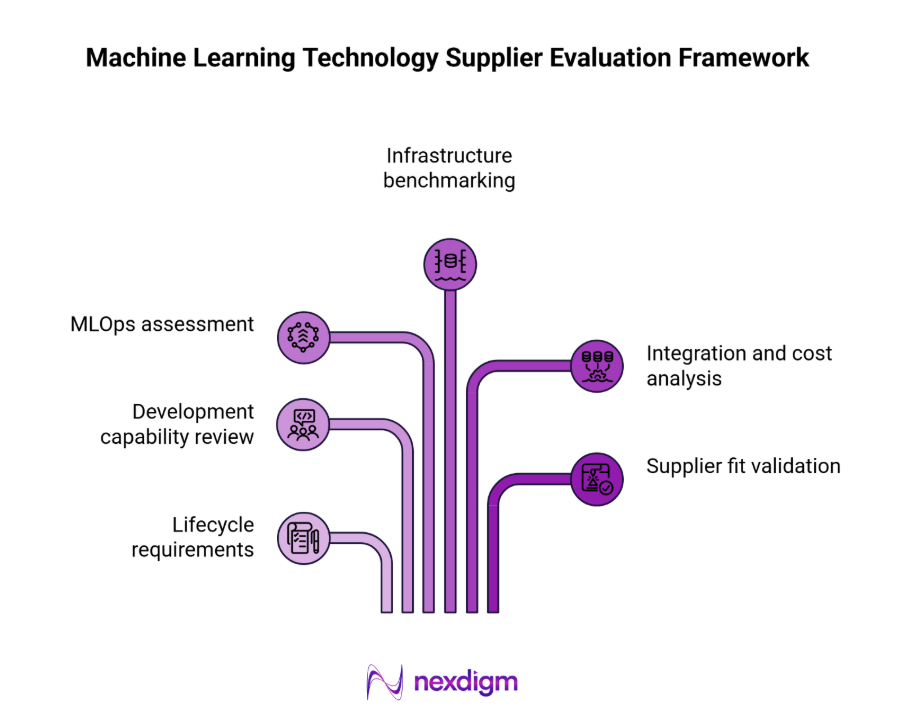
- Lifecycle requirements: Document data preparation, development, deployment, monitoring and retraining needs.
- Development capability review: Compare frameworks, experimentation tools, computing resources and collaboration features.
- MLOps assessment: Evaluate model registries, deployment automation, monitoring, version control and governance.
- Infrastructure benchmarking: Compare compute capacity, accelerator availability, storage, networking and scalability.
- Integration and cost analysis: Examine data connectivity, application compatibility, training and inference costs, and ongoing platform expenditure.
- Supplier fit validation: Test shortlisted platforms against representative workloads and assess long-term operational flexibility.
Nexdigm can support organisations through machine learning technology market research, supplier benchmarking, MLOps capability assessment and commercial analysis. These services help enterprise buyers compare platform providers, understand the competitive landscape and identify technology partners suited to their machine learning requirements.
Nexdigm’s Case Study: Comparing Machine Learning Technology Suppliers
Nexdigm assessed 13 machine learning technology suppliers across 5 lifecycle capabilities, comparing development, MLOps, infrastructure, integration and pricing. The study identified a 22% variation in comparable platform costs, shortlisted 4 providers and established 8 technical and commercial benchmarks.
To take the next step, simply visit our Request a Consultation page and share your requirements with us.
Harsh Mittal
+91-8422857704