

Machine tool demand is being reshaped by manufacturing expansion, automation, capacity additions, and replacement of aging production assets. Global machine tool consumption reached approximately $84.2 billion in 2024, while production was valued at around $90.1 billion, according to the latest available World Machine Tool Survey data.
Asia remains the dominant demand center, accounting for roughly two-thirds of global machine tool consumption, reflecting its concentration of automotive, electronics, engineering, and industrial production. Meanwhile, manufacturers are increasingly investing in CNC equipment, automation, and digitally enabled machinery to improve precision and productivity.
These trends make application-level demand, capital expenditure cycles, equipment replacement requirements, and regional manufacturing investment increasingly important for identifying where machine tool suppliers can capture the strongest growth opportunities.
Understand Where Machine Tool Demand Is Concentrating
Demand is increasingly concentrated in industries where manufacturers are expanding capacity, improving precision, or modernizing production. Automotive, aerospace, electronics, energy, and general engineering remain important application areas. At the same time, CNC, multi-axis, automated, and digitally connected machine tools are gaining importance as manufacturers seek higher productivity, greater flexibility, improved quality, and more efficient use of production assets.
Capex and Replacement Cycles Shaping the Opportunity
Machine-tool demand depends not only on market growth but also on manufacturers’ capital expenditure and equipment replacement cycles. New production facilities, capacity expansions, aging machinery, and technology upgrades can create distinct purchasing opportunities. Understanding these investment triggers helps machine-tool suppliers identify when demand is most likely to translate into equipment purchases and where commercial opportunities may emerge.
Nexdigm’s Approach to Identifying High Potential Machine Tool Demand
Identifying where machine-tool demand is growing is only the first step. Nexdigm helps manufacturers interpret these demand signals in the context of customer applications, capital spending patterns, replacement needs, competitive positioning, and market attractiveness.
Rather than viewing applications, regions, and end-use industries separately, Nexdigm connects these factors to reveal where demand is most likely to translate into actual equipment purchases. This helps machine-tool businesses identify priority markets, high-value applications, customer segments, and investment windows where their capabilities can create stronger commercial opportunities.
The approach provides a practical bridge between market intelligence and revenue-focused decision-making, helping businesses determine where to compete, what opportunities to pursue, and how to prioritize growth investments.
Nexdigm’s Machine Tools Market Opportunity Assessment
Nexdigm’s Machine tools market opportunity assessment helps manufacturers move from identifying demand pockets to determining which opportunities deserve commercial focus. The assessment focuses on the following key areas:
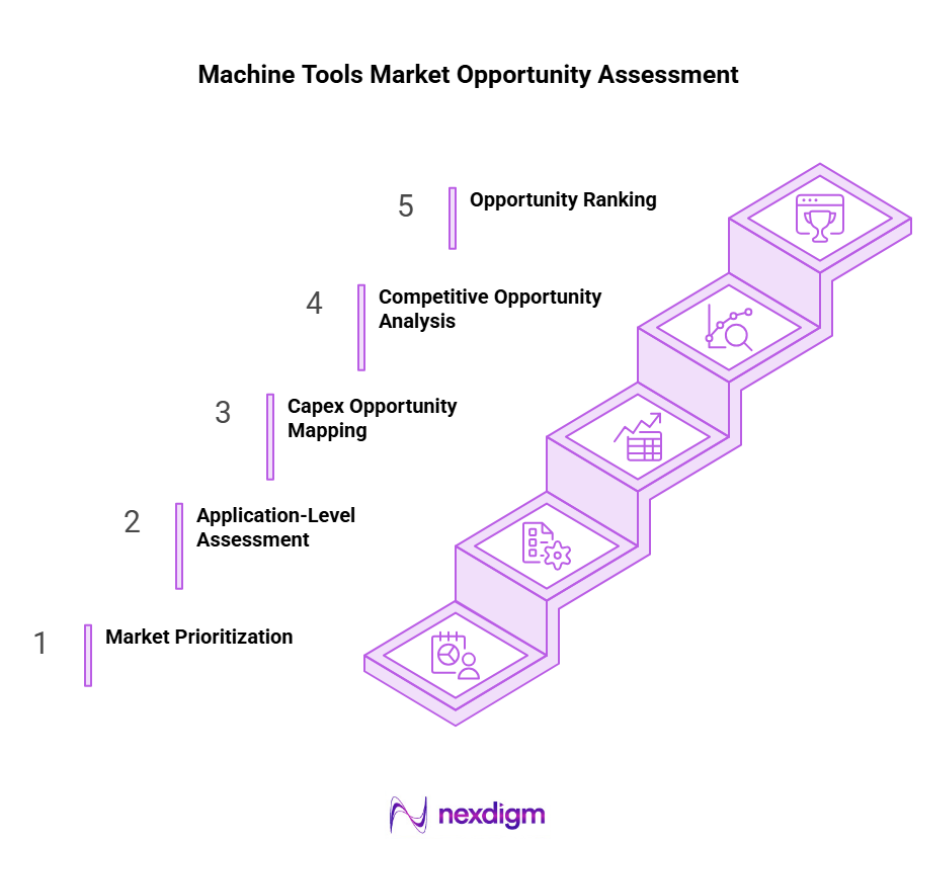
- Market Prioritization: Identifying regions, industries, and applications offering stronger demand potential and attractive growth prospects.
- Application-Level Assessment: Evaluating machining requirements, equipment needs, production volumes, and technology preferences across priority applications.
- Capex Opportunity Mapping: Tracking capacity expansion, modernization programs, and replacement cycles that can generate equipment demand.
- Competitive Opportunity Analysis: Assessing competitors, product positioning, capabilities, and market gaps to identify areas for differentiation.
- Opportunity Ranking: Prioritizing opportunities based on market potential, customer relevance, competitive conditions, and strategic fit.
This enables machine-tool businesses to focus commercial resources on the markets and applications with the strongest combination of demand potential and achievable business value.
Questions Addressed Through Nexdigm’s Machine Tools Market Opportunity Assessment
Nexdigm’s Machine tools market opportunity assessment helps manufacturers and businesses to answer the strategic questions that influence machine-tool growth and investment decisions. Such as:
- Where is demand growing fastest? Identifying the industries, applications, and regions generating the strongest equipment requirements.
- What is driving equipment purchases? Understanding the role of capacity expansion, automation, modernization, and replacement cycles.
- Which opportunities are commercially attractive? Evaluating demand potential, customer needs, competitive intensity, and market accessibility.
- Where should investment be prioritized? Determining which markets, applications, products, and capabilities warrant greater resources.
- How can businesses capture growth? Identifying opportunities for portfolio expansion, partnerships, localization, customer development, and market entry.
These answers give machine-tool businesses a clearer basis for deciding where to compete, where to invest, and how to convert market opportunities into sustainable growth.
Nexdigm in Turning Machine Tool Opportunities into Sustainable Growth
Once attractive opportunities are identified, businesses need a clear path to convert them into sustained commercial results. Nexdigm helps connect market insights with strategic actions across products, customers, capabilities, and expansion priorities. This involves:
- Defining the Growth Play: Determining which applications, customer segments, and geographic markets should receive priority based on long-term attractiveness.
- Aligning Capabilities: Identifying product, technology, manufacturing, service, and distribution capabilities that need strengthening to address targeted machine-tool opportunities.
- Shaping the Go-to-Market Approach: Developing market-specific strategies based on customer needs, application requirements, competitive positioning, purchasing processes, and the factors influencing investment decisions.
- Prioritizing Strategic Actions: Prioritizing the initiatives across portfolio expansion, partnerships, localization, capacity investments, channel development, and customer acquisition according to opportunity size, feasibility, and strategic importance.
- Tracking Commercial Progress: Establishing relevant performance indicators to monitor opportunity conversion, customer engagement, pipeline development, market penetration, and progress toward sustainable revenue growth.
Through a strategic assessment approach, Nexdigm helps machine-tool businesses move from identifying attractive opportunities to building focused strategies that support scalable, repeatable, and sustainable growth.
Nexdigm’s Case
Nexdigm supported a machine-tool manufacturer in assessing application demand, capex cycles, and replacement opportunities across priority markets. The analysis evaluated 30+ applications, identified 6 high-potential segments, and helped prioritize 20% more focused growth opportunities, supporting clearer market-entry decisions and targeted commercial investment.
To take the next step, simply visit our Request a Consultation page and share your requirements with us.
Harsh Mittal
+91-8422857704