

Machinery demand rarely moves as one market. A new factory may require several equipment classes, while an established plant may generate demand through replacement, modernization, capacity expansion, or automation. Forecasting therefore requires more than applying an industry growth rate to historical machinery sales.
The more useful question is where future equipment requirements will emerge, which applications will create them, and whether the demand represents new capacity, replacement demand, or technology migration.
The Equipment Cycle Behind Future Machinery Demand
Machinery demand typically develops through several overlapping cycles.
New production capacity creates an immediate requirement for core equipment. Capacity expansion generates another layer of demand as manufacturers add lines, increase throughput, or diversify production. Replacement demand follows the installed base, equipment age, utilization and maintenance economics. Technology upgrades create a separate cycle when older machines become less productive, less energy-efficient or incompatible with new production requirements.
These cycles can move in opposite directions.
A mature industry may have limited new-factory demand but a large installed base requiring replacement. A fast-growing industry may show strong greenfield demand but limited replacement opportunities. Semiconductor manufacturing demonstrates the scale that technology-led capacity expansion can create: SEMI forecasts global semiconductor manufacturing equipment sales at $165.9 billion in 2026, up 23.2% year on year. Wafer-fab equipment alone is projected at $143.9 billion.
The implication for forecasting is straightforward: market size needs to be connected to the underlying equipment cycle.
Demand Needs to Be Read Through Applications
Industry-level growth can hide substantial variation between applications.
For example, semiconductor equipment investment is being pulled by advanced logic, HBM-related memory, testing and advanced packaging rather than by semiconductor production in the abstract. SEMI expects DRAM equipment sales to grow 39.0% in 2026, while semiconductor test equipment is projected to rise 31.0%.
A machinery forecast therefore needs to identify:
- Which end-use applications are expanding
- Which production processes are becoming more equipment-intensive
- Which equipment classes are essential to those processes
- Whether technology changes are increasing or reducing equipment requirements
- Whether demand is concentrated among a small number of customers or distributed across an industry
This application-level view is particularly important when evaluating entry opportunities. A large industry may still offer limited addressable demand for a specific machine, while a smaller but rapidly evolving application may create a stronger equipment opportunity.
Installed Base Matters as Much as New Capacity
Replacement demand represents a critical yet frequently overlooked element when forecasting machinery markets.
Evaluating an installed base involves analyzing key factors such as equipment age, operational utilization, ongoing maintenance expenses, production needs, and technological obsolescence. Assessing these metrics enables a clear distinction between markets driven by routine replacement cycles and those reliant primarily on new capacity development.
This structural difference directly shapes the commercial landscape.
For instance, equipment with a 15-year operational lifespan creates significant replacement demand, though over extended periods. Conversely, heavily utilized machinery functioning within rapidly evolving manufacturing settings yields more frequent modernization and upgrade demands.
Additionally, service intensity plays an essential role, as equipment suppliers continuously expand their focus beyond initial sales to compete on system uptime, routine maintenance, spare parts supply, and technical support services.
Geography Can Change the Forecast
Machinery demand is also being reshaped by manufacturing localization.
SEMI expects China, Taiwan and Korea to remain the three largest destinations for semiconductor equipment spending through 2028, while other regions are expected to see higher spending supported by regionalization, government incentives and specialty capacity expansion.
That means a global machinery forecast should not simply distribute demand according to manufacturing output.
It should account for:
- New plant announcements
- Industrial policy and incentives
- Capacity relocation
- Import dependence
- Local production capabilities
- Technology adoption
- Supply-chain restructuring
The same equipment category can therefore have very different demand trajectories across countries.
Nexdigm’s Machinery Demand Forecasting Architecture
Nexdigm can support machinery demand forecasting and assessment through market sizing, end-use analysis, installed-base assessment, technology mapping, regional forecasting and competitive benchmarking.
A decision-ready forecast can be built across six connected layers:
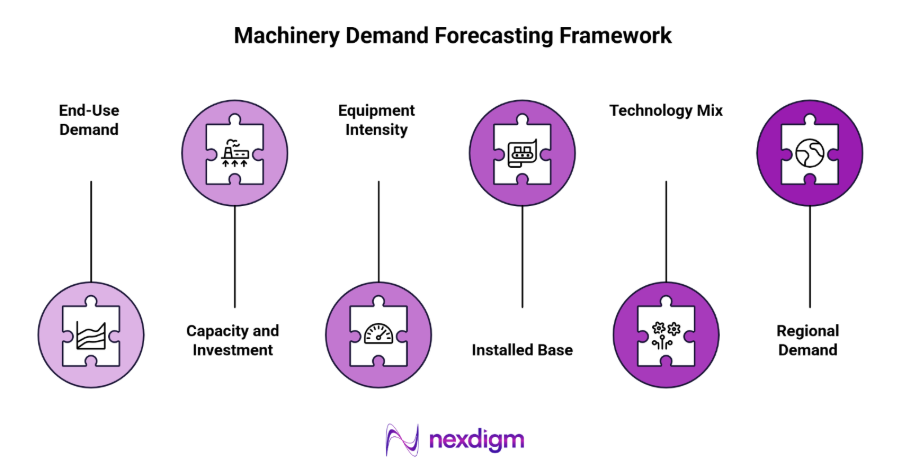
- End-Use Demand
Measure growth across industries, applications and production requirements that generate machinery demand. - Capacity and Investment Pipeline
Track announced plants, capacity additions, modernization programmes and capital expenditure. - Equipment Intensity
Estimate machinery requirements per production line, facility, application or unit of output. - Installed Base and Replacement Cycle
Assess equipment age, utilization, replacement frequency, obsolescence and modernization requirements. - Technology and Product Mix
Map how automation, process changes and technology migration alter equipment specifications and volumes. - Regional Demand Potential
Compare country-level manufacturing growth, investment pipelines, localization policies, competition and addressable demand.
Together, these layers can convert broad industrial growth into an equipment-specific demand forecast that supports capacity planning, market entry and investment decisions.
Nexdigm Case Study: Prioritizing High-Growth Machinery Segments
Nexdigm supported an industrial machinery company assessing expansion opportunities across semiconductor equipment categories. The analysis examined a $165.9 billion 2026 market, 39% DRAM growth and 31% test-equipment growth, helping prioritize equipment classes and end-use applications with stronger demand potential.
The assessment helped the client focus its market-entry and capacity strategy on higher-growth equipment segments and geographies aligned with semiconductor investment.
To take the next step, simply visit our Request a Consultation page and share your requirements with us.
Harsh Mittal
+91-8422857704