

A new industrial machine enters a market only when a buyer has a sufficiently expensive problem to justify replacing an existing process.
That problem may be rising labour costs, production bottlenecks, excessive scrap, energy consumption, quality variation, or the need to increase output without adding another production line.
Machinery demand is therefore derived from downstream industrial activity. When factories approach capacity limits, replace ageing equipment, introduce new production processes, or automate labour-intensive operations, equipment demand follows.
The scale of the opportunity depends on which of these conditions exists in the target market.
Demand Begins With the Application
A machine category can appear attractive at the market level while offering limited opportunity for a particular product.
The relevant question is where the equipment creates measurable value.
For a packaging machine, that could mean higher units per minute and reduced changeover time. For a precision machining system, it may be tighter tolerances and lower scrap. For an automated assembly cell, the commercial case may depend on labour availability and consistent quality.
This makes application-level analysis more useful than simply estimating the size of the machinery market.
The supplied market framework identifies three major demand triggers: greenfield expansion, brownfield modernization, and maintenance or automation retrofits.
Each produces a different buying cycle.
Replacement Demand Is Often More Predictable Than New Demand
An installed machine base creates a recurring replacement opportunity.
Equipment approaching the end of its useful life becomes more expensive to maintain, less productive, or increasingly incompatible with newer production systems. Replacement demand can therefore be estimated using installed base, equipment age, useful life, maintenance intensity, and production requirements.
Expansion demand is less predictable because it depends on downstream growth.
Retrofit demand sits between the two. A factory may retain its core equipment but add robotics, machine vision, sensors, software, or upgraded controls to address a specific bottleneck.
These distinctions matter when forecasting equipment volumes.
Buyers Evaluate Total Economics, Not Machine Price
Industrial customers rarely make equipment decisions on purchase price alone.
They evaluate acquisition cost alongside energy consumption, labour, maintenance, downtime, scrap, throughput, financing, and expected useful life.
The total-cost-of-ownership model supplied for machinery feasibility work captures these components by comparing acquisition and operating costs with savings generated throughout the machine’s working life.
This changes the pricing question.
A machine priced above an incumbent can still win if it reduces operating costs sufficiently to produce an acceptable payback period. Conversely, a lower-priced machine can struggle if maintenance requirements, downtime, or low throughput undermine its lifetime economics.
Technology Shifts Create Narrower, Higher-Value Opportunities
The strongest opportunities often appear where an existing process is changing.
Servo-electric systems can replace hydraulic technologies where speed and energy efficiency matter. Machine vision can replace manual inspection in applications where defect detection and consistency are commercially important. Robotics can address labour shortages or increase throughput without proportionally increasing headcount.
Global robotics investment reflects this broader industrial shift. The International Federation of Robotics reported that the global market value of industrial robot installations reached $16.7 billion, while global installations are forecast to exceed 700,000 units by 2028.
But technology adoption does not guarantee equipment demand. Buyers still require technical compatibility, reliable service, financing, integration capability, and evidence of operational returns.
The Competitive Question Is About Replacement Potential
A new machinery offering competes against more than other new machines.
The incumbent may be a lower-cost legacy system that is already fully depreciated. Customers may also have strong relationships with existing OEMs, established spare-parts networks, trained technicians, and validated production processes.
Switching costs can therefore be significant.
The most promising opportunities often arise where incumbent technology has become economically inefficient or cannot meet new production requirements. In those cases, the buyer’s willingness to change is driven by a measurable operational problem rather than technology novelty.
Through our dedicated machinery market feasibility study consulting, we help OEMs evaluate capital risk, buyer economics, and market demand before commercial launch.
Nexdigm’s Machinery Entry Feasibility Framework
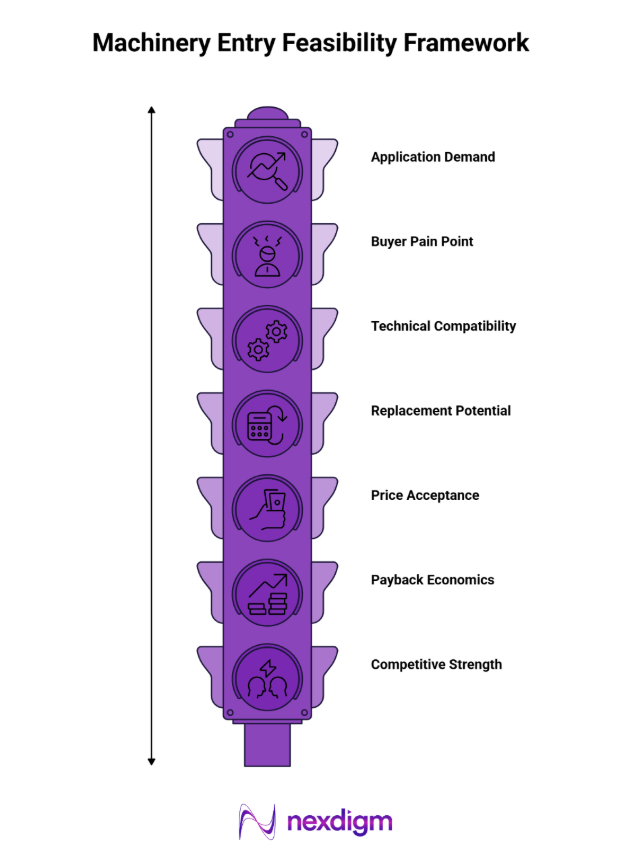
- Application Demand
Identify the manufacturing processes, applications, throughput requirements, and equipment specifications generating actual demand. - Buyer Pain Point
Quantify the cost of labour, downtime, scrap, energy consumption, quality failures, or capacity constraints under incumbent equipment. - Technical Compatibility
Assess factory layouts, electrical requirements, controls, communication standards, integration requirements, and installation constraints. - Replacement and Retrofit Potential
Estimate the active installed base, equipment age, replacement cycle, retrofit opportunity, and probability of conversion. - Price Acceptance and Financing
Determine buyer willingness to pay and evaluate purchase, lease, financing, and outcome-based models. - Payback Economics
Model savings from labour, energy, throughput, quality, and downtime against total installed capital expenditure. - Competitive and After-Sales Strength
Assess incumbent brands, service networks, spare-parts availability, distributor coverage, warranty structures, and technical support.
Case Study: Machinery Market Feasibility Study Consulting
A machinery producer compared automated packaging demand across food, pharmaceutical, and consumer goods applications. Pharmaceutical equipment delivered a 24% higher projected gross margin and an 18-month faster payback despite lower total market volume.
To take the next step, simply visit our Request a Consultation page and share your requirements with us.
Harsh Mittal
+91-8422857704