

The make-versus-buy decision is becoming more complex as companies balance cost efficiency with supply resilience, capacity requirements, and strategic control. A recent survey found that 74% of procurement leaders considered alternative supply sources an effective risk-mitigation strategy, while 64% prioritized greater supply-chain visibility.
The Hackett Group’s 2026 research also found that procurement workloads are expected to increase by 8%, despite continued resource constraints. Meanwhile, CIPS’ 2026 research identified risk management and new technology skills as priorities for 47% of procurement professionals.
These developments reinforce the need for a structured make vs buy analysis that considers not only production costs, but also supplier economics, capacity, quality, technology, flexibility, risk, and the strategic value of retaining capabilities internally.
Why Make-or-Buy Decisions Are More Than a Cost Comparison
A lower external purchase price does not automatically make outsourcing the better choice. Internal production may provide greater control over quality, technology, capacity, intellectual property, and responsiveness. Conversely, external sourcing can provide access to specialist capabilities, established supplier ecosystems, lower production costs, or greater flexibility without requiring additional capital investment. The right decision depends on the full economic and strategic context surrounding the product or process.
What Should Be Compared Before Deciding?
A structured evaluation should examine both immediate economics and longer-term business implications.
- Internal Economics: Assess labor, materials, equipment, overhead, maintenance, utilization, capital requirements, and incremental production costs to determine the true cost of manufacturing internally.
- External Economics: Compare supplier pricing, logistics, quality costs, contract terms, switching costs, supplier capacity, and market competitiveness to understand the total cost of buying.
These comparisons create a more balanced view of the financial, operational, and strategic trade-offs behind a make-or-buy decision.
Nexdigm’s Expert-led View on Make vs Buy Decisions
Comparing make and buy options requires a view that goes beyond the immediate cost difference. Nexdigm brings together procurement, cost, supplier, market, and industry perspectives to help businesses assess the broader implications of each choice.
Our make vs buy analysis considers internal production economics alongside supplier-market conditions, capacity, quality, logistics, investment requirements, and strategic considerations. This helps businesses understand which option offers the stronger overall value and under what conditions that conclusion may change.
The result is a more balanced basis for decisions involving manufacturing, outsourcing, capacity, and long-term sourcing strategy.
Nexdigm’s Approach to Assessing Make and Buy Options
Nexdigm evaluates both alternatives against a common set of commercial and operational factors, ensuring that the decision reflects the full economics and strategic implications by assessing the following areas:
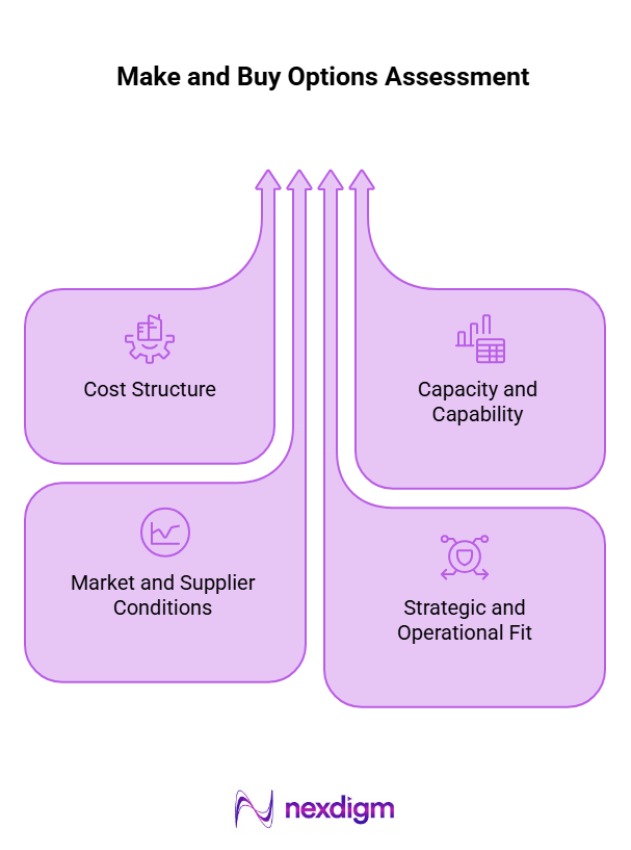
- Cost Structure: Comparing incremental manufacturing costs with the complete cost of external sourcing, including logistics, quality, inventory, and contractual considerations.
- Capacity and Capability: Assessing available production capacity, technical capabilities, equipment requirements, supplier capacity, and the investment needed to support either option.
- Market and Supplier Conditions: Examining supplier competition, pricing, market capacity, sourcing alternatives, and external cost drivers that could influence the attractiveness of buying.
- Strategic and Operational Fit: Evaluating quality requirements, intellectual property, flexibility, scalability, supply continuity, and the strategic importance of retaining capability internally.
This assessment provides a like-for-like comparison of make and buy options, giving decision-makers a clearer basis for selecting the most suitable route.
How Nexdigm’s Analysis Favors Make or Buy Decisions
The outcome of a make-or-buy assessment depends on the specific economics and strategic priorities of the business. Nexdigm’s analysis helps identify the conditions under which each option can create greater value, such as:
- When Make Becomes Attractive: Internal production may be preferable where existing capacity, proprietary capabilities, quality requirements, or strategic control provide meaningful advantages over external sourcing.
- When Buy Becomes Attractive: External sourcing may offer stronger value where suppliers provide scale, specialist capabilities, competitive pricing, flexible capacity, or lower investment requirements.
- When A Hybrid Model May Work: Some businesses can benefit from retaining critical production internally while sourcing selected volumes externally to improve flexibility, capacity utilization, or supply resilience.
Rather than forcing a binary decision, this approach helps businesses determine which operating model best fits the economics, capabilities, and strategic requirements of the specific category or product.
Nexdigm’s Case
Nexdigm evaluated 10 production categories across internal and external sourcing options, identifying four categories where external sourcing offered stronger economics and three where internal production delivered greater strategic value. The assessment indicated a 17% potential cost advantage across priority categories, helping the client make more targeted decisions around outsourcing, capacity utilization, and internal manufacturing.
To take the next step, simply visit our Request a Consultation page and share your requirements with us.
Harsh Mittal
+91-8422857704