

Industrial investment decisions increasingly depend on how manufacturing demand, infrastructure readiness, production technology and supply-chain access fit together. A location offering inexpensive land may be less attractive if electricity is unreliable. A region with established factories may offer a stronger starting point because skilled labour, component suppliers and logistics services are already available.
For investors, developers and industrial suppliers, the task is to understand how these factors combine to shape the next generation of investment opportunities.
The Investment Picture Is Becoming More Selective
UNCTAD’s World Investment Report 2026 recorded a 6% increase in global foreign direct investment to US$1.6 trillion in 2025. However, the recovery was uneven, with investment increasingly concentrated in a relatively small number of economies and sectors.
This distinction matters for industrial research. Rising global investment does not mean that every manufacturing or construction market is receiving more capital. The location, sector and purpose of investment must be identified before its implications for factories, industrial buildings or infrastructure can be assessed.
Manufacturing data adds another layer. UNIDO reported that global manufacturing production increased by 1.5% quarter on quarter in Q2 2026, while manufacturing exports rose by 6.1%. Higher-technology exports grew by 7.1%, outpacing the overall export increase.
These indicators point to different rates of momentum across industrial segments. They can help researchers identify sectors worth examining more closely, but local demand, competition and project feasibility still determine whether an investment makes sense.
Four Shifts Worth Watching
- Production Networks Are Being Reconfigured
Companies are reassessing supplier concentration, trade exposure and production locations. This does not mean global supply chains are simply disappearing. The OECD’s 2026 Trends in Global Value Chains report found that global value-chain trade remained near historical highs in 2024. The changes are more complex, involving shifts in sourcing relationships, sectors and production structures.
For investors, this can create demand for new facilities, supplier parks and logistics infrastructure in locations gaining a role in production networks. - Infrastructure Is Part Of The Investment Case
Industrial sites need reliable energy, transport, water and digital connectivity. Infrastructure gaps can increase operating costs or delay commissioning. Researchers should examine actual capacity and delivery schedules rather than assuming planned infrastructure will be available when a factory opens. - Technology Is Changing Facility Requirements
Automation and digital production systems can affect factory layout, power demand, skills requirements and equipment investment. Some operations benefit from specialised facilities and highly reliable utilities, while others prioritise flexible space and proximity to labour or suppliers. - Construction Costs Affect Timing And Returns
Financing costs, material availability and contractor capacity can alter project economics. An industrial investment may remain attractive over the long term but become less viable if construction delays push back production and revenue.
A Better Way To Screen Investment Opportunities
The phrase industrial investment opportunities covers more than identifying fast-growing sectors. An effective screen should link market demand with the conditions needed to build and operate assets.
- Market Demand: Examine sector output, orders, imports and customer growth.
- Capital Commitment: Review funding, permits, investment announcements and project status.
- Infrastructure Readiness: Assess power, transport, water and logistics capacity.
- Industrial Ecosystem: Evaluate supplier depth, workforce availability and technical capabilities.
- Financial Feasibility: Examine construction costs, operating expenses and potential downside scenarios.
The strongest candidates are those where these dimensions reinforce one another rather than where one impressive statistic hides several practical weaknesses.
Nexdigm’s Industrial Investment Decision Sequence
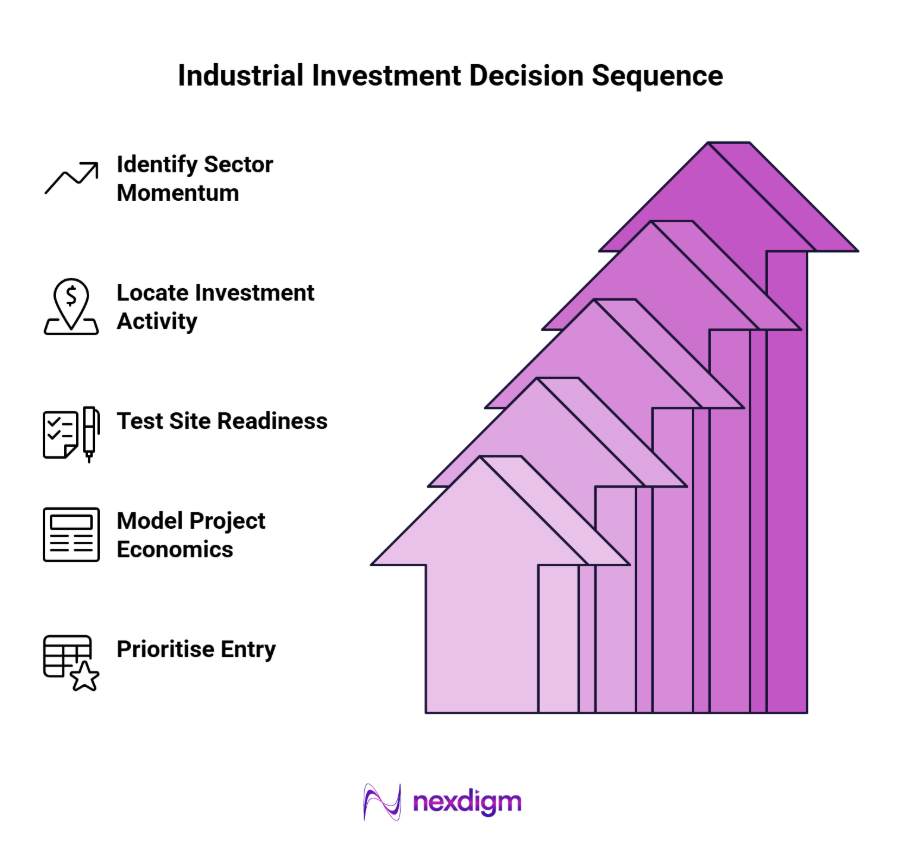
- Identify Sector Momentum: Find industries with sustained demand and production activity.
- Locate Investment Activity: Map factory projects, expansions and related capital commitments.
- Test Site Readiness: Verify infrastructure, workforce, permitting and logistics access.
- Model Project Economics: Compare construction costs, operating requirements and revenue assumptions.
- Prioritise Entry: Select investments or partnerships that remain viable under realistic downside scenarios.
From Trend Monitoring To Capital Allocation
Manufacturing and construction trends become useful when they inform specific decisions about location, facility design, infrastructure and timing. Combining investment data with operational and market evidence helps investors distinguish an attractive industrial narrative from a project that can be delivered and operated profitably
Nexdigm’s Case Study: Comparing Two Industrial Locations
An investor evaluates two locations for a manufacturing facility. The first offers lower land costs but has uncertain utility expansion timelines. The second has higher initial costs, established suppliers and available transport connections. After modelling commissioning delays and operating expenses, the investor prioritises the second location.
To take the next step, simply visit our Request a Consultation page and share your requirements with us.
Harsh Mittal
+91-8422857704