

A new factory rarely operates in isolation. It needs reliable power, roads, water, communications, warehousing and access to suppliers and customers. The surrounding infrastructure can determine whether an industrial investment becomes productive on schedule or remains constrained by operating costs and logistics.
For investors, industrial developers, equipment suppliers and construction firms, the opportunity lies in studying factory investment and infrastructure development as connected decisions.
Read Investment Signals Beyond The Headline
Investment announcements can indicate where businesses expect demand or strategic advantage to emerge. Yet aggregate foreign direct investment figures do not tell the full story of factory construction or industrial capacity.
UN Trade and Development’s World Investment Report 2026 reported that global foreign direct investment increased 6% to US$1.6 trillion in 2025. The report also noted that investment growth remained concentrated among a relatively narrow group of economies and sectors.
For market research, this means national inflows should be treated as a starting signal. Analysts need to identify the destination of capital, the industries receiving it, the stage of project development and the infrastructure required to support it.
A manufacturing investment pipeline should distinguish between a public announcement, a committed investment, construction activity, installed capacity and actual commercial production.
Follow The Infrastructure That Makes Production Possible
Consider a proposed manufacturing cluster. The factory investment may create demand for industrial buildings and machinery, but also for electricity generation, substations, roads, water treatment, ports, logistics parks and worker housing.
These linked requirements can create opportunities across several industries. They also reveal potential bottlenecks. A factory may be ready before its power connection or access road, while a new logistics facility may be commercially weak until nearby industrial tenants begin operating.
Research should therefore map industrial projects against existing and planned infrastructure, including completion dates, capacity constraints and the organisations responsible for delivery.
The World Bank’s infrastructure project data and national development plans can help identify major investment programmes. Local permits, utility plans and procurement notices provide more granular evidence about whether enabling infrastructure is progressing.
Look For Clusters, Not Just Individual Projects
Industrial clusters can produce more durable opportunities than isolated investments because multiple manufacturers draw on common infrastructure, suppliers, labour pools and transport connections.
The commercial potential depends on the cluster’s industrial mix. Electronics manufacturing may require reliable power and specialised components. Heavy industry may depend on bulk transport and energy access. Food processing may need cold storage, water and efficient connections to agricultural supply networks.
manufacturing and construction opportunities are best evaluated together when the analysis identifies how industrial demand creates requirements for buildings, utilities and logistics, and how infrastructure investment makes further manufacturing activity viable.
Companies should also assess whether infrastructure capacity is genuinely available or merely planned. Project timing matters: suppliers and contractors can incur costs if they mobilise before the underlying investment decisions are secure.
Nexdigm’s Industrial Investment Linkage Framework
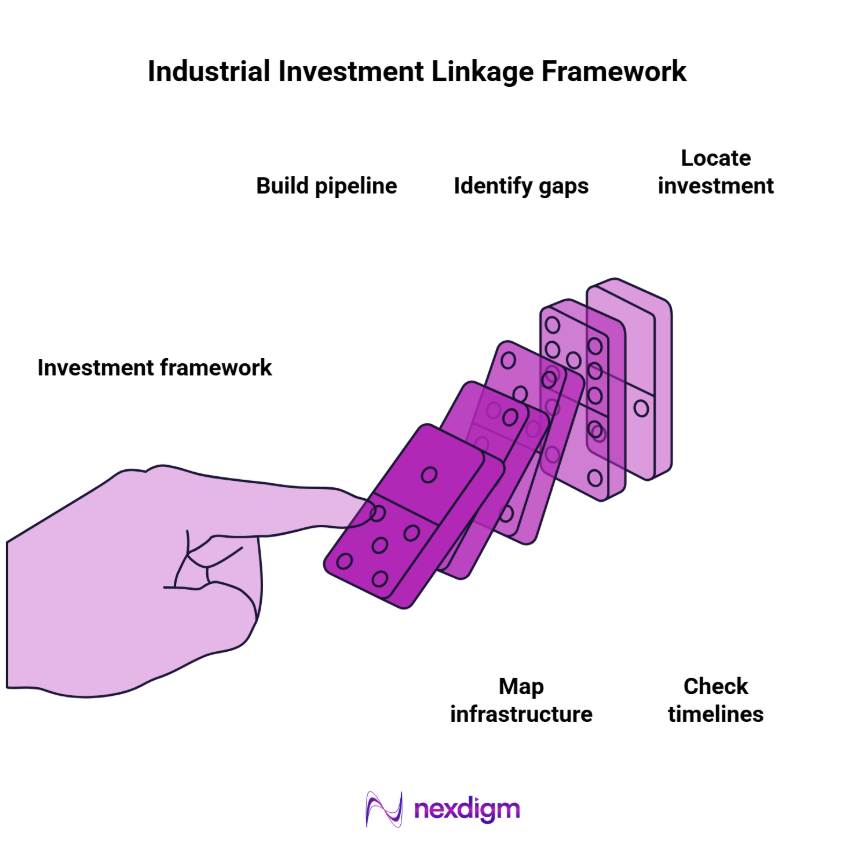
- Locate Industrial Investment: Identify announced, committed and operational manufacturing projects.
- Map Enabling Infrastructure: Track power, transport, water, communications and logistics capacity.
- Identify Capability Gaps: Compare planned demand with existing infrastructure and supplier coverage.
- Check Delivery Timelines: Verify permits, funding, procurement and construction progress.
- Build An Opportunity Pipeline: Prioritise projects by certainty, timing, customer demand and execution risk.
Researching The Full Investment Ecosystem
Factory investment and infrastructure development should not be assessed as separate markets. Connecting the two reveals where industrial demand is likely to generate construction requirements, where missing infrastructure could delay growth and which projects offer the clearest commercial entry points.
Nexdigm’s Case Study: Finding Opportunities Around A Factory Cluster
A construction supplier tracks a planned industrial cluster and maps its announced factories against power, road and warehouse projects. The analysis reveals that logistics and utility works are advancing ahead of several factory buildings. The supplier prioritises funded infrastructure contracts while monitoring later demand from manufacturers.
To take the next step, simply visit our Request a Consultation page and share your requirements with us.
Harsh Mittal
+91-8422857704