

Manufacturers facing capacity constraints are increasingly looking beyond existing facilities to identify markets where new production lines can support sustainable growth. The latest data indicates continued momentum: global manufacturing production increased 1.5% in Q2 2026, while manufacturing exports rose 6.1%, according to UNIDO.
Higher-technology manufacturing was particularly strong, with production increasing 2.0% and exports rising 7.1% during the quarter. This growth is creating opportunities for companies to expand capacity closer to customers, suppliers, and strategic markets. However, selecting the right market requires more than demand forecasts.
Manufacturers must evaluate market size, growth trajectory, competitive intensity, infrastructure, labor availability, supplier ecosystems, logistics, incentives, and location economics to determine where additional production capacity can generate the strongest long-term returns.
Capacity Pressure Is Driving Expansion Decisions
Growing orders, limited production capacity, longer lead times, and changing customer expectations can push manufacturers to reconsider their existing footprints. While expanding current facilities may offer speed and lower disruption, capacity constraints can also highlight the need for new production lines. The decision increasingly depends on expected demand, utilization levels, scalability, and proximity to key markets.
Markets With Strong Fundamentals Attract New Capacity
Manufacturers are increasingly assessing locations where demand growth is supported by strong industrial ecosystems and favorable operating conditions. Access to suppliers, skilled labor, infrastructure, logistics, customers, and incentives can influence expansion attractiveness. Markets offering a combination of demand visibility and production advantages can provide a stronger foundation for new capacity and long-term manufacturing growth.
Nexdigm’s Role in Identifying Expansion-Ready Markets
Identifying the right market for new manufacturing capacity requires a balanced view of demand potential, operating conditions, competitive dynamics, and location advantages. Nexdigm helps businesses bring these factors together through Manufacturing capacity expansion opportunities analysis and industry-led market intelligence.
Its approach evaluates market growth, customer proximity, supplier ecosystems, infrastructure, talent availability, logistics, incentives, and competitive conditions to identify locations where additional production capacity could be commercially viable. This enables manufacturers to compare markets more systematically and understand which locations are better aligned with their capacity expansion, market-entry, and long-term growth objectives.
Nexdigm’s Approach to Manufacturing Capacity Opportunity Analysis
Nexdigm helps businesses move beyond identifying attractive markets to understand where and how additional manufacturing capacity can create value. Its analysis combines demand outlook, production economics and competitive dynamics to evaluate Manufacturing capacity expansion opportunities. The approach helps businesses:
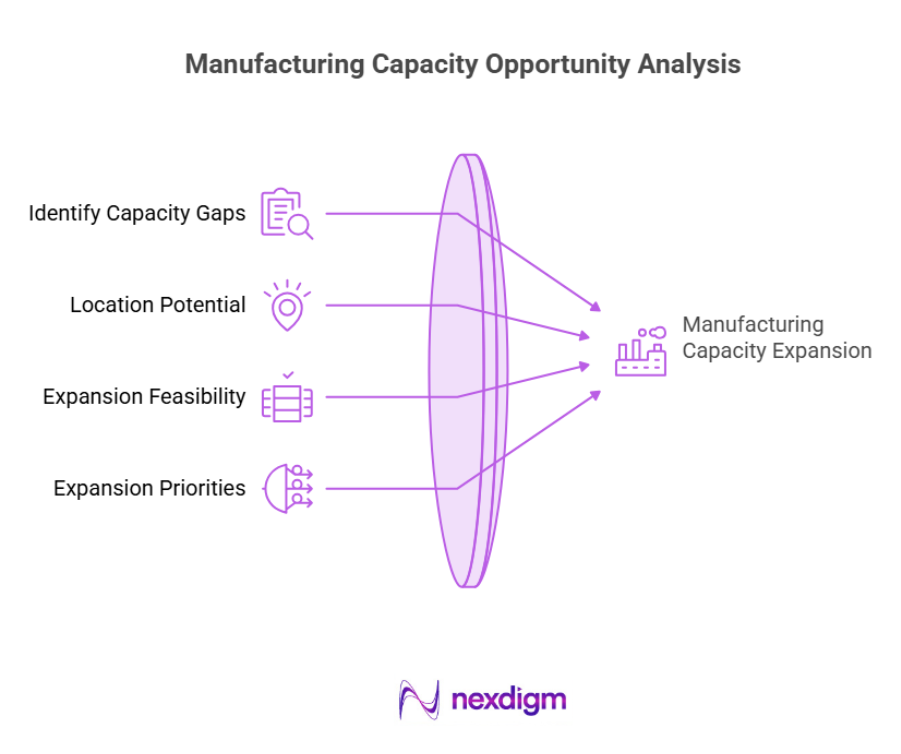
- Identify Capacity Gaps: Analyze demand growth trends, production utilization levels, and market needs to identify where existing manufacturing capacity may be insufficient to support future opportunities.
- Evaluate Location Potential: Compare potential markets based on infrastructure quality, talent availability, supplier ecosystems, logistics connectivity, customer proximity, operating costs, and investment attractiveness.
- Assess Expansion Feasibility: Evaluate commercial potential, production requirements, supply-chain readiness, regulatory considerations, and organizational capabilities to determine the practicality of capacity expansion.
- Shape Expansion Priorities: Develop actionable expansion strategies by identifying optimal investment options, facility locations, production configurations, and phased approaches aligned with business objectives.
This gives manufacturers a structured basis for moving from market opportunity identification to informed capacity investment decisions.
Nexdigm’s Insights for Smarter Capacity Decisions
Nexdigm’s opportunity analysis helps manufacturers make capacity decisions with greater confidence by connecting market opportunities with practical investment, operational, and growth considerations. These insights include:
- Reduced Investment Uncertainty: Provide a structured assessment of demand outlook, competitive conditions, cost considerations, and location factors to support informed capital allocation and expansion decisions.
- Improved Market Selection: Identify markets where customer demand, industrial infrastructure, supplier networks, and business objectives align to create stronger expansion opportunities.
- Optimized Capacity Planning: Determine the appropriate capacity scale, expansion timing, and production location by evaluating market requirements, operational capabilities, and growth expectations.
- Support towards Long-Term Growth: Align manufacturing investments with future demand trends, supply chain priorities, strategic objectives, and evolving competitive market conditions.
These insights help businesses approach manufacturing capacity expansion as a strategic growth opportunity rather than simply a response to current production constraints.
Nexdigm’s Role in Manufacturing Capacity Decision-Making
Manufacturing capacity expansion involves balancing market potential, operational feasibility, investment requirements, and long-term business objectives. Nexdigm helps organizations evaluate these factors through a structured, data-driven approach that supports more informed capacity decisions:
- Connect Market Demand with Capacity Requirements: Assess whether future demand justifies additional production investments and identify where new capacity may create the greatest value.
- Evaluate Expansion Alternatives: Compare different capacity expansion options, including new facilities, production line additions, contract manufacturing, or phased investment approaches.
- Support Investment Prioritization: Help businesses focus resources on opportunities that offer stronger commercial potential, operational feasibility, and strategic alignment.
By linking market opportunities with practical investment considerations, Nexdigm helps businesses make manufacturing capacity decisions with greater confidence and strategic clarity.
Nexdigm’s Case
Nexdigm supported an industrial manufacturer assessing expansion opportunities across multiple markets. The engagement evaluated 15+ markets, analyzed 25+ capacity and location factors, and identified 4 priority expansion markets, helping reduce the initial market shortlist by 35% and enabling more focused capacity investment planning.
To take the next step, simply visit our Request a Consultation page and share your requirements with us.
Harsh Mittal
+91-8422857704