

Manufacturing competitiveness is not determined by factory output alone. Companies compete through production efficiency, product quality, technology adoption, supplier reliability, export access and the ability to respond to changing customer requirements.
A manufacturer with large production capacity may struggle to compete if its costs are high or delivery times are inconsistent. A smaller producer can gain ground through specialised capabilities, dependable suppliers and access to attractive markets. Understanding these differences requires comparing operational performance with market outcomes.
Measure Scale Without Confusing It With Competitiveness
Production volume, manufacturing value added, capacity utilisation and export revenue offer different perspectives on industrial performance. Each measure answers a different question.
The United Nations Industrial Development Organization’s International Yearbook of Industrial Statistics 2025 reported that global manufacturing value added grew by 2.9% in 2024. Middle-income industrial economies recorded stronger growth than high-income industrial economies, reflecting changes in the geography and composition of manufacturing activity.
However, aggregate growth does not show whether an individual manufacturer is gaining market share. Companies need comparisons at the level of specific products, industries, countries and customer segments.
Useful indicators include:
- Production Scale: Measure output, capacity utilisation and the ability to fulfil large orders.
- Operational Efficiency: Compare labour productivity, energy use, scrap rates and production cycle times.
- Product Competitiveness: Assess quality, technical specifications, customisation and compliance.
- Market Reach: Track exports, destination markets, customer concentration and repeat business.
- Financial Resilience: Evaluate input-cost exposure, working capital and investment requirements.
These measures help separate size from the ability to compete profitably.
Examine Supply Networks And Operating Costs
Manufacturers depend on networks of raw-material suppliers, component producers, logistics providers and distribution partners. Disruptions at any stage can affect output, cost and delivery performance.
A competitive assessment should examine supplier concentration, lead times, import dependence, inventory requirements and access to alternative sources. Businesses should also compare total input costs rather than relying on quoted purchase prices alone.
Energy-intensive industries, for example, may face substantial cost differences across production locations. Electronics manufacturers may depend on specialised components, while automotive producers can be exposed to delays involving multiple tiers of suppliers.
manufacturing competitive analysis becomes more useful when operational indicators are connected to trade and market data. Export growth can show where a manufacturer is gaining access, while supplier and import data can reveal dependencies that threaten continuity or cost competitiveness.
Compare Market Reach And Technology Adoption
The ability to reach customers matters as much as production efficiency. Manufacturers need to assess whether their products meet market-specific requirements, whether distribution networks are reliable and whether tariffs or technical standards affect competitiveness.
UNIDO’s quarterly manufacturing production and trade reports provide a useful way to compare industrial output and manufacturing exports across economies and sectors. Its 2026 reporting also highlights differences between higher-technology industries and lower-technology sectors, reinforcing the importance of evaluating competitiveness at the industry level.
Automation should be assessed in commercial terms. Investments in robotics, digital production monitoring and quality-control systems may improve throughput and consistency, but the returns depend on production volumes, product complexity, workforce skills and maintenance capabilities.
The objective is not to automate every process. It is to identify where technology can improve measurable performance.
The Manufacturing Competitiveness Assessment Framework
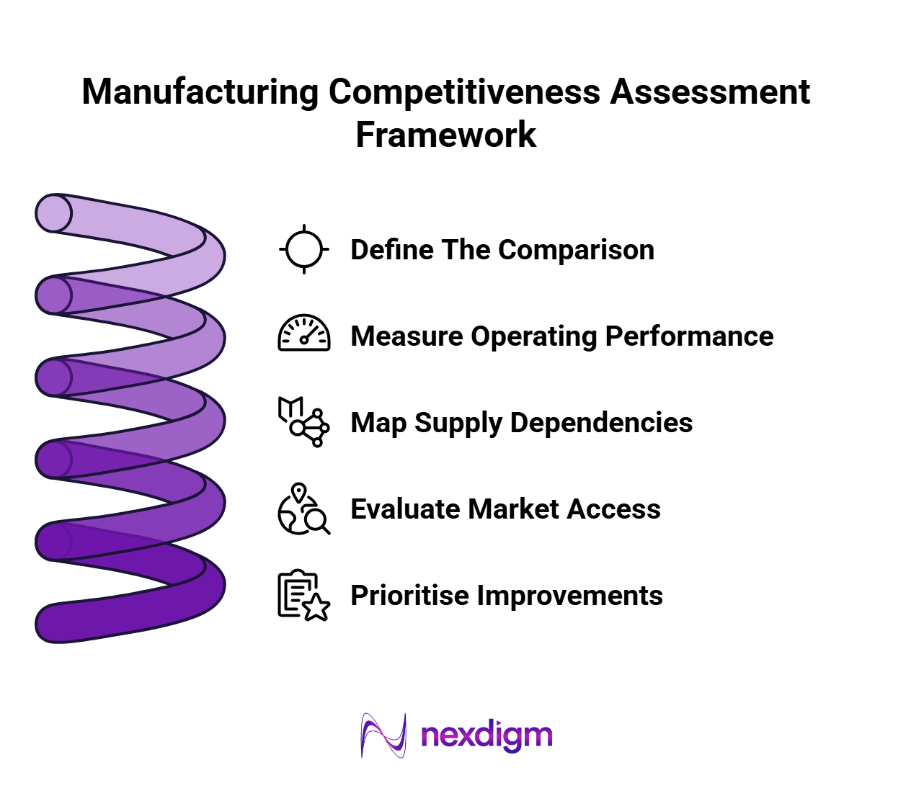
- Define The Comparison: Select relevant products, competitors, markets and time periods.
- Measure Operating Performance: Compare productivity, quality, utilisation and production costs.
- Map Supply Dependencies: Assess supplier concentration, input availability and logistics exposure.
- Evaluate Market Access: Compare export reach, customer requirements and competitive positioning.
- Prioritise Improvements: Identify the operational, technological or commercial changes most likely to strengthen performance.
Turning Competitive Evidence Into Action
Manufacturers need a clear view of where they outperform competitors and where structural disadvantages limit growth. Combining operational measures with trade, supplier and market intelligence helps businesses prioritise investments, improve resilience and pursue expansion where their capabilities offer a defensible advantage.
Case Study: Finding A Manufacturing Advantage
A component manufacturer finds that its production costs are higher than those of regional competitors. A detailed comparison identifies excessive changeover time and dependence on one imported input. The company prioritises process improvements and qualifies a second supplier before committing to a major capacity expansion.
To take the next step, simply visit our Request a Consultation page and share your requirements with us.
Harsh Mittal
+91-8422857704