

Digital transformation in manufacturing is moving beyond isolated technology pilots. Manufacturers are connecting production equipment, enterprise systems, supply-chain data and analytics to improve decisions across the factory. The opportunity spans cloud infrastructure, industrial data platforms, AI, automation and connected operations, but these technologies solve different problems and require different levels of readiness.
The World Economic Forum’s Global Lighthouse Network expanded to 201 industrial sites by September 2025. Its newest cohort reported an average 40% improvement in labour productivity and a 48% reduction in lead times. The results demonstrate the potential of coordinated digital transformation, although these leading sites should not be treated as representative of the wider manufacturing base.
For suppliers, the market question is where manufacturers have a defined operational need, the data infrastructure to support a solution and the budget to deploy it at scale.
The Digital Manufacturing Stack Is Expanding
Manufacturing digitalisation covers several connected layers:
- Cloud and industrial data platforms: Infrastructure for consolidating production, equipment, quality and supply-chain data across plants.
- AI and analytics: Applications for predictive maintenance, quality inspection, process optimisation, production planning and energy management.
- Automation and robotics: Equipment and control systems that execute production tasks, often using analytics or machine vision to adjust operations.
- Connected operations: Manufacturing execution systems, digital twins, industrial IoT and integration between shop-floor and enterprise applications.
- Cybersecurity and integration: Technologies and services that protect operational systems, manage access and connect legacy equipment with newer platforms.
Demand varies with plant maturity. A factory with fragmented data may need connectivity and system integration before advanced AI becomes viable. A manufacturer with reliable production data may be ready for predictive maintenance or AI-based defect detection. This creates demand for foundational services as well as advanced applications.
Why Are Some Digital Investments Scaling While Others Stall?
The difference often lies in the connection between technology and operating decisions. Predictive maintenance creates value when alerts lead to timely intervention. Production analytics matters when managers can change schedules, process settings or resource allocation based on the findings. A digital twin has limited value if it is not linked to current operating data or used in engineering and production decisions.
The World Economic Forum’s 2025 Lighthouse cohort also shows how AI is being embedded into wider operating models. Up to half of the leading use cases in the latest cohort used AI or generative AI. Reported outcomes included a 41% reduction in product defects and a 28% reduction in energy consumption. These results came from selected advanced sites and should be used as evidence of potential, not as standard expected returns.
A market assessment should therefore examine more than technology adoption rates. It needs to establish the business problems being funded, the systems already installed, the implementation barriers and the level of external support required.
For a Manufacturing digital transformation market study, Nexdigm can segment demand by technology layer, plant maturity, manufacturing sector and operational objective. The analysis can identify which applications have purchase-ready demand, where integration creates a barrier and which customer groups are likely to need implementation partners.
Commercial Priorities for Technology Providers
Digital transformation suppliers need to understand how manufacturers purchase and implement technology. Cloud platforms may be selected at corporate level, while plant managers approve equipment upgrades and engineering teams specify control systems. Cybersecurity requirements and compatibility with existing equipment can influence vendor selection as much as functionality.
The strongest market opportunities often combine a clear operational benefit with a repeatable deployment model. Suppliers that reduce implementation time, integrate with legacy equipment and demonstrate measurable outcomes can be better positioned than providers offering technology without an operating plan.
Manufacturing Digital Transformation Opportunity Framework
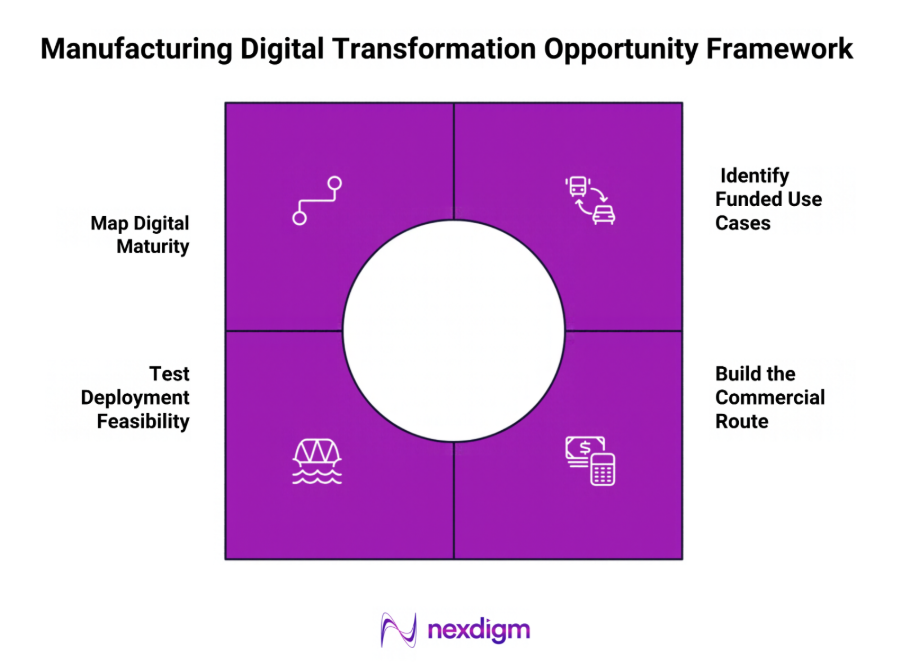
- Map Digital Maturity
Assess equipment connectivity, data quality, system architecture, cybersecurity and workforce capability across target plants. - Identify Funded Use Cases
Prioritise problems such as downtime, defects, energy consumption, scheduling and traceability that have measurable operational costs. - Test Deployment Feasibility
Evaluate integration requirements, implementation time, change management, recurring costs and expected benefits. - Build the Commercial Route
Identify buyers, partners, deployment models and service requirements, then prioritise applications that can be replicated across plants.
Nexdigm Case Study: Prioritising Digital Manufacturing Investments
Nexdigm assessed digital transformation requirements across 90 plants in three manufacturing sectors. The team mapped cloud, analytics, AI, automation and connected-operations needs, then evaluated data readiness, implementation complexity and expected operating benefits. Thirty-two plants had defined investment cases, while 19 required foundational connectivity or integration work before advanced applications could scale. Nexdigm recommended a phased portfolio beginning with predictive maintenance and quality analytics, targeting a combined first-stage opportunity of ₹41 crore.
To take the next step, simply visit our Request a Consultation page and share your requirements with us.
Harsh Mittal
+91-8422857704