
Manufacturers are entering a new equipment-investment cycle shaped by capacity expansion, automation, modernization, and replacement of aging assets. Global manufacturing activity strengthened in Q2 2026, with medium-high- and high-technology industries continuing to outperform lower-technology sectors.
Automation is also accelerating: factories installed 603,000 industrial robots in 2025, an 11% increase, taking the global operational stock beyond 5 million units. The metal and machinery sector recorded particularly strong momentum, with robot installations rising 22% during the year.
These developments point toward rising demand for automated production equipment, high-efficiency machinery, digital monitoring systems, material-handling solutions, and replacement equipment capable of supporting higher productivity and more flexible manufacturing.
From Equipment Replacement to Capability Upgrades
Equipment purchasing is increasingly becoming a strategic capability decision. Manufacturers are looking beyond replacing aging assets and evaluating whether new equipment can improve throughput, precision, flexibility, energy efficiency, and integration with digital production systems. This shift is encouraging investment in machinery that strengthens long-term manufacturing competitiveness rather than simply restoring existing capacity.
Prioritizing the Next Generation of Manufacturing Equipment
With multiple equipment needs competing for capital, manufacturers must determine which investments will deliver the strongest strategic value. Prioritization increasingly depends on:
- Capacity Requirements: Identify equipment needed to support production expansion and changing volume requirements.
- Automation Potential: Determine where automation can improve productivity, consistency, flexibility, and process efficiency.
- Future Capability: Consider whether new equipment can support emerging products, materials, quality standards, and production technologies.
A structured approach helps manufacturers sequence equipment investments according to business priorities rather than treating every replacement or expansion requirement as an isolated purchase decision.
How Nexdigm Helps Manufacturers Prioritize Equipment Demands
As manufacturers balance capacity expansion, automation, modernization, and replacement needs, determining where to allocate equipment investment can be complex. Nexdigm helps businesses evaluate these competing priorities through Manufacturing equipment demand analysis.
The analysis connects equipment requirements with production demand, asset conditions, emerging technologies, customer expectations, and market opportunities to identify investments with stronger strategic relevance.
This helps manufacturers determine which equipment categories require immediate attention, where automation can create additional value, and which investments can support future production requirements. The result is a more structured basis for equipment selection, capital allocation, capacity planning, and long-term manufacturing growth.
Nexdigm’s Approach to Equipment Demand Analysis
Nexdigm’s Manufacturing equipment demand analysis helps manufacturers determine where, when, and why to invest in new or replacement equipment. The assessment combines market outlook with operational requirements to create a clearer view of investment priorities through
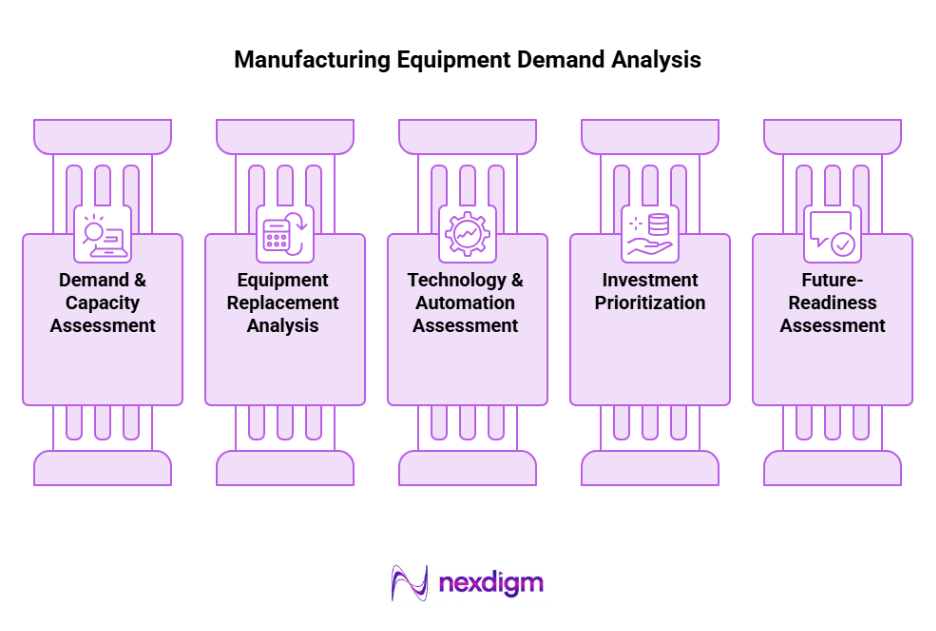
- Demand & Capacity Assessment: Evaluation of production growth, capacity requirements, utilization levels, and anticipated demand to identify where additional equipment may be required.
- Equipment Replacement Analysis: Assessment of existing equipment based on age, performance, maintenance requirements, productivity limitations, and replacement urgency.
- Technology & Automation Assessment: Examination of automation, digitalization, advanced machinery, and process technologies to identify opportunities for productivity and efficiency improvements.
- Investment Prioritization: Comparison of potential investments based on strategic importance, market opportunity, operational impact, implementation requirements, and expected business value.
- Future-Readiness Assessment: Determination of whether proposed equipment can support evolving products, materials, quality standards, production volumes, and manufacturing requirements.
This approach enables manufacturers to develop a structured equipment investment roadmap, balancing immediate replacement needs with capacity expansion, automation opportunities, and longer-term growth objectives.
Business Benefits of Nexdigm’s Equipment Demand Analysis
Nexdigm’s analysis helps manufacturers turn complex equipment requirements into clearer investment priorities. By linking market intelligence with operational and strategic considerations, businesses are offered with the following benefits:
- Better Capital Allocation: Direct investment toward equipment categories with stronger demand potential and strategic relevance.
- Lower Replacement Risk: Identify aging assets and replacement priorities before reliability or productivity issues affect operations.
- Faster Automation Decisions: Determine where automation and digital technologies can improve throughput, flexibility, and production consistency.
- Future-Ready Capacity: Align equipment investments with anticipated production volumes, product requirements, and evolving manufacturing technologies.
- Stronger Investment Planning: Build phased equipment roadmaps that balance immediate operational needs with longer-term growth objectives.
With the following benefits, Nexdigm helps manufacturers move from reactive equipment purchasing to strategic investment planning, supporting more efficient capital deployment and stronger long-term manufacturing capabilities.
Nexdigm’s Analysis in Building Long-Term Manufacturing Readiness
Nexdigm helps manufacturers look beyond immediate equipment requirements and build capabilities aligned with future market conditions. By connecting equipment demand with production outlook, technology evolution, customer expectations, and competitive dynamics, its analysis supports more resilient manufacturing strategies. Businesses can better anticipate capacity needs, prioritize modernization, and prepare for changing production requirements.
This forward-looking perspective enables manufacturers to strengthen operational flexibility, improve investment discipline, and develop equipment strategies that support long-term competitiveness, scalable capacity, and sustainable manufacturing growth.
Nexdigm’s Case
Nexdigm supported an industrial manufacturer in evaluating equipment replacement and expansion priorities. The assessment reviewed 40+ equipment requirements identified 8 high-priority investments, and helped reduce the potential investment shortlist by 25%, enabling more focused capital allocation and a clearer roadmap for automation, capacity expansion, and modernization.
To take the next step, simply visit our Request a Consultation page and share your requirements with us.
Harsh Mittal
+91-8422857704