

Export expansion can look straightforward on a spreadsheet. A country imports billions of dollars of industrial products; domestic manufacturers have spare capacity, and a new market appears to offer room for growth. Yet aggregate import value says little about whether a particular manufacturer can win orders profitably. Tariffs, technical requirements, incumbent suppliers, freight costs and customer expectations can turn an apparently attractive destination into an expensive distraction.
A rigorous export assessment connects market demand with the conditions required to serve it. The objective is to identify where a company can secure sustainable revenue, defend its margins, and build a repeatable route to market.
Demand Must Be Examined at Product Level
The global trade environment offers opportunities, but growth is uneven. UNCTAD estimated that international trade reached a record US$35 trillion in 2025, with goods trade accounting for most of the increase. Its 2026 updates also caution that higher prices have inflated some trade values. Manufacturers therefore need to distinguish genuine increases in purchasing volumes from price-driven growth.
Country-level import totals are only a starting point. An assessment should narrow the analysis to specific products, ideally at the Harmonized System (HS) code level, and evaluate import value, volume, unit values and growth over several years. A market importing large quantities of a product may already be supplied by established exporters. A smaller market with rising imports, fragmented competition and recurring procurement needs may offer a more realistic entry point.
The analysis should also identify who buys the product. Industrial distributors, original equipment manufacturers, public procurement agencies, and large end users have different qualification processes, order sizes, and payment expectations. Demand is commercially meaningful only when the target customer segment can be reached and served.
The Export Price is Not the Selling Price
Market access begins with the full landed-cost calculation. Exporters need to account for the applicable customs duty, preferential tariff eligibility, rules of origin, freight, insurance, port charges, distributor margins and relevant domestic taxes. Product-specific standards, certification, labelling, testing and registration can add both cost and lead time.
The WTO’s World Tariff Profiles 2025 provides tariff and non-tariff measure information for more than 170 economies and customs territories. It is a useful starting point, but broad national averages should not substitute for checking the actual tariff line, product classification and trade agreement that apply to the proposed shipment.
A tariff advantage can be decisive, but it is not always enough to win a business. A manufacturer may enjoy lower customs duties yet lose its advantage through expensive shipping, inconsistent delivery or a product that requires costly adaptation. Conversely, a higher-priced offer can remain competitive when it delivers better reliability, longer service life or lower maintenance costs.
Where is the Strongest Competitive Position?
A useful Manufacturing export market assessment compares the target exporter with the suppliers already serving each destination. That means examining more than the number of competing countries. The analysis should assess competitor prices, product specifications, delivery lead times, distributor relationships, local manufacturing presence, and the reliability buyers associate with each supplier.
Trade data can reveal supplier concentration and changing market shares. Interviews with importers, distributors, and procurement teams can explain why those shares are moving. The combination matters: import statistics show what buyers purchase, while customer research helps explain the criteria behind the purchase.
Three questions should guide the comparison:
- Can the manufacturer deliver a product that meets the market’s technical and regulatory requirements without excessive modification?
- Can it match the incumbent supplier’s delivered price, service level and lead time?
- Is the likely sales volume sufficient to recover certification, channel development and customer acquisition costs?
The answers should be stress-tested against changes in freight rates, exchange rates, raw-material costs, and tariffs. A market that works only under one favourable cost assumption is a fragile export strategy.
Market Selection and Entry Framework
A practical assessment can score each product-country combination across five dimensions.
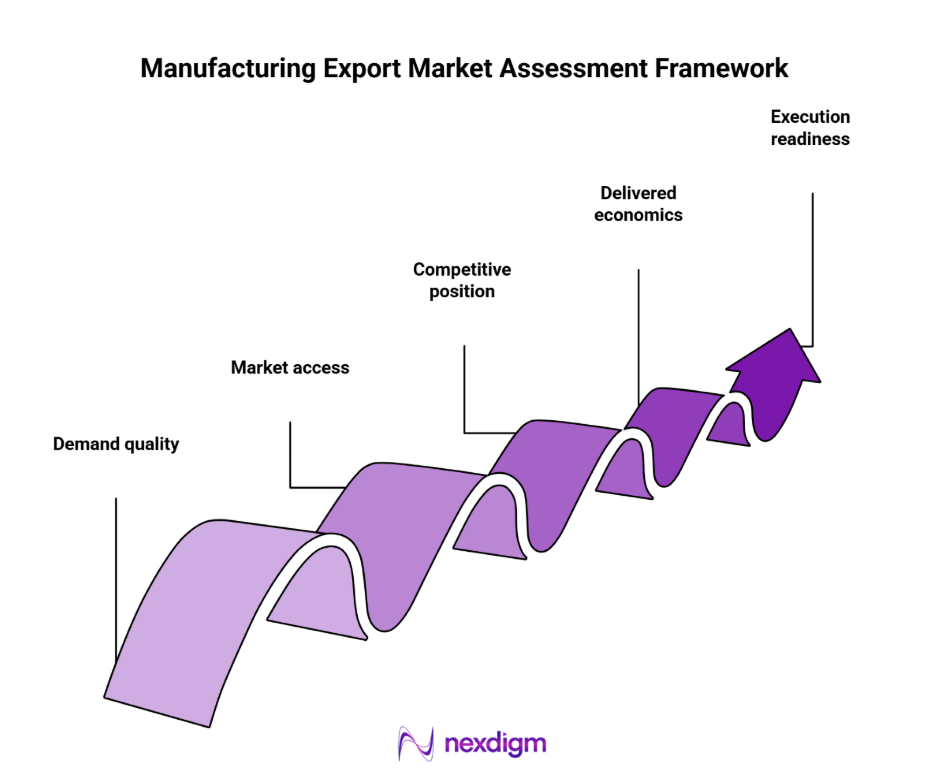
- Demand quality: Import growth, volume stability, buyer concentration, and replacement demand.
- Market access: Tariffs, rules of origin, technical standards, certification and documentation.
- Competitive position: Supplier concentration, price benchmarks, product differentiation, and incumbent advantages.
- Delivered economics: Freight, insurance, distribution margins, working capital, and post-sale support.
- Execution readiness: Production capacity, export documentation, sales channels, and service capability.
The scores should be weighted according to the company’s priorities. A high-volume opportunity may deserve a lower ranking if it requires heavy upfront investment or exposes the business to a single buyer. The output should be a short list of markets, a defensible entry price and a clear go, test or defer recommendation.
Nexdigm Case Study: Prioritising Export Markets for Industrial Components
Nexdigm assessed export opportunities for an Indian industrial-components manufacturer across 12 destination markets and six product families. The assessment combined five-year import trends, supplier-country shares, tariff treatment, competitor pricing, logistics estimates and interviews with channel participants.
The initial long list of 72 product-market combinations narrowed to 19 with credible demand and market access. Of these, seven met the client’s preliminary margin and operational thresholds. The strongest opportunities were not necessarily the largest markets:4 offered a more favourable combination of import growth, manageable certification requirements and lower incumbent concentration.
To take the next step, simply visit our Request a Consultation page and share your requirements with us.
Harsh Mittal
+91-8422857704