

An import-heavy product category can look like an obvious manufacturing opportunity. Buyers are already spending money, demand has been established, and local production could reduce dependence on overseas suppliers. Yet a large import bill does not tell a manufacturer whether it can produce the same goods at a competitive cost.
The important question is why the product is imported. Domestic capacity may be insufficient. Local suppliers may struggle to meet technical specifications. Overseas producers may also benefit from scale, established technology or access to cheaper inputs. Each situation calls for a different investment decision.
How to Identify Products with High Import Substitution Potential
India’s push to deepen domestic electronics manufacturing illustrates the complexity of import substitution. Expanding assembly operations does not automatically establish a competitive local supply chain for semiconductors, specialised components and precision parts. Similar gaps can occur in industrial machinery, electrical equipment, chemicals, and automotive components.
The first step is to examine imports at the individual product level rather than relying on broad industry totals. Import value, volume, unit prices, and supplier-country shares can reveal whether demand is persistent or driven by temporary price movements.
Three patterns deserve attention:
- Recurring imports with limited domestic supply: These may indicate an opportunity to develop local production; provided demand is large enough to support efficient operations.
- Imports of specialised components: These can offer attractive margins but may require technology partnerships, certification or substantial engineering investment.
- Products already made locally: The opportunity may lie in improving quality, productivity, or delivery rather than establishing another manufacturing facility.
The next step is to identify the actual buyers. A product used by several industrial sectors offers a different risk profile from one purchased by a handful of large customers. Procurement requirements, qualification timelines and willingness to switch suppliers should be established before production economics are finalised.
Can Local Manufacturing Compete with Imported Products?
The comparison must use the cost of an equivalent product delivered to the customer. An overseas factory price is not an appropriate benchmark if the buyer also pays freight, insurance, customs duties, inventory costs and distribution margins.
Domestic production has its own cost structure: raw materials, labour, energy, tooling, quality control, depreciation, financing, and production losses. Low labour costs or shorter transport distances will not guarantee an advantage if the plant operates below efficient capacity or depends on expensive imported inputs.
Technology is another constraint. A manufacturer may be able to produce a component, but not to the tolerances, consistency or performance standards required by its customers. In that situation, a technology partner or contract-manufacturing arrangement may be more commercially sensible than an immediate independent investment.
A Manufacturing import substitution assessment should also consider planned domestic capacity additions. An import gap that exists today may narrow before a new plant reaches stable production, particularly when several competitors are investing in the same product category.
Nexdigm’s Local Manufacturing Feasibility Framework
The Import Substitution Feasibility Framework helps manufacturers distinguish a promising trade gap from an investable production opportunity.
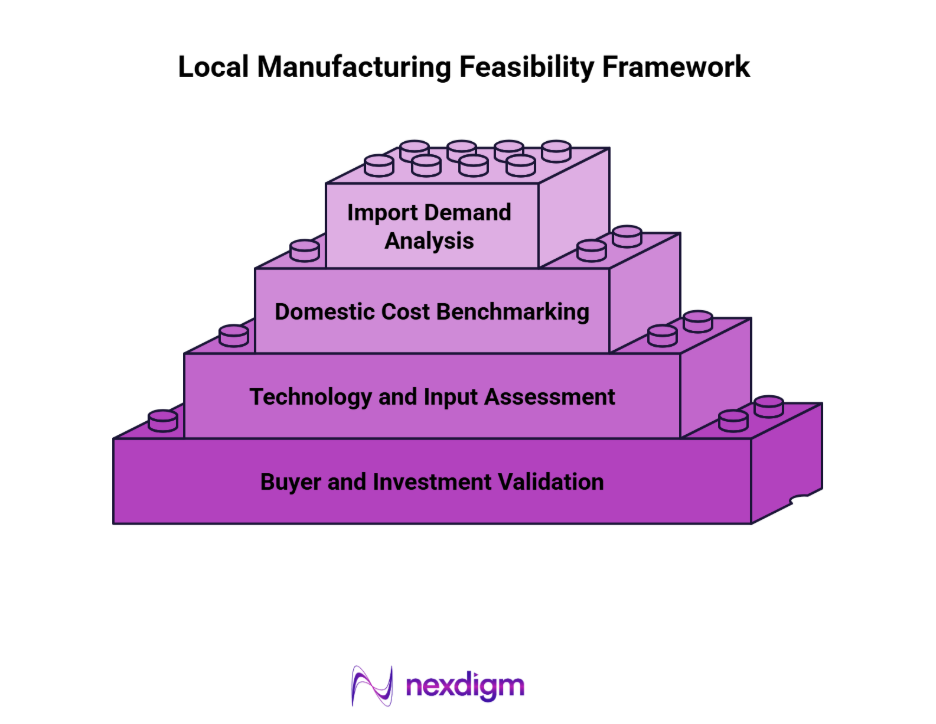
- Import Demand Analysis: Establish recurring demand, product-level import trends, major suppliers and the industries purchasing the product.
- Domestic Cost Benchmarking: Compare landed import prices with local manufacturing costs at realistic utilisation levels.
- Technology and Input Assessment: Evaluate process requirements, machinery, raw materials, quality standards and supplier availability.
- Buyer and Investment Validation: Confirm customer interest, qualification requirements, achievable pricing and the investment needed to reach competitive production.
The output should be a shortlist of products ranked by commercial attractiveness, technical readiness, and investment risk. Products that require significant capability development can remain on a longer-term roadmap rather than being treated as immediate manufacturing opportunities.
Nexdigm Case Study: Screening Imported Industrial Products
Nexdigm assessed 28 imported industrial product categories for an Indian manufacturer considering domestic production. Ten showed sustained demand, but only six remained commercially attractive after input costs; production requirements and capacity utilisation were evaluated. Four were shortlisted for detailed feasibility assessment, while products requiring substantial technology investment were deferred.
To take the next step, simply visit our Request a Consultation page and share your requirements with us.
Harsh Mittal
+91-8422857704