

Manufacturing opportunities emerge at different points in the industrial value chain. Growth in electronics assembly, for example, can increase demand for precision components, electrical equipment, testing services and specialised materials. Investment in transport infrastructure can support demand for fabricated metals, industrial machinery, cables and equipment maintenance.
UNIDO’s Q4 2025 manufacturing report recorded a 1.7% increase in global manufacturing exports during the quarter. Higher-technology exports grew by 2.6%, while exports of other manufactured goods declined slightly. The pattern indicates that manufacturing opportunities are unevenly distributed across technology levels and product categories.
Which Industrial Segments Offer the Strongest Commercial Potential?
Opportunity mapping should trace demand through the value chain, from raw materials and components to finished products, distribution and aftermarket services. This helps identify where growth in one industry creates requirements for suppliers in adjacent sectors.
Several areas warrant product-level assessment:
- Electrical equipment and power systems: Cables, switchgear, transformers and control equipment linked to grid investment, industrial electrification and data-centre development.
- Industrial machinery and automation: Equipment, sensors, drives and precision components required for factory modernisation and capacity expansion.
- Electronics and advanced components: Assemblies, semiconductor-related equipment, thermal management and specialised materials, subject to technical capability and customer qualification.
- Transport and mobility supply chains: Components, castings, fabricated structures and electrical systems for vehicles, rail and other transport equipment.
- Industrial materials and processing: Chemicals, engineered polymers, metal products and intermediate materials used across construction, packaging and manufacturing.
These are opportunity pools to investigate, not a universal ranking. Their attractiveness depends on local demand, supply gaps, production capabilities and the competitive position of potential entrants.
Manufacturers Can Distinguish Structural Growth from Temporary Demand
A segment may expand quickly because of a temporary inventory cycle, subsidies or a short-lived shortage. Structural growth is more likely where customers have committed investment, installed capacity is insufficient or regulation and technology are changing product requirements over several years.
Steel offers a useful warning. The OECD’s 2026 outlook estimates that global excess steelmaking capacity could reach 745 million tonnes by 2028, despite continued capacity additions. At the same time, demand prospects vary considerably, with India and Southeast Asia showing stronger growth potential than China and several mature economies. A growing industrial ecosystem can therefore contain both attractive downstream opportunities and oversupplied upstream products.
Opportunity mapping should assess demand growth alongside capacity utilisation, imports, announced projects, customer concentration and the pace at which new supply could enter the market. It should also distinguish a segment’s total growth from the portion accessible to a new supplier.
Identify the Best Point of Entry
Entering an industrial value chain does not always require building a complete manufacturing operation. A company may be better positioned to supply a specialised component, provide contract manufacturing, develop a local finishing capability or serve an aftermarket requirement before investing in a larger facility.
The appropriate entry point depends on technical barriers, capital intensity, customer qualification and the ability to differentiate. Segments with demanding certification requirements may take longer to enter but offer stronger customer retention once qualified. Standardised products may offer faster access but expose suppliers to more intense price competition.
A useful assessment should identify the products customers struggle to source, the capabilities required to supply them and the investment needed to reach commercial scale.
Nexdigm’s Manufacturing Opportunity Mapping Framework
For Manufacturing industry opportunity mapping, Nexdigm can connect end-market demand, value-chain relationships, competitive capacity and product-level economics to identify segments where investment can capture measurable commercial value.
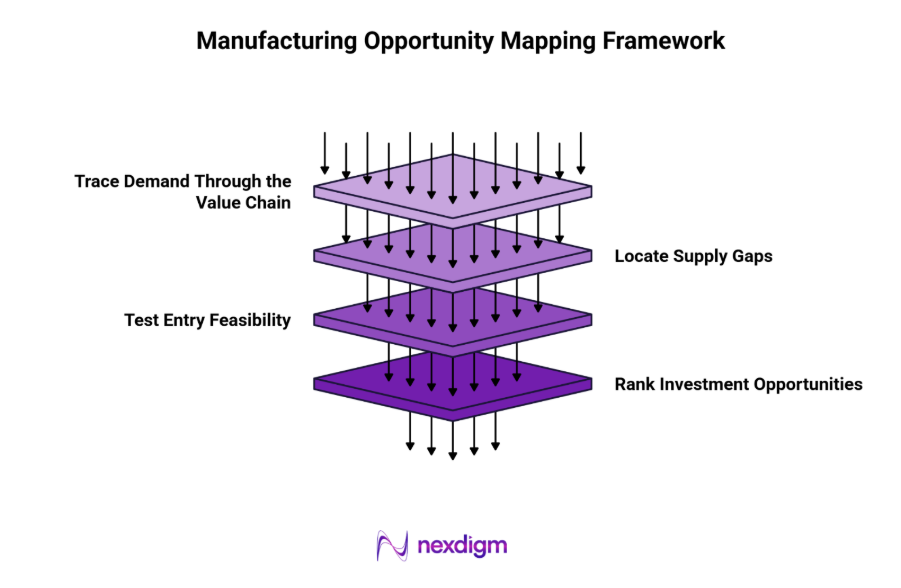
- Trace Demand Through the Value Chain
Map major end markets to the components, materials, equipment and services required to support their growth. - Locate Supply Gaps
Compare demand forecasts with domestic capacity, imports, supplier concentration, lead times and planned production additions. - Test Entry Feasibility
Assess technical requirements, capital intensity, customer qualification, production capability and competitive differentiation. - Rank Investment Opportunities
Compare addressable revenue, achievable margins, time to market, execution risk and downside resilience to prioritise products and segments.
Nexdigm Case Study: Prioritising Industrial Value-Chain Opportunities
Nexdigm mapped 32 product segments across electrical equipment, industrial machinery, transport components and engineered materials for a manufacturing group evaluating diversification. Screening covered 5 end markets, import dependence, capacity additions, customer concentration and estimated gross margins.
6 segments advanced to detailed assessment, with three showing projected annual demand growth above 6% and gross-margin potential of 18% to 22%.
To take the next step, simply visit our Request a Consultation page and share your requirements with us.
Harsh Mittal
+91-8422857704