

A manufacturing project can meet its revenue target and still underperform financially. Raw-material inflation, low utilisation, delayed customer approvals, working-capital requirements and unplanned capital expenditure can absorb the margin expected at the investment stage.
The first task is to establish how much demand a proposed facility can realistically capture. This requires product-level forecasts, customer evidence and an assessment of competing supply. Capacity should be sized against achievable sales rather than an optimistic share of the total market.
UNIDO’s Q2 2026 manufacturing data show that global production increased by 1.5% quarter on quarter, but the performance of individual industries remained uneven. A favourable aggregate trend cannot compensate for a weak product-market fit or an oversized facility.
Build the Revenue Case Before Committing Capital
The revenue forecast should identify the customers, product mix, selling prices and volumes supporting the investment. Each assumption needs a defensible basis, such as customer forecasts, historical purchasing, tender pipelines or verified demand from downstream industries.
Price assumptions require scrutiny. A market experiencing rapid demand growth may also be attracting new producers. If competing capacity enters service before a new plant reaches full utilisation, selling prices can fall precisely when the investor needs cash flow to improve.
The assessment should establish:
- Addressable demand and expected market share.
- Customer concentration and the status of offtake commitments.
- Competitive capacity and the timing of new supply.
- Price realisation, product mix and potential margin erosion.
- The time required for customer qualification and volume ramp-up.
The result should be a sales forecast that distinguishes secured volumes from prospective business and makes the assumptions behind each explicit.
Test the Cost Base Under Operating Conditions
Manufacturing costs vary with production scale, utilisation and process efficiency. A facility may appear competitive at full output but become uneconomic when orders fall below plan. Fixed labour, depreciation, maintenance and facility costs continue even when production volumes decline.
Variable costs also require careful treatment. Raw materials, energy, freight, scrap rates, consumables and outsourced processing can change the economics materially. Labour comparisons should account for productivity and quality rather than wages alone.
Capital expenditure is only one part of the funding requirement. Equipment installation, commissioning, tooling, certification, recruitment, initial inventory and customer payment terms can create a substantial cash requirement before the plant reaches stable production.
A robust model should calculate the break-even utilisation rate, peak funding requirement and cash-flow trajectory during ramp-up. It should also test whether the business can withstand delays in commissioning or customer approvals without breaching financing constraints.
Which Risks Can Change the Investment Decision?
Risk assessment is most useful when it quantifies how a specific disruption affects returns. Currency depreciation may increase imported-input costs. A delayed customer qualification can postpone revenue while labour and facility expenses continue. A competitor’s new production line may reduce attainable prices or the share of demand available to the project.
For a Manufacturing investment feasibility assessment, Nexdigm can integrate demand forecasts, cost benchmarking, capacity planning, financial modelling and scenario analysis to determine whether the investment meets the client’s return requirements under realistic operating conditions.
The analysis should distinguish risks that can be managed through contracts or operating choices from those that could invalidate the investment thesis. Dual sourcing may reduce input disruption, for example, while a long-term customer agreement may improve revenue visibility. Neither can compensate for a structurally oversupplied market.
Manufacturing Investment Return Assessment Framework
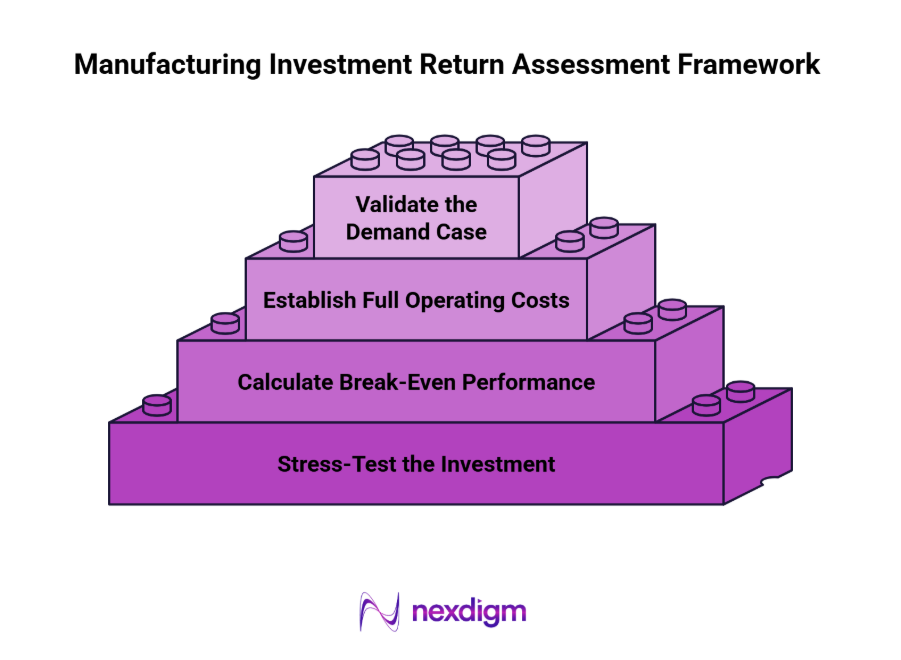
- Validate the Demand Case
Build a product-level sales forecast from customer requirements, market growth, competition and realistic market-share assumptions. - Establish Full Operating Costs
Model materials, labour productivity, utilities, logistics, maintenance, quality losses, working capital and the complete capital requirement. - Calculate Break-Even Performance
Determine the utilisation, price and volume needed to cover operating costs and meet the target return. - Stress-Test the Investment
Model downside demand, delayed ramp-up, cost inflation, lower prices and currency changes. Define the conditions under which the investment should proceed, be phased or be rejected.
Nexdigm Case Study: Stress-Testing a New Production Facility
Nexdigm evaluated a proposed 36,000-unit annual facility for an industrial equipment supplier. The team modelled demand across 18 target customers, benchmarked input and logistics costs, and tested utilisation from 55% to 90%.
The base case reached a 17% project IRR at 78% utilisation, while a six-month commissioning delay reduced the return to 11%. Nexdigm recommended staged equipment installation, dual sourcing for two critical inputs and securing purchase commitments covering 45% of first-year capacity before full capital approval.
To take the next step, simply visit our Request a Consultation page and share your requirements with us.
Harsh Mittal
+91-8422857704