

Manufacturing location decisions are becoming more strategic as companies balance cost efficiency with supply-chain resilience, infrastructure quality, workforce availability, and market access. According to UNIDO, global manufacturing production increased 1.5% in Q2 2026, while manufacturing exports grew 6.1%.
Higher-technology manufacturing was particularly strong, with production rising 2.0% and exports increasing 7.1% during the quarter. Asia and the Pacific led regional export growth, highlighting the importance of competitive manufacturing ecosystems. These trends make location attractiveness more complex than comparing labor or land costs alone.
Manufacturers increasingly need to assess supplier networks, utilities, skilled labor, logistics connectivity, incentives and operating costs together. A structured scoring framework helps businesses compare markets consistently, identify strengths and constraints, and determine which locations are best positioned for sustainable manufacturing growth.
Evaluating Manufacturing Ecosystem Strength
Manufacturing performance is often influenced by the strength of the surrounding ecosystem. Supplier availability, utility reliability, skilled workforce access, and supporting industrial infrastructure can directly affect production efficiency and business continuity. Assessing these factors together helps manufacturers identify locations that offer a stronger foundation for sustainable operations and future expansion.
Balancing Costs with Long-Term Competitiveness
While labor and operating costs remain important, manufacturers increasingly evaluate locations based on broader strategic considerations. Logistics connectivity, regulatory environment, investment incentives, and proximity to customers can significantly impact long-term competitiveness. A structured assessment enables businesses to compare markets more effectively and select locations that align with both operational requirements and growth objectives.
Why Manufacturing Location Decisions Require a Structured Assessment
As manufacturing networks become more complex, location decisions require a comprehensive evaluation of factors that influence both operational performance and long-term competitiveness. Through Manufacturing location attractiveness analysis, Nexdigm helps businesses assess supply chain ecosystems, infrastructure availability, workforce access, incentives, logistics efficiency, and operating conditions. This structured approach enables manufacturers to compare locations objectively, identify market strengths and constraints, and make informed decisions that support sustainable production, resilience, and future growth.
Nexdigm’s Expertise in Analyzing Manufacturing Location Attractiveness
With experience across diverse manufacturing sectors, Nexdigm combines market intelligence, location analysis, and strategic advisory to help businesses evaluate manufacturing opportunities with greater confidence. Its industry-led approach goes beyond comparing costs to assess the operational, infrastructural, and ecosystem factors that influence long-term success. By connecting market realities with business objectives, Nexdigm helps manufacturers identify locations that support efficiency, resilience, and sustainable growth.
Nexdigm’s Manufacturing Location Attractiveness Analysis
As manufacturers balance cost considerations with long-term competitiveness, selecting the right location requires a comprehensive evaluation of operational and strategic factors. Nexdigm’s Manufacturing Location Attractiveness Analysis helps businesses compare markets across through:
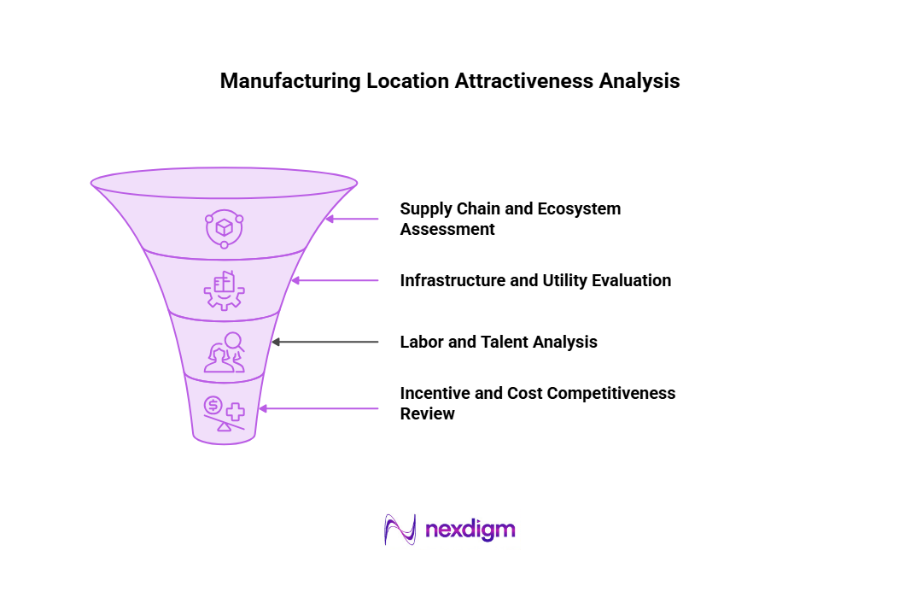
- Supply Chain and Supplier Ecosystem Assessment: Evaluation of supplier networks, industrial clusters, sourcing capabilities, and ecosystem maturity to understand operational support and resilience.
- Infrastructure and Utility Evaluation: Assessment of power reliability, water availability, transportation infrastructure, and industrial readiness required to support efficient manufacturing operations.
- Labor and Talent Analysis: Examination of workforce availability, skill levels, labor costs, and talent accessibility to determine a location’s ability to support production requirements.
- Incentive and Cost Competitiveness Review: Analysis of investment incentives, operating costs, tax considerations, and regulatory factors that influence overall manufacturing attractiveness.
Through this structured and comparative approach, Nexdigm helps manufacturers identify locations that support operational efficiency, supply chain resilience, and sustainable long-term growth.
Nexdigm’s Analysis Offering Manufacturing Advantage
Manufacturing performance is shaped by a combination of supply chain strength, infrastructure quality, workforce availability, logistics efficiency, and the overall business environment. Evaluating these factors in isolation can overlook important interdependencies. Nexdigm’s Manufacturing location attractiveness analysis offers these advantages:
- Operational Readiness: Assess infrastructure quality, utility reliability, supplier accessibility, and workforce capabilities to determine whether a location can efficiently support manufacturing operations from inception.
- Supply Chain Resilience: Evaluate sourcing networks, supplier ecosystems, logistics connectivity, and industrial linkages to reduce disruptions and strengthen long-term manufacturing continuity.
- Growth Potential: Analyze industrial development trends, market access, investment activity, and expansion opportunities to identify locations capable of supporting future manufacturing growth.
- Cost Competitiveness: Compare operating costs, labor economics, incentives, taxation, and resource availability to understand the overall financial attractiveness of manufacturing locations.
- Sustainable Advantage: Identify locations where ecosystem strengths, infrastructure, talent availability, and business conditions can support long-term competitiveness and operational scalability.
By connecting location factors with business outcomes, Nexdigm helps manufacturers identify markets positioned to deliver both immediate operational benefits and long-term strategic value.
Nexdigm’s Case
Nexdigm supported an industrial client in comparing potential manufacturing locations across supply chains, utilities, labor, incentives, and logistics. The assessment scored 14 locations across 30+ criteria, identified priority markets, and helped narrow the initial shortlist by 38%, enabling more focused location and investment decisions.
To take the next step, simply visit our Request a Consultation page and share your requirements with us.
Harsh Mittal
+91-8422857704