

Manufacturing growth is not spreading evenly across industries or production locations. Some sectors are benefiting from investment in electronics, machinery and transport equipment, while others face slower demand, higher input costs or pressure from imports. For manufacturers evaluating expansion, national growth figures provide a starting point, not a decision.
The more useful question is where production is increasing, what is driving that increase and whether the growth creates a defensible commercial opportunity.
Start With the Production Data
UNIDO’s World Manufacturing Production and Trade Report, Q2 2026 recorded a 1.5% quarter-on-quarter increase in global manufacturing production. Manufacturing exports rose by 6.1% over the same period. Production of higher-technology goods increased by 2.0%, while their exports grew by 7.1%.
The difference between production and export growth is worth examining. It may reflect stronger external demand, changes in inventory or differences in the industries and markets driving output. It does not, by itself, establish that every exporting country has become more competitive.
UNIDO’s data allows comparisons across regions and industrial sectors using harmonised production indices and manufacturing trade statistics. Businesses can use this to identify where momentum is broad-based and where it is concentrated in a small number of industries.
Three Questions To Ask Of A Growth Market
- Is demand actually expanding?
Rising output may serve domestic consumers rather than export customers. Manufacturers should compare production growth with imports, exports, order books and relevant end-market indicators. A market that is importing more of a product may offer an opening for new suppliers, but only if the demand is accessible and commercially attractive. - Can local producers meet the demand?
Capacity utilisation, labour productivity, energy reliability, input availability and technology determine how quickly a market can respond. Strong demand in a location with constrained infrastructure may create opportunities for imported goods or additional production investment, but it can also increase operating costs. - Who is capturing the value?
Market share, product quality, delivery reliability and customer relationships help explain why some manufacturers gain ground while others lose it. A country can expand production without improving its position in higher-value products.
Follow The Supply Chain, Not Just The Factory
Manufacturing competitiveness is shaped by access to components, specialist suppliers, logistics networks and technical skills. An expanding electronics cluster, for example, may attract additional investment because component suppliers and skilled workers are already available nearby.
This creates a cumulative effect: established industrial ecosystems can lower sourcing friction and shorten production lead times. However, excessive reliance on a single supplier region may increase exposure to disruption.
Businesses should map the origins of important inputs and identify whether new production capacity is supported by a sufficiently broad supplier base. They should also examine whether investment announcements have progressed to operational facilities and actual shipments.
Nexdigm’s Manufacturing Growth Screening Model
Use these five tests to shortlist expansion markets:
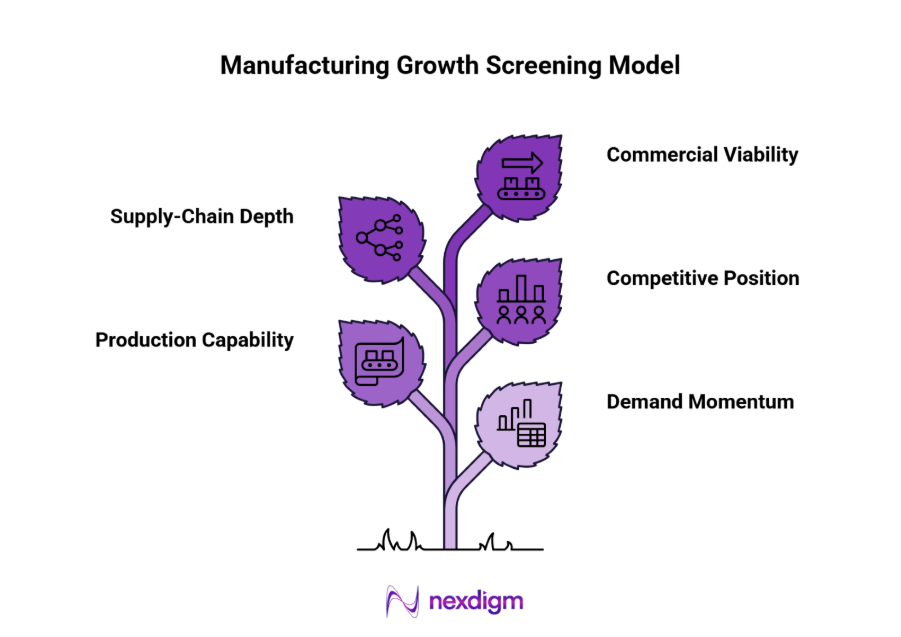
- Demand Momentum: Verify growth in product demand, imports and customer orders.
- Production Capability: Assess output, capacity utilisation, skills and infrastructure.
- Competitive Position: Compare supplier shares, product mix, quality and delivered costs.
- Supply-Chain Depth: Measure access to components, logistics and alternative suppliers.
- Commercial Viability: Test margins, investment needs and downside scenarios.
The output should be a ranked set of markets and sectors, each supported by evidence about demand, execution and competitive position.
Nexdigm’s Case Study: Separating Growth from Opportunity
An industrial equipment producer identifies three markets with rising manufacturing output. One is dominated by established suppliers, another lacks reliable component sourcing, and the third combines import growth with accessible distribution partners. The company focuses its initial market-entry work on the third location.
Manufacturing growth is most valuable when demand, production capability and market access reinforce one another. Tracking production and trade together helps businesses avoid treating temporary output increases as proof of long-term competitiveness and gives investment teams a more grounded basis for selecting markets.
To take the next step, simply visit our Request a Consultation page and share your requirements with us.
Harsh Mittal
+91-8422857704