

Manufacturing investment is increasingly being distributed across multiple locations rather than concentrated around the lowest-cost production base. Companies are balancing customer proximity, supply-chain resilience, infrastructure, tariffs, supplier depth, labour costs, and access to expanding end markets.
The global backdrop remains supportive but uneven. The IMF projects global growth of 3.0% in 2026 and 3.4% in 2027, while noting that technology investment is benefiting economies integrated into global technology value chains.
UNIDO reported that global manufacturing production increased 1.2% quarter-on-quarter in Q1 2026, following relatively subdued growth through 2025. Asia and the Pacific recorded the strongest regional performance, while Europe experienced a significant decline.
For manufacturers, the issue is therefore less about whether global manufacturing will grow and more about where incremental capacity can earn attractive returns.
Capacity Is Moving for Different Reasons
The next manufacturing hub is rarely determined by one cost variable.
Semiconductor manufacturing demonstrates the role of technology and strategic localization. SEMI’s July 2026 forecast puts global semiconductor manufacturing equipment sales at $165.9 billion in 2026, up 23.2% year-on-year, with AI infrastructure, advanced memory, leading-edge logic, and back-end technologies driving investment.
Other industries face very different economics. Battery manufacturing, for example, is dealing with substantial existing capacity in some regions. The IEA has highlighted how weaker projected demand in the United States is making additional battery investment harder to justify, while supply-chain localization continues to influence where new capacity is developed.
The result is a manufacturing landscape where capacity expansion, relocation, and localization can happen simultaneously.
Low Cost Does Not Guarantee Manufacturing Competitiveness
Direct labour remains important, but it is only one component of delivered manufacturing cost.
A location with lower wages can lose its advantage through expensive power, imported components, poor logistics, high inventory requirements, port congestion, or unreliable utilities.
Supplier depth is particularly important. A manufacturer dependent on imported components may require larger working-capital buffers and longer replenishment cycles than a competitor operating inside a mature industrial cluster.
Infrastructure creates another dividing line. Advanced production facilities increasingly depend on stable electricity, reliable industrial water, digital connectivity, skilled technical workers, and predictable logistics.
Manufacturing market assessment consulting therefore needs to compare total operating economics rather than headline wage rates.
India, Mexico and Southeast Asia Represent Different Investment Logic
India has benefited from policies supporting electronics and other strategic manufacturing segments. The supplied market material notes that electronics exports reached $47 billion in 2025, with smartphones accounting for nearly $30 billion, while PLI investments reached ₹20,587 crore.
Mexico offers a different proposition through proximity to the US market and North American supply chains. Vietnam combines access to East Asian component ecosystems with extensive trade agreements, while Eastern Europe offers integration into European manufacturing networks and established engineering capabilities.
None of these advantages operates independently.
A location can offer tariff benefits but face power constraints. Another may have low labour costs but weak supplier depth. A third may have excellent infrastructure but expensive industrial land.
The investment decision comes from the combined economics.
Manufacturing Growth Needs to Be Separated From Capacity Surplus
Headline demand growth can also conceal an unattractive investment environment.
The solar manufacturing industry demonstrates the problem. The IEA has reported manufacturing capacity substantially above current deployment in several clean-energy technologies, creating pressure on utilization and margins.
This makes capacity-gap analysis essential. New production is commercially attractive when additional demand is sufficiently large to absorb capacity, when existing competitors are operating near practical limits, or when the proposed facility has a meaningful cost, technology, or location advantage.
A market with rapid demand growth can therefore still be a poor entry opportunity if competitors have already committed significantly more capacity than the market can absorb.
Nexdigm’s Manufacturing Market Attractiveness Framework
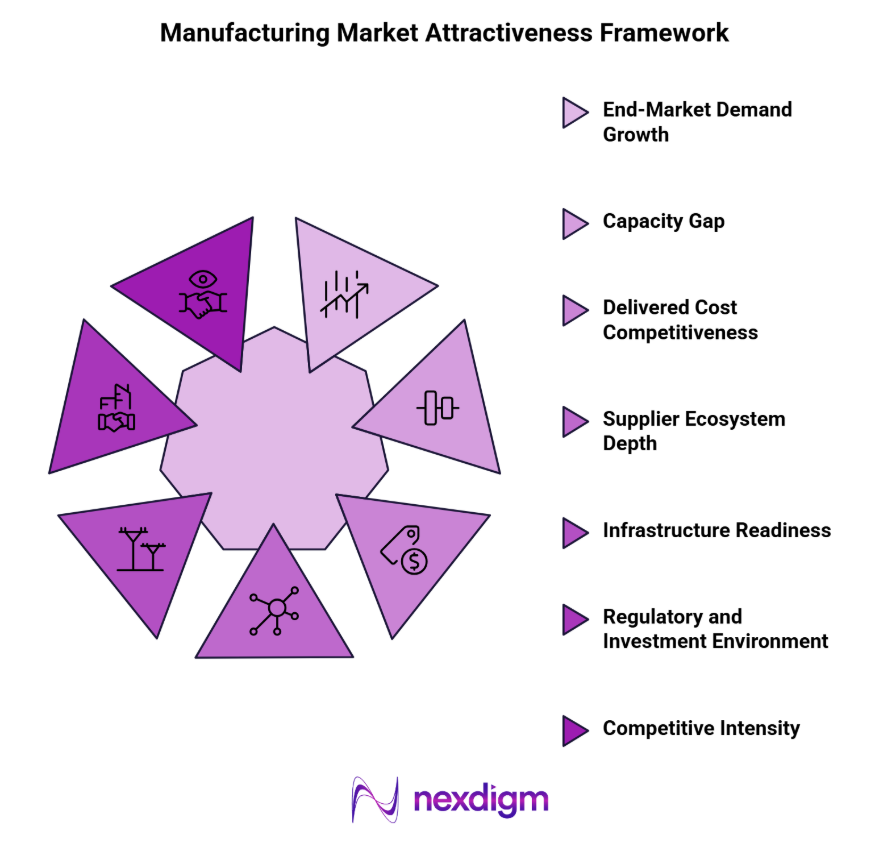
- End-Market Demand Growth
Measure consumption growth across the industries and customer segments that the proposed manufacturing facility will serve. - Capacity Gap
Compare verified demand with operational installed capacity, utilization, announced projects, and realistic commissioning timelines. - Delivered Cost Competitiveness
Assess labour, power, utilities, raw materials, freight, tariffs, taxes, inventory, and other location-specific operating costs. - Supplier Ecosystem Depth
Evaluate local availability of components, raw materials, tooling, maintenance services, logistics providers, and technical suppliers. - Infrastructure Readiness
Assess electricity reliability, water availability, industrial land, ports, roads, rail, digital infrastructure, and site-development timelines. - Regulatory and Investment Environment
Evaluate incentives, industrial policy, taxation, import requirements, environmental rules, and regulatory predictability. - Competitive Intensity
Map incumbent capacity, pricing behaviour, planned investments, market concentration, and the likelihood of future capacity additions.
Deciding where to allocate capital requires rigorous manufacturing market assessment consulting to evaluate operational realities beyond headline incentives.
Case Study: Manufacturing Market Assessment Consulting
A components manufacturer compared India, Mexico, and Vietnam on supplier depth, labour, logistics, and customer access. The preferred location produced a 14% higher projected operational EBITDA margin for high-volume assemblies despite a less favourable headline tariff position.
To take the next step, simply visit our Request a Consultation page and share your requirements with us.
Harsh Mittal
+91-8422857704