

A large industrial market can look compelling on paper while offering poor returns to a new entrant. High demand may already be served by established producers, import competition may constrain pricing, or operating costs may erode margins. Market attractiveness depends on the portion of demand a company can realistically capture and the economics of serving it.
The OECD’s Steel Outlook 2026 projects global excess steelmaking capacity could reach 745 million tonnes by 2028, while global steel demand growth is expected to remain weak. India and Southeast Asia have stronger demand prospects than several mature markets, but capacity additions and trade flows still affect local profitability. Demand growth alone does not guarantee an attractive production environment.
Manufacturers need to compare markets on commercial returns and operational feasibility together. The most attractive location is one where customer demand, competitive positioning, production economics and execution conditions support a sustainable business.
How Can Manufacturers Compare Market Attractiveness?
A useful comparison starts with addressable demand rather than total market size. Estimate consumption for the target product, identify the share supplied by domestic producers and imports, and assess which customers may consider an additional supplier.
The next step is to establish the economics of competing in that market. Costs should be evaluated on a comparable basis, including raw materials, labour productivity, utilities, freight, tariffs, working capital and after-sales requirements.
A market comparison should include:
- Commercial opportunity: Addressable demand, customer growth, price realisation, import dependence and sales concentration.
- Competitive position: Installed capacity, utilisation, product quality, incumbent advantages and planned capacity additions.
- Operating feasibility: Labour availability, productivity, energy reliability, industrial land, utilities and supplier networks.
- Market access: Transport connectivity, customs procedures, trade agreements, product standards and customer qualification.
- Investment resilience: Currency movements, policy changes, supply-chain exposure and the cost of exiting or scaling down.
These criteria should be weighted according to the business model. A precision-component manufacturer may place greater emphasis on skilled labour, quality systems and customer proximity. A commodity producer may prioritise feedstock access, energy costs, scale and freight economics.
What Makes a Manufacturing Location Operationally Viable?
Operational viability requires evidence that a facility can achieve its planned output at the required cost and quality. Average wages are a poor substitute for labour productivity. Similarly, an industrial park’s advertised utility capacity does not establish the reliability of power or water available to a particular site.
Manufacturers should test practical constraints before committing capital. These include supplier lead times, maintenance support, access to technical skills, logistics bottlenecks, permitting and the time needed to qualify a new production location with customers.
For a Manufacturing market attractiveness study, Nexdigm can combine demand sizing, competitor analysis, cost benchmarking and operating-risk assessment to compare markets on expected commercial returns rather than headline growth alone.
From Market Ranking to an Investment Decision
A single composite score can help narrow the shortlist, but it should not hide critical weaknesses. A market with low operating costs may still be unsuitable if the company cannot secure customers or meet product standards. Another may justify a higher-cost footprint if proximity reduces inventory, improves service levels or enables access to strategic customers.
The final comparison should quantify the economics under base and downside scenarios. Key outputs include expected margins, break-even utilisation, initial capital requirements, working-capital needs, payback period and the sensitivities that could change the ranking.
Nexdigm’s Manufacturing Market Viability Framework
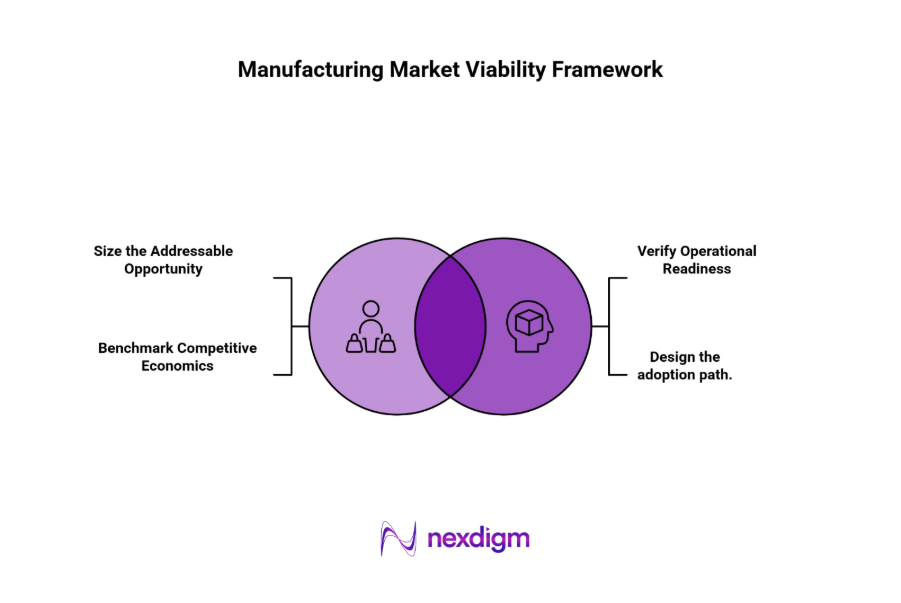
- Size the Addressable Opportunity
Estimate demand for the target product, identify customers and determine how much business is realistically contestable. - Benchmark Competitive Economics
Compare achievable selling prices, incumbent capacity, input costs, logistics, tariffs and expected margins. - Verify Operational Readiness
Test supplier access, workforce capability, utility reliability, infrastructure, permitting and customer qualification requirements. - Stress-Test Investment Returns
Model utilisation, working capital, price pressure, currency exposure and downside demand before selecting the market and entry mode.
Nexdigm Case Study: Comparing Three Manufacturing Markets
Nexdigm compared three markets for a manufacturer of precision-engineered components, assessing 16 customer segments, competitor capacity, landed costs, labour productivity and supplier availability. The leading market offered a projected 14% operating margin at 70% utilisation, compared with 9% and 11% in the alternatives. Sensitivity analysis showed that a 7% increase in imported input costs would reduce the leading market’s margin to 10.5%. Nexdigm recommended a local production partnership with staged capital commitments and supplier diversification.
To take the next step, simply visit our Request a Consultation page and share your requirements with us.
Harsh Mittal
+91-8422857704