

Manufacturers facing rising demand must decide whether to expand an existing plant or invest in new capacity. The decision has become more significant as global manufacturing investment, utilization levels, labor costs, and supply-chain considerations continue to evolve.
According to the UNIDO, global manufacturing output grew by approximately 3.1% year over year in Q4 2025, indicating continued industrial expansion across major economies. Meanwhile, the OECD reports that global foreign direct investment reached approximately $1.6 trillion in 2025, reflecting substantial cross-border investment activity.
These conditions make capacity planning increasingly strategic. Businesses must evaluate demand visibility, current plant utilization, expansion costs, available infrastructure, labor, logistics, incentives, and location economics to determine whether extending an existing facility or establishing a new plant offers the stronger long-term business case.
Key Factors Influencing Capacity Expansion Decisions
Choosing between expanding an existing facility and building new capacity requires evaluating multiple operational, financial, and strategic factors. A structured assessment helps manufacturers understand:
- Demand Growth and Capacity Requirements: Analyze future demand projections to determine whether incremental expansion or significant new capacity is required.
- Current Plant Utilization: Evaluate existing asset utilization to identify available capacity, bottlenecks, and expansion feasibility.
- Capital and Operating Costs: Compare investment requirements, operating expenses, maintenance costs, and expected returns for both options.
- Risk and Strategic Flexibility: Measure market uncertainty, expansion risks, diversification benefits, and long-term growth flexibility.
The optimal capacity strategy depends on balancing demand expectations, utilization levels, investment economics, and location advantages. A data-driven evaluation enables manufacturers to select the most sustainable and value-accretive path for future growth.
Understanding the Need for Structured Capacity Expansion Assessment
As manufacturing markets evolve, capacity investment decisions carry significant operational and financial implications. Whether the objective is increasing production, reducing costs, improving market access, or strengthening supply chain resilience, businesses need a clear understanding of demand potential, facility performance, investment requirements, and location advantages.
Through its Manufacturing plant expansion assessment and strategic advisory capabilities, Nexdigm helps manufacturers evaluate expansion opportunities holistically, enabling data-driven decisions that balance growth objectives, operational efficiency, and long-term competitiveness. This structured assessment not only helps compare expansion alternatives and quantify risks but also provides the foundation for sustainable capacity planning and investment success.
Why Businesses Choose Nexdigm
Manufacturers require more than data when evaluating capacity expansion decisions. They need actionable insights that connect market opportunities, operational realities, and investment priorities. Nexdigm combines industry expertise, market intelligence, and strategic advisory capabilities to help businesses make informed and confident expansion decisions.
- Industry-Led Expertise: Deep sector knowledge enables tailored assessments that reflect industry dynamics, competitive landscapes, and operational requirements.
- Comprehensive Decision Support: Evaluates demand potential, capacity utilization, investment feasibility, location attractiveness, and strategic growth opportunities through an integrated approach.
- Data-Driven Insights: Combines market research, benchmarking, and analytical frameworks to support objective and evidence-based decision-making.
By combining market intelligence, industry expertise, and strategic analysis, Nexdigm helps manufacturers evaluate expansion opportunities with greater confidence, reduce decision-making uncertainty, and build sustainable capacity growth strategies.
Nexdigm’s Expertise in Manufacturing Plant Expansion Assessment
A successful Manufacturing plant expansion assessment requires balancing demand projections, operational capacity, investment economics, and location-specific advantages. Nexdigm supports manufacturers through data-driven assessments that involves:
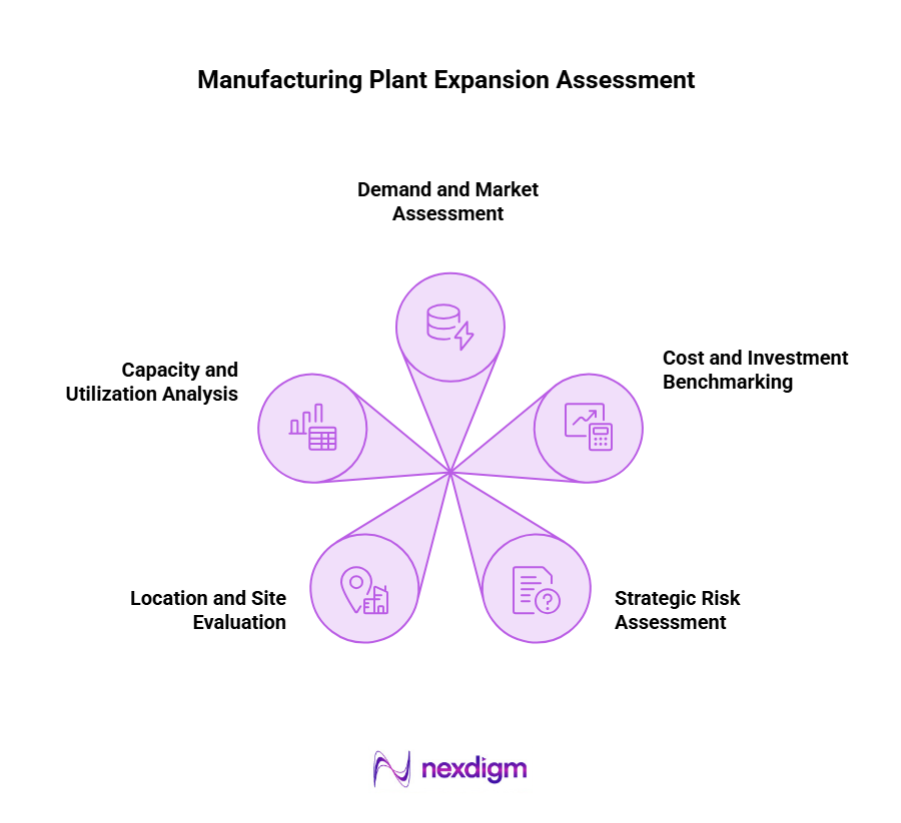
- Demand and Market Assessment: Evaluation of market growth potential and future demand to validate expansion requirements and investment priorities.
- Capacity and Utilization Analysis: Assessment of current production capabilities, utilization levels, bottlenecks, and opportunities for operational optimization.
- Cost and Investment Benchmarking: Comparison of capital expenditure, operating costs, and financial returns across different expansion scenarios.
- Location and Site Evaluation: Analysis of labor availability, infrastructure, logistics connectivity, and regional advantages to support site selection.
- Strategic Risk Assessment: Identification of market, operational, and regulatory risks while supporting long-term capacity planning decisions.
Through this comprehensive assessment, Nexdigm helps manufacturers make informed capacity investment decisions that align with growth objectives, operational efficiency goals, and long-term business strategy.
Industrial Applications of Nexdigm’s Manufacturing Plant Expansion Assessment
Nexdigm helps manufacturers evaluate expansion opportunities by aligning market potential, production requirements, and location advantages with business objectives. This Manufacturing plant expansion assessment supports investment decisions across industries such as:
- Automotive and Auto Components: Manufacturers can assess expansion opportunities based on evolving vehicle demand, supplier ecosystem maturity, production scalability,logistics efficiency, and proximity to major automotive manufacturing and consumption hubs.
- Chemicals and Specialty Materials: Expansion assessments focus on market demand, feedstock availability, plant utilization, infrastructure readiness, environmental considerations, and long-term cost competitiveness across regional and international markets.
- Food and Beverage Processing: Capacity planning supports production optimization by evaluating consumption trends, distribution capabilities, raw material sourcing, storage requirements, and opportunities for market expansion.
- Packaging and Industrial Products: Manufacturers evaluate facility expansion needs driven by industrial production growth, e-commerce activity, customer requirements, operational efficiency targets, and regional demand patterns.
- Pharmaceuticals and Healthcare Manufacturing: Expansion decisions require analysis of production scalability, regulatory compliance, quality standards, supply chain resilience, and demand growth across domestic and export markets.
With Nexdigm’s data-driven approach, industries across various sectors can make informed expansion decisions that support sustainable growth and long-term competitiveness.
Nexdigm’s Case
Nexdigm supported an industrial manufacturer evaluating plant expansion versus new capacity. The analysis assessed 12 location options, reviewed 20+ operational and cost factors, and identified a preferred scenario offering an estimated 18% lower investment requirement, enabling a more informed capacity and location decision.
To take the next step, simply visit our Request a Consultation page and share your requirements with us.
Harsh Mittal
+91-8422857704