

Raw-material demand is closely tied to how much manufacturers produce, what they make, and how intensively each product uses key inputs. Recent data shows why this relationship matters: global manufacturing recorded another quarter of growth in Q2 2026, with most regions expanding by more than 1% quarter-on-quarter.
In the U.S., manufacturing capacity utilization stood at 75.7% in August 2026, while selected high-technology industries continued to expand faster than broader manufacturing. These shifts can change demand for metals, chemicals, energy, components, and other industrial inputs, making a detailed assessment essential for anticipating procurement needs and capacity requirements.
Raw Material Signals Are Becoming More Immediate
Recent manufacturing indicators show how quickly input requirements can shift. Global manufacturing output rose in September 2026 at its fastest pace since July 2021, with production increasing in 22 of 33 economies tracked by S&P Global. In the U.S., the September ISM Manufacturing PMI reached 54.5, while its New Orders Index rose to 55.3.
At the same time, the ISM Prices Index climbed to 77.9, with steel, aluminum, petroleum-based products, and resins among materials reporting price increases. These movements highlight why businesses need timely demand assessments that connect production trends with changing input requirements.
Understanding the Drivers Behind Raw Material Demand
Raw-material requirements are shaped by more than changes in production volumes. Businesses need to examine the factors that determine how much and what type of input materials different manufacturing activities require.
- Industrial Output: Changes in production volumes directly influence raw-material consumption, making manufacturing growth and production forecasts important indicators for estimating future input requirements.
- Product Mix: Shifts toward different products, specifications, or higher-value offerings can change the materials required, even when overall manufacturing volumes remain relatively stable.
- Input Intensity: Changes in material intensity, production processes, technology, and efficiency can alter the quantity of raw materials required for each unit of finished output.
Assessing these dimensions together helps businesses distinguish temporary demand fluctuations from structural changes and develop more reliable raw-material procurement and capacity strategies.
Nexdigm’s Expertise in Raw Material Demand Assessment
As industrial output, product mix, and input intensity continue to shift, manufacturers need a structured way to translate these changes into future raw-material requirements. Nexdigm utilizes Manufacturing Raw Material Demand Assessment to help businesses understand how production trends influence material consumption through:
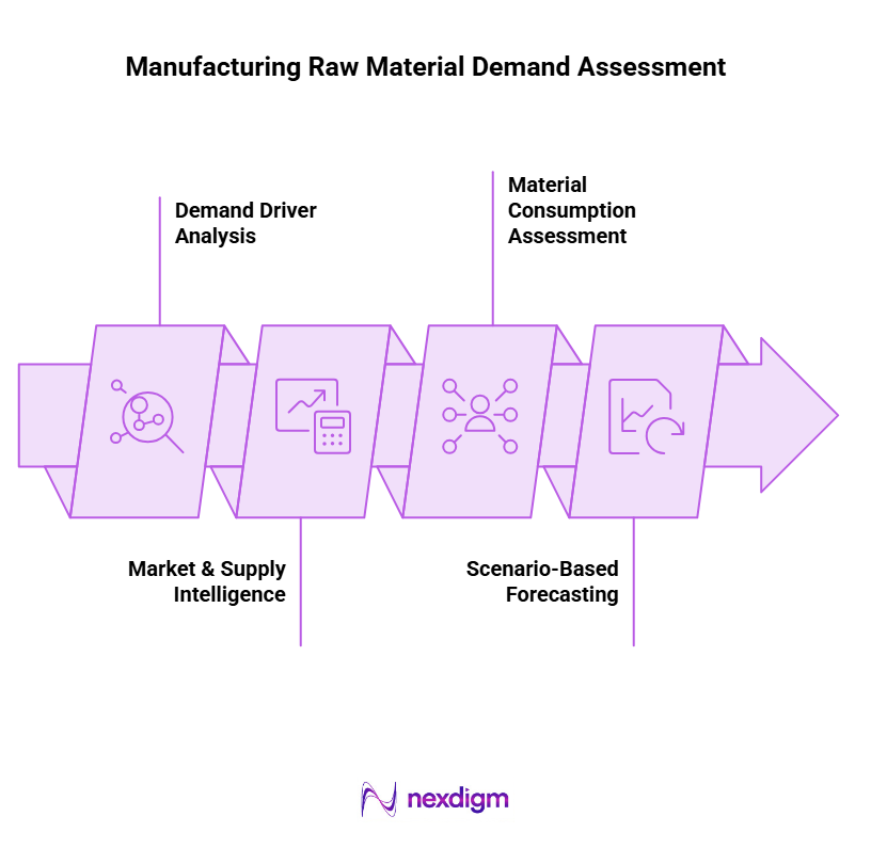
- Demand Driver Analysis: Assessment of production growth, product mix changes, capacity utilization, and input intensity to identify the factors shaping raw-material demand.
- Material Consumption Assessment: Evaluation of consumption patterns across industries and applications to estimate current and potential requirements for key inputs.
- Market & Supply Intelligence: Tracking of industry trends, capacity additions, supplier dynamics, trade flows, and material-market developments that could influence future availability and pricing.
- Scenario-Based Forecasting: Development of demand scenarios based on changes in industrial output, product specifications, technology, and manufacturing intensity.
This approach helps manufacturers convert production and market signals into clearer procurement, inventory, capacity, and sourcing decisions.
Business Benefits of Nexdigm’s Demand Assessment Expertise
Nexdigm’s analysis helps manufacturers translate changing raw-material demand into decisions that are commercially and operationally relevant. By connecting production trends with material consumption and market dynamics, businesses get advantages through:
- Improved Demand Visibility: Gain a clearer view of current and future raw-material requirements by linking production forecasts, product mix, and input intensity.
- Smarter Procurement Planning: Align purchasing volumes and timing with anticipated demand, helping reduce shortages, excess inventory, and reactive procurement.
- Better Capacity Planning: Identify potential increases or shifts in material requirements early, supporting timely supplier and production-capacity decisions.
- Reduced Supply Risk: Anticipate material availability constraints and changing market conditions to strengthen sourcing strategies and supply continuity.
- Stronger Investment Decisions: Use demand insights to evaluate capacity expansion, supplier development, localization, and other strategic investment opportunities.
Together, these benefits help manufacturers move from reactive material planning to forward-looking decisions across procurement, inventory, sourcing, and capacity management.
How Nexdigm’s Demand Intelligence Shapes Manufacturing Decisions
Nexdigm helps manufacturers translate raw-material demand insights into practical supply-chain and investment decisions. By combining demand analysis with market and supply intelligence, its approach supports more informed actions across four key areas:
- Procurement Optimization: Nexdigm helps align purchasing volumes, timing, and supplier allocations with projected material requirements and changing market conditions.
- Inventory Planning: Nexdigm assesses demand patterns, lead times, availability, and supply uncertainty to support appropriate inventory and safety-stock strategies.
- Sourcing Strategy: Nexdigm identifies alternative suppliers, sourcing markets, and localization opportunities to address potential material shortages and supply dependencies.
- Capacity Planning: Nexdigm evaluates sustained demand changes to help businesses assess supplier expansion, production capacity, and infrastructure investment requirements.
By connecting demand forecasts with actionable recommendations, Nexdigm helps manufacturers make more timely, evidence-based decisions across procurement, inventory, sourcing, and capacity management.
Nexdigm’s Case
Nexdigm supported a global pharmaceutical company in reassessing its chemical raw-material sourcing model and shifting from intermediary-led procurement to direct manufacturers. The initiative delivered an approximately 23% reduction in raw-material costs and up to 30% faster deliveries, while improving quality consistency and shelf life, leading to stronger supply reliability.
To take the next step, simply visit our Request a Consultation page and share your requirements with us.
Harsh Mittal
+91-8422857704