

Manufacturing demand is created by end-market sales, translated into production plans, and then converted into purchases of materials, components and equipment. Investment can expand supply, but it does not guarantee demand. Trade can fill a production gap, while utilization shows whether existing assets are being used.
This chain helps explain why headline indicators sometimes appear inconsistent. Global manufacturing exports rose 6.1% in Q2 2026, faster than production growth of 1.5%. The gap may reflect stronger export demand, shifts in product mix, price effects or cross-border supply-chain movements. It should prompt investigation into which products and regions are gaining orders, not a blanket forecast that all manufacturers will expand.
Investment has different demand effects by stage
Factory investment creates demand for construction, machinery and installation before production begins. Once operations start, demand shifts toward inputs, maintenance, packaging, logistics and replacement. Expansion spending can therefore lift equipment suppliers now while providing a later demand signal for industrial products.
Track projects by stage: announced, financed, permitted, under construction, commissioning and operating. Weight projects by evidence and timing. A planned plant with no financing or construction activity should not carry the same forecast weight as a funded facility placing equipment orders.
Utilization identifies slack, but trade reveals pressure
U.S. manufacturing utilization was 75.7% in August 2026, below its long-run average. At the same time, product-level constraints can remain if available capacity is in the wrong location, lacks customer qualification or cannot make the required grade.
Read utilization alongside:
- New orders and unfilled backlogs.
- Imports, exports and delivery lead times.
- Inventory levels and order cancellations.
- Customer production schedules and end-market sales.
- Capacity additions, shutdowns and equipment investment.
If imports are rising while local utilization is low, the issue may be product fit, cost or logistics rather than insufficient capacity. If backlogs rise and imports cannot close the gap, expansion may be justified. This diagnostic prevents a common mistake: treating every supply problem as a need for more nameplate capacity.
Build a demand bridge for each product
For the products being forecast, link end-market growth to customer output, then apply product intensity per unit. Adjust for imports, inventory changes, yield, substitution and new capacity. That bridge explains whether market growth comes from more final demand, a share shift toward local production, stocking behavior or increased product content.
It also improves commercial planning. Sales teams can focus on the end markets that actually drive orders; operations can set capacity against customer schedules; procurement can distinguish persistent demand from temporary inventory rebuilding.
Investment-to-Order Demand Bridge
Nexdigm’s Manufacturing Sector Demand Drivers Assessment connects industrial investment, capacity utilization, trade and end-market growth to help manufacturers make better demand and capacity decisions.
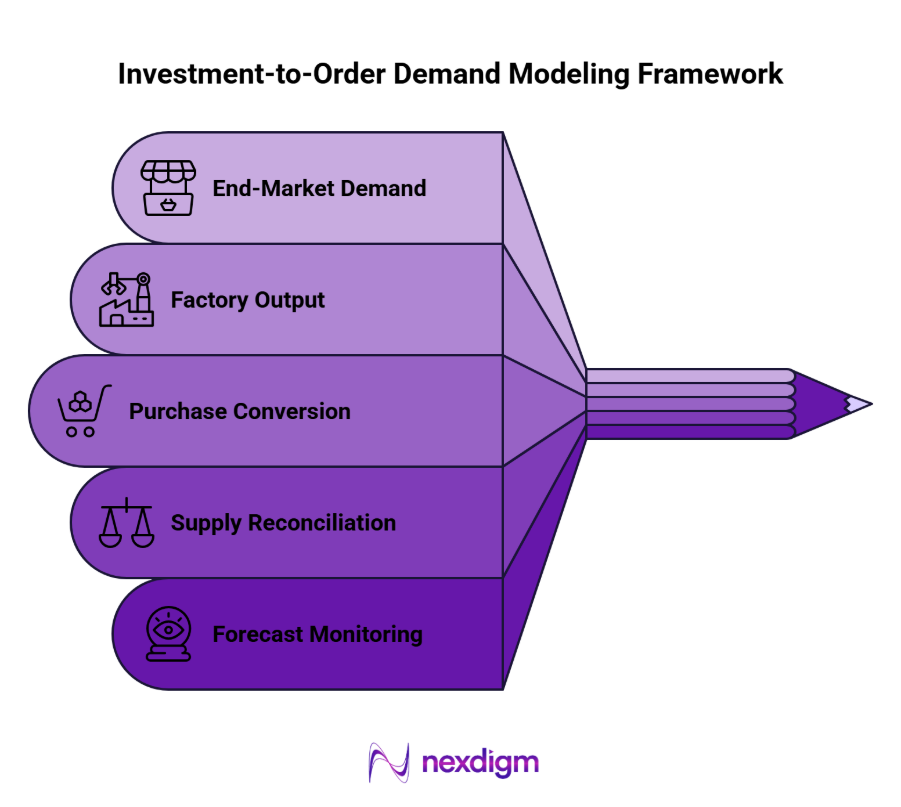
- Size end-market demand
Measure customer-sector sales, production requirements and relevant export markets. - Translate into factory output
Estimate production, utilization, product mix and capacity additions by customer segment. - Convert output into purchases
Apply usage rates, replacement cycles, yields and procurement timing. - Reconcile supply and trade
Account for imports, exports, inventory, lead times and customer qualification. - Monitor forecast triggers
Update when orders, utilization, project milestones or trade flows diverge from the base case.
Nexdigm Case Study
Nexdigm linked industrial investment, utilization, trade and end-market demand for a supplier serving five manufacturing sectors. Our model found that two sectors’ order growth was mainly inventory-led, while three showed production-backed demand; we recommended aligning capacity additions with the latter.
To take the next step, simply visit our Request a Consultation page and share your requirements with us.
Harsh Mittal
+91-8422857704