

Manufacturing expansion decisions involve three connected choices: which markets to serve, which products to manufacture and where to locate production. A country may offer strong demand but lack the supplier ecosystem or infrastructure required for efficient manufacturing. Another may have lower operating costs but limited customer access or insufficient demand to support a new facility.
UNIDO’s latest manufacturing data show that global production increased by 0.5% quarter on quarter in Q4 2025. Growth remained uneven across industries, with medium-high- and high-technology manufacturing outperforming lower-technology sectors. This divergence matters because aggregate manufacturing growth can conceal significant differences in product demand, capacity utilisation and investment potential.
Expansion planning should begin with the specific products and customers a facility is expected to serve. The objective is to identify a production footprint that can compete on delivered cost, quality, lead time and supply reliability.
How Should Companies Prioritise Markets and Products?
Market selection should combine demand forecasts with competitive supply analysis. Industrial output, imports, customer purchasing patterns and announced capacity additions help establish whether a market offers room for another producer.
Product selection requires a more detailed assessment.
A manufacturer may find stronger margins in a specialised component or intermediate product than in a high-volume category dominated by established suppliers.
Qualification requirements, customer concentration, product standards and switching costs all influence the commercial opportunity.
According to Nexdigm a practical expansion screen should examine:
- Demand potential: Market growth, import dependence, customer concentration and forecast consumption by product.
- Competitive intensity: Existing capacity, utilisation, pricing pressure, competing imports and planned investments.
- Production economics: Labour productivity, energy costs, raw materials, logistics, tooling and quality requirements.
- Customer access: Distance to major buyers, supplier qualification, delivery expectations and local-content requirements.
- Expansion risk: Trade restrictions, currency exposure, policy changes, infrastructure constraints and execution timelines.
These factors should be evaluated together.
A market with high demand growth may be unattractive if new capacity is already scheduled to exceed consumption. A slower-growing market can still justify investment when customers depend on imports, local supply is unreliable or specialised products command better margins.
Should Manufacturers Build Locally or Serve Markets Through Exports?
The production-footprint decision depends on the balance between manufacturing cost and the cost of reaching customers.
Exporting may be suitable when demand is fragmented or uncertain, while local production becomes more compelling when volumes are stable, freight costs are high or customers require short lead times.
Regional production can also reduce exposure to disruptions and trade barriers, but duplication of facilities increases fixed costs and management complexity.
Companies should therefore compare a new plant with alternatives such as contract manufacturing, a joint venture, an existing facility expansion or a phased local assembly operation.
For a Manufacturing sector expansion assessment, Nexdigm can integrate product-level demand forecasts, location economics, supplier availability and investment scenarios to determine where expansion is commercially justified and how much capacity should be committed initially.
Nexdigm’s Manufacturing Expansion Decision Framework
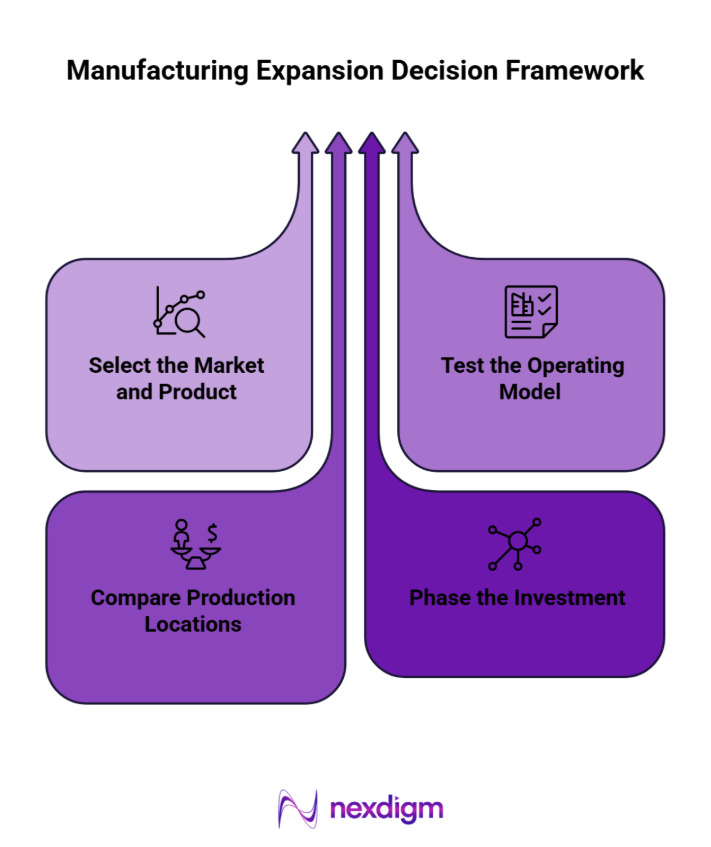
- Select the Market and Product
Identify attractive customer segments and products using demand growth, import dependence, competitive intensity and achievable margins. - Compare Production Locations
Evaluate labour productivity, energy, materials, logistics, supplier depth, infrastructure and regulatory requirements. - Test the Operating Model
Compare exporting, contract manufacturing, local assembly, joint ventures and owned production against cost, control and customer-service requirements. - Phase the Investment
Model capacity utilisation, cash flow, demand downside and expansion triggers to establish the appropriate initial scale and conditions for further investment.
Nexdigm Case Study: Prioritising a Regional Manufacturing Footprint
Nexdigm assessed 6 candidate locations for an industrial components manufacturer targeting 3 export markets. The team compared 11 product families across demand forecasts, landed costs, supplier access, labour productivity and logistics. Two locations offered a projected 8% to 11% delivered-cost advantage over the existing footprint. A phased 24,000-unit annual capacity plan was recommended, with a second production line conditional on utilisation exceeding 75% for two consecutive quarters.
To take the next step, simply visit our Request a Consultation page and share your requirements with us.
Harsh Mittal
+91-8422857704