

Manufacturers face a difficult capital-allocation decision: invest in the markets they already understand, or move towards product categories where demand is changing faster. The first option offers established customers and operating knowledge. The second may provide better growth, but often requires new capabilities, supplier relationships and routes to market.
The decision is becoming more consequential as industrial investment shifts towards electrification, automation, advanced components and digitally connected production. UNIDO’s 2025 industrial statistics show that global manufacturing grew by 2.9% in 2024, with higher-technology products accounting for almost half of global manufactured exports. That shift creates opportunities beyond traditional production categories, although it does not guarantee that every high-technology segment offers attractive margins.
A strategic bet should therefore be assessed by the advantage a manufacturer can build, not simply by the projected size of the market.
Three Routes to Growth, Three Different Investment Cases
- Deepen the core. Expanding an established product line can be attractive when customers are increasing orders, existing capacity is constrained or the manufacturer can win share from imports. The primary advantage is familiarity with production processes, buyers and quality requirements. The risk is committing capital to a market where competitors are expanding just as quickly.
- Move into adjacent products. Existing capabilities in precision machining, materials processing, electrical systems or industrial design can support entry into related product categories. This route can reduce the cost of capability development, provided the new products meet the technical specifications and qualification requirements of target customers.
- Enter an emerging growth pool. Electrification, factory automation and advanced industrial equipment can create opportunities for suppliers positioned at critical points in the value chain. These markets may offer stronger demand growth, but entry often depends on technical certification, engineering talent and the ability to support customers after installation.
The choice should reflect the manufacturer’s capabilities and the time available to establish a competitive position. An adjacent product with moderate growth may generate better risk-adjusted returns than a faster-growing category requiring substantial new investment.
Where Technology Creates a Defensible Advantage
The World Economic Forum’s Global Lighthouse Network offers evidence of what advanced manufacturing can achieve at scale. In September 2025, the network expanded to 201 industrial sites. Its newest cohort reported an average 40% improvement in labour productivity and a 48% reduction in lead times. These are results from recognised advanced sites, not average outcomes for manufacturers adopting digital technology.
The distinction matters when selecting a strategic investment. Buying automation equipment does not automatically create an advantage. Returns depend on the production problem being solved, integration with existing systems and the ability to change operating practices.
For a Manufacturing sector strategic opportunity study, Nexdigm can compare product-market attractiveness with a manufacturer’s technical capabilities, cost position, customer access and investment capacity. The objective is to identify opportunities where demand growth and the company’s ability to compete reinforce one another.
Strategic Opportunity Selection Framework
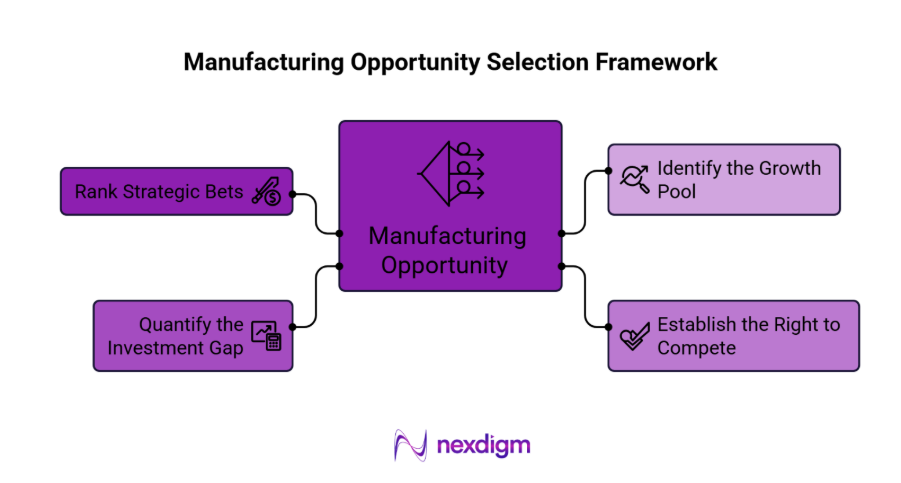
- Identify the Growth Pool
Screen markets and product categories using demand forecasts, customer investment, import dependence and supply constraints. - Establish the Right to Compete
Determine which existing capabilities, customer relationships, intellectual property or supplier advantages can transfer to the opportunity. - Quantify the Investment Gap
Estimate capital expenditure, technical skills, qualification time, working capital and new operating capabilities. - Rank Strategic Bets
Compare risk-adjusted returns, time to revenue, scalability and downside exposure. Prioritise investments with a clear competitive advantage rather than relying on market growth alone.
Nexdigm Case Study: Selecting the Next Product Platform
Nexdigm assessed 19 product categories for an industrial equipment manufacturer deciding between core expansion and diversification. The team compared five-year demand, import competition, qualification requirements, capital intensity and expected margins. Four categories advanced to detailed evaluation, with two offering projected annual demand growth of 7% to 9% and gross-margin potential of 20% to 23%.
To take the next step, simply visit our Request a Consultation page and share your requirements with us.
Harsh Mittal
+91-8422857704