

Manufacturers are rethinking sourcing strategies as cost pressures increasingly compete with resilience, quality, and supply continuity. The shift is visible in recent trade and manufacturing data: global merchandise trade reached about $33 trillion in 2024, while the WTO expects global trade in goods and services to continue expanding through 2026.
In the U.S., manufacturing capacity utilization stood at 75.7% in August 2026, highlighting available capacity alongside persistent supply-chain considerations. These conditions are encouraging companies to compare sourcing markets more systematically, looking beyond unit cost to supplier capabilities, production capacity, logistics, quality standards, geopolitical exposure, and the ability to scale reliably.
Matching Sourcing Markets to Business Priorities
Selecting the right sourcing market requires balancing multiple business priorities beyond cost. Manufacturers must evaluate factors such as cost efficiency, proximity, quality standards, and supply reliability to identify sourcing strategies that best support their operational and growth objectives.
By aligning sourcing market selection with specific business priorities, manufacturers can achieve the right balance of cost, quality, speed, and resilience, creating a more effective and sustainable supply chain.
Comparing Sourcing Markets on What Matters
Once business priorities are clear, manufacturers can compare potential sourcing destinations across cost, quality, capacity, and supply risk. This means looking beyond labor or production costs to assess total landed costs, supplier capabilities, certifications, production standards, available capacity, scalability, logistics reliability, infrastructure, geopolitical exposure, and concentration risks.
The need for this broader view is evident as U.S. manufacturers import around $3 trillion in manufactured goods annually, with roughly 25% exposed to criticality, supply concentration, or geopolitical-distance risks. A balanced assessment helps manufacturers identify sourcing markets that offer the strongest overall fit.
Nexdigm’s Expertise in Manufacturing Sourcing Strategy
Choosing the right sourcing market requires more than comparing production costs. Nexdigm brings together market research, supplier intelligence, industry expertise, and strategic analysis to help manufacturers evaluate sourcing opportunities from both operational and commercial perspectives.
Its approach helps businesses understand market attractiveness, supplier capabilities, capacity availability, logistics, and risk before committing resources to a new sourcing destination.
This expertise provides the foundation for a structured Manufacturing sourcing market assessment, helping clients identify suitable markets and translate sourcing intelligence into practical strategic decisions.
How Nexdigm Evaluates Manufacturing Sourcing Opportunities
Nexdigm applies a structured framework to compare sourcing markets and identify options that balance cost efficiency with quality, capacity, resilience, and scalability. The framework focuses on the following areas:
- Cost Analysis: Comparing production, labor, logistics, tariffs, and total landed costs to understand the true economic advantage of each potential sourcing market.
- Supplier Capability: Assessing supplier depth, technical expertise, quality standards, certifications, and production capabilities to determine whether markets can meet required specifications.
- Capacity & Scalability: Evaluating existing production capacity, utilization, expansion potential, and supplier readiness to support future volumes without compromising operational continuity.
- Risk Assessment: Examining geopolitical, logistics, infrastructure, regulatory, and supplier-concentration risks that could affect sourcing reliability and long-term business continuity.
The resulting analysis gives manufacturers a clearer basis for selecting sourcing markets and moving toward specific sourcing, diversification, and localization actions.
Nexdigm’s Manufacturing Sourcing Assessment Framework
Nexdigm’s approach moves from broad market screening to detailed supplier and risk evaluation, helping manufacturers progressively narrow their options and make informed sourcing decisions.
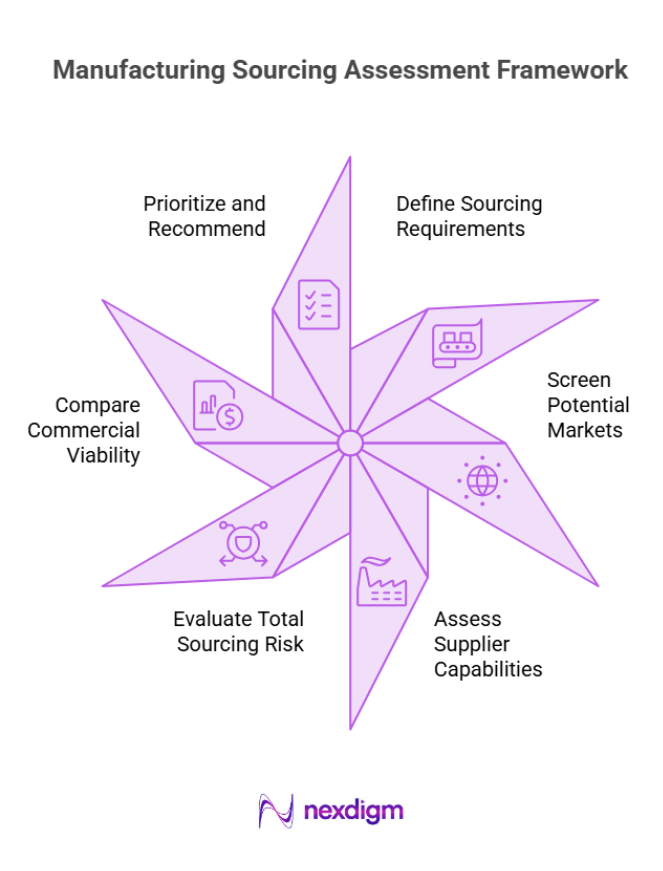
- Define Sourcing Requirements: Establish product specifications, required volumes, cost targets, quality expectations, delivery timelines, and strategic priorities.
- Screen Potential Markets: Shortlist sourcing destinations based on manufacturing capabilities, cost competitiveness, infrastructure, workforce, trade conditions, and market accessibility.
- Assess Supplier Capabilities: Evaluate supplier depth, technical expertise, certifications, production capacity, quality standards, and ability to scale with demand.
- Evaluate Total Sourcing Risk: Analyze logistics, geopolitical exposure, regulatory conditions, supplier concentration, infrastructure constraints, and potential disruption scenarios.
- Compare Commercial Viability: Assess total landed costs, operational requirements, investment needs, and expected benefits to understand the overall business case.
- Prioritize and Recommend: Rank sourcing markets and suppliers based on strategic fit, feasibility, resilience, and long-term value, providing a clear basis for action.
This structured process enables manufacturers to move from market exploration to confident sourcing, diversification, and localization decisions.
Business Benefits of Nexdigm’s Sourcing Framework
By applying a structured evaluation process, Nexdigm helps manufacturers make sourcing decisions based on evidence rather than isolated cost comparisons. The framework provides a clearer view of:
- Better Cost Visibility: Evaluate total landed costs across markets, helping manufacturers understand the real economics of sourcing beyond basic labor or production cost comparisons.
- Reduced Supply Risk: Identify supplier concentration, geopolitical exposure, logistics constraints, and capacity limitations before they create significant operational or financial disruptions.
- Stronger Supplier Selection: Compare suppliers using consistent criteria covering capabilities, quality, certifications, capacity, scalability, and reliability to support more confident sourcing decisions.
- Faster Market Prioritization: Systematically screen and rank sourcing destinations, reducing complexity and helping management focus resources on markets with stronger strategic and commercial potential.
These benefits help manufacturers progress from evaluating sourcing options to making targeted decisions that support resilience, cost efficiency, and sustainable growth.
Nexdigm’s Case
Nexdigm supported a global pharmaceutical company in shifting key chemical raw-material sourcing from an intermediary to direct manufacturer relationships. The initiative delivered 23% reduction in raw-material costs and up to 30% faster deliveries, while improving quality consistency and shelf life through better handling at source.
To take the next step, simply visit our Request a Consultation page and share your requirements with us.
Harsh Mittal
+91-8422857704