

Manufacturers are reassessing supply chains as capacity constraints, supplier concentration, geopolitical risks, and demand volatility make resilience increasingly important. The U.S. manufacturing sector was operating at 75.7% of capacity in August 2026, around 2.5 percentage points below its long-run average, while overall industrial production remained 1.4% above its August 2025 level.
Meanwhile, U.S. construction spending reached $2.203 trillion at an annual rate in August 2026, underscoring continued demand for manufactured materials, equipment, and components. These conditions are pushing companies to examine supplier concentration, production capacity, logistics dependencies, and regional manufacturing footprints.
A structured Manufacturing Supply Chain Assessment can help identify capacity gaps, reduce concentration risks, and pinpoint practical localization opportunities.
Why Manufacturing Networks Are Being Reassessed
Manufacturing networks are increasingly being evaluated through the lens of cost, resilience, proximity to customers, and supply continuity. Companies are reconsidering where products and components should be made, how much capacity is required, and which suppliers are critical. This shift is creating a stronger need for data-led decisions around sourcing, capacity expansion, localization, and network redesign.
Understanding Capacity Gaps and Supplier Dependencies
Before investing in new capacity or shifting production, manufacturers need to understand where their existing networks are most exposed. Supplier concentration, limited production capacity, long lead times, logistics bottlenecks, and dependence on a single region can all create operational risk. Mapping these gaps helps companies focus resources on the areas where changes can deliver the greatest resilience and business value.
Nexdigm’s Approach to Strengthening Manufacturing Supply Chains
Once supply chain vulnerabilities are mapped, manufacturers need a clear view of where capacity, sourcing, and localization decisions can create the greatest value. Nexdigm’s industry led expertise in conducting Manufacturing supply chain market assessment combines industry research, supply chain analysis, and strategic advisory to help companies evaluate these opportunities and make informed network decisions. This helps clients in:
- Mapping Capacity Gaps: Identifying production constraints, underutilized capacity, and future capacity requirements across key markets.
- Assessing Supplier Concentration: Evaluating critical suppliers, geographic dependencies, and potential disruption exposure.
- Identifying Localization Opportunities: Comparing regions based on costs, capabilities, infrastructure, workforce availability, and proximity to demand.
- Prioritizing Strategic Actions: Translating market and supply chain insights into sourcing, investment, localization, and expansion priorities.
This approach helps manufacturers build supply networks that are not only cost-efficient but also more resilient, flexible, and aligned with future demand.
How Nexdigm Helps Manufacturers Build More Resilient Supply Networks
Nexdigm helps manufacturers turn supply chain risks into actionable decisions by combining market intelligence, manufacturing analysis, and strategic planning. Its advisory approach evaluates sourcing alternatives, capacity requirements, supplier dependencies, production footprints, and localization scenarios, enabling clients to balance cost, resilience, customer proximity, and long-term growth while making more informed investment and network decisions.
Nexdigm’s Supply Chain Market Assessment
Nexdigm’s Manufacturing supply chain market assessment helps manufacturers understand where their networks are strong, where vulnerabilities exist, and where strategic changes could create greater value. The assessment focuses on the following areas:
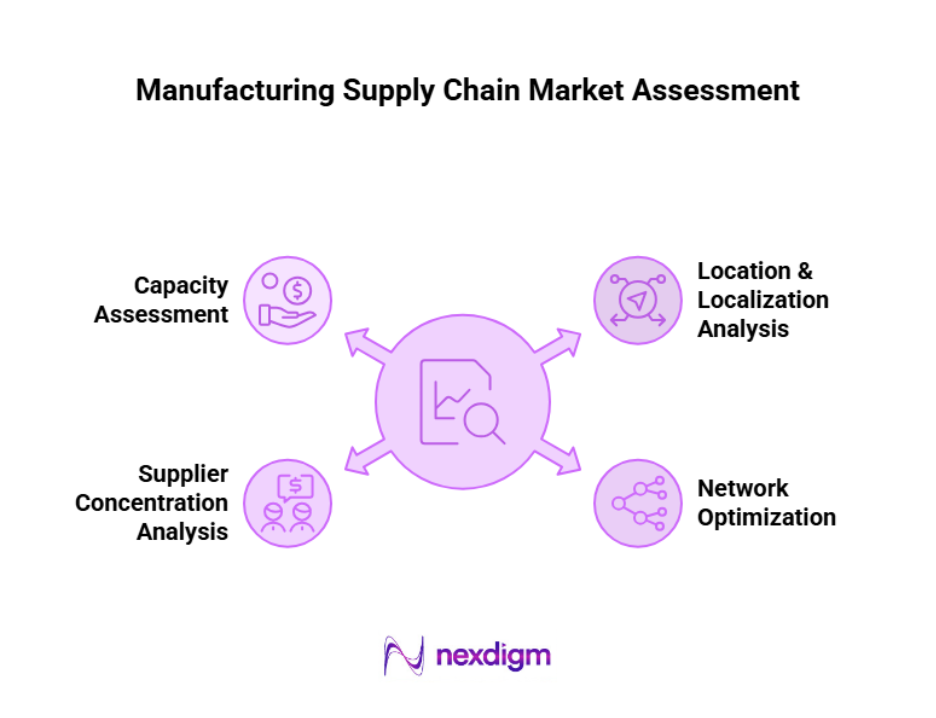
- Capacity Assessment: Evaluation of current production capacity, utilization levels, and future requirements to identify potential shortfalls and opportunities for expansion or capacity balancing.
- Supplier Concentration Analysis: Examination of supplier dependencies, geographic concentration, and critical sourcing relationships to identify disruption risks and opportunities for supplier diversification.
- Location & Localization Analysis: Comparison of potential manufacturing locations using costs, infrastructure, workforce availability, logistics, capabilities, and proximity to customers to identify attractive localization options.
- Network Optimization: Assessment of sourcing and manufacturing configurations to determine how companies can balance cost efficiency, resilience, flexibility, and service requirements.
By connecting supply chain intelligence with strategic priorities, Nexdigm helps manufacturers establish a clear foundation that provides them with measurable business outcomes.
Business Outcomes from Nexdigm’s Supply Chain Advisory
Nexdigm’s analysis helps manufacturers move from identifying supply chain vulnerabilities to making targeted improvements. By evaluating capacity, supplier exposure, sourcing alternatives, and localization scenarios, clients can make better-informed decisions around network investments, production expansion, supplier diversification, and regional manufacturing strategies while improving resilience without losing sight of cost competitiveness.
How Nexdigm Turns Supply Chain Insights into Action
Through valuable findings from supply chain assessment, Nexdigm helps manufacturers use these findings to build a longer-term roadmap for strengthening their manufacturing footprint, diversifying critical suppliers, and aligning capacity with evolving demand. This involves:
- Implementation Roadmap: Translating priority findings into phased sourcing, capacity, and localization actions.
- Supplier Diversification: Building strategies to reduce dependence on concentrated or high-risk supply sources.
- Capacity Expansion: Identifying where investments in new or expanded manufacturing capabilities can support future demand.
- Continuous Optimization: Reassessing manufacturing networks as market conditions, costs, customer needs, and supply risks change.
This progression enables manufacturers to move from assessment and measurable outcomes to sustained supply chain resilience and competitive advantage.
Nexdigm’s Case
Nexdigm assisted a U.S. consumer healthcare company to strengthen supply resilience through local sourcing. Nexdigm supported supplier transition and capacity planning, helping protect $192 million in net trade sales, avoid $0.56 million in air-freight costs, and establish 30 days of safety stock. The engagement strengthened supply continuity while reducing international sourcing exposure.
To take the next step, simply visit our Request a Consultation page and share your requirements with us.
Harsh Mittal
+91-8422857704